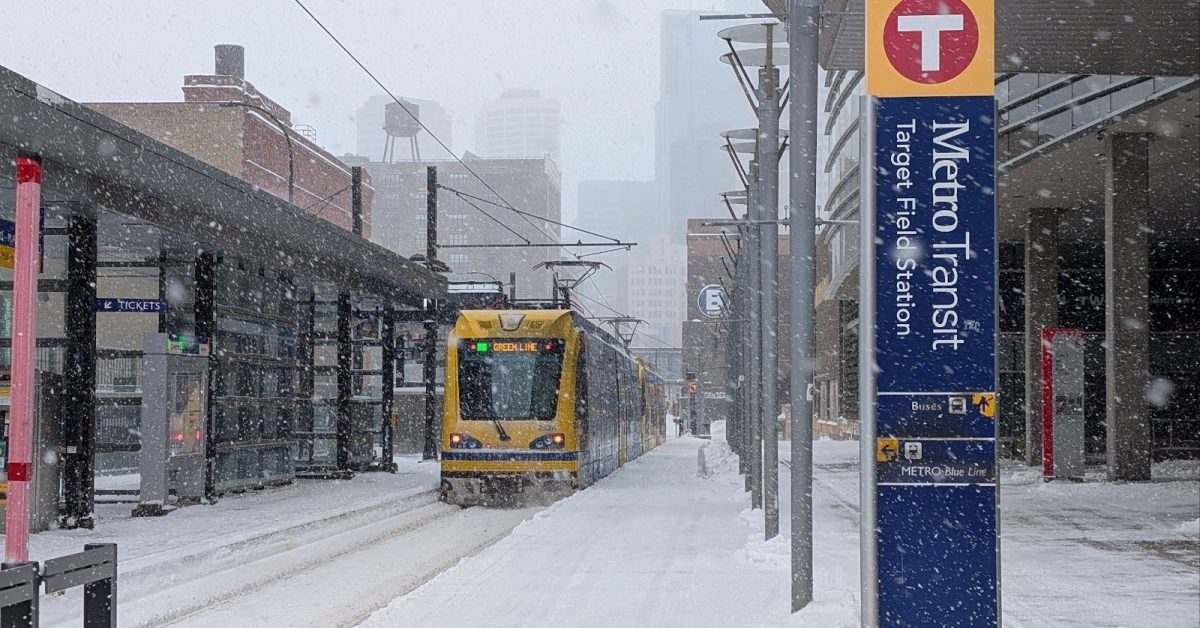
After being a reliable rider of Metro Transit and now driver for the light rail system, it is my firm belief that light rail is the superior form of public transit for a winter metro area like ours. Its flexibility of implementation, operations, and passenger comfort make it a fantastic medium between buses and other forms of rail transportation.
Personal History
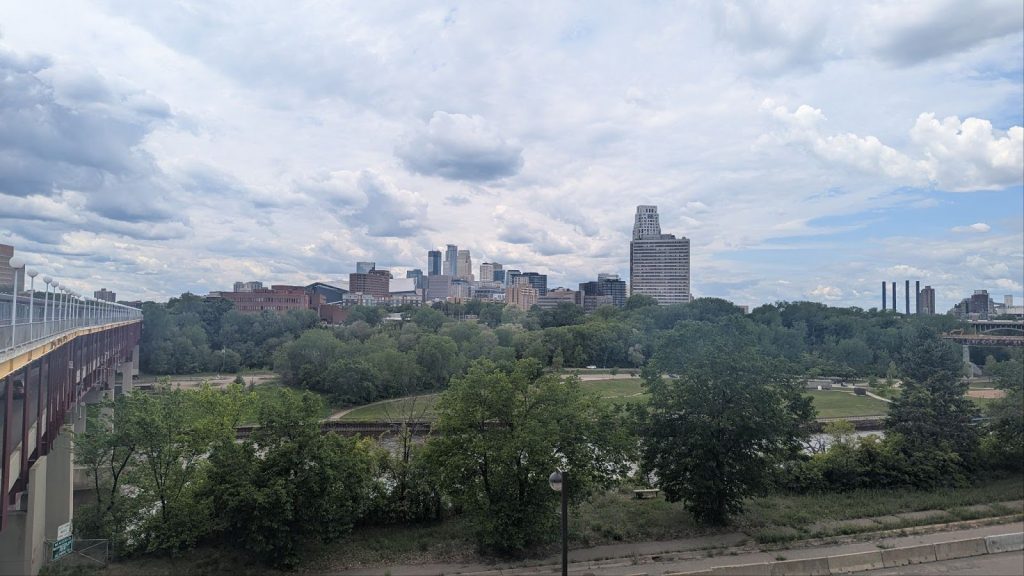
Prior to moving to Minneapolis, I drove for the fare-free university transit system while attending the University of Iowa (Go Hawks!) and a fare-reliant suburban system after graduating, for a combined three years. Since relocating to Minneapolis in 2024 to enjoy a car-free lifestyle, I have been a regular transit user for trips that I can’t comfortably bike. I’ve been an operator for Metro Transit’s light rail system since the summer of 2025. My favorite line to drive is the Green Line due to the diversity of urban scenery it passes through, along with a beautiful view of the Mississippi River and the Minneapolis skyline while crossing the Washington Avenue bridge. I can’t wait to see everything along the beautiful Southwest Extension when operations begin.
With all this in mind, I have nothing against buses as a form of transit in and of themselves — they’re incredibly useful, providing links where rail would be impractical. Buses are the backbone of most transit systems, but the star of the show is rail. Even in rail-heavy metropolitan areas like Philadelphia and New York City, bus systems are used at a higher rate than all forms of rail combined. This is because many of these bus routes feed into the rail system or are local bus routes that help riders get to areas rail does not serve. My argument is not about ridership share, but about every other aspect. Light rail is superior from a passenger, operator, and urban planning perspective. I wish we had more light rail lines instead of overburdened bus routes. In my view, BRT and articulated buses are not supporting those corridors as effectively as a light rail line could — especially during extreme conditions.
Winter Reliability, Comfort, and Accessibility
My inspiration for this article comes from my recent experience operating during the blizzard of March 14-15. I have never operated in conditions as severe or as prolonged as what I experienced that Sunday. Snow fell all day, and wind caused whiteout conditions for much of it. Yet our light rail system suffered only minor delays. The maximum delay I saw on the Blue Line was 30 minutes, and service recovered within an hour. This reliability comes down to the infrastructure the trains run on. Every light rail vehicle (LRV) has a plow at its base which allows trains to travel through snow like a hot knife through butter. A snowplow on the street just made a three foot mound of snow on the tracks? The train pushes through it with no problem. Ice on the tracks is crushed under the weight of the vehicle. An ice cutter deployed ahead of the pantograph gets rid of almost all ice on the overhead catenary system.
What do our buses have by comparison? They have good engines that can overcome slippery uphill climbs cars cannot, but they rely on snowplows to clear the path first. Going downhill in a bus during the winter is a dangerous, nerve-wracking journey for a driver. Due to the accumulation of ice and snow, every winter results in buses getting stuck. Articulated buses can turn out of control on these hills — even at low speeds — and end up blocking the road at a 90-degree angle because of how quickly something minor can cause the vehicle to make an unrecoverable turn. Thankfully, such incidents almost always take place at low speeds, with no injuries to passengers or drivers. Bus speeds are dependent on street maintenance, which differs by street and municipality. For the most part, light rail can go regular speed during conditions that cause buses to be delayed, sometimes an hour or two, due to the number of stops and traffic, as we saw on March 15.
Light rail stops are much more comfortable and accessible than bus stops, on average. Most bus stops are poorly maintained during snowstorms (largely due to the plethora of them that need to be cleared, which prioritizes higher-ridership routes), while light rail platforms are semi-accessible at worst. Through the years, I’ve seen a broad spectrum of bus stop conditions during winters: giant mounds of snow accumulated from multiple storms blocking the sidewalk from the street, forcing passengers to wait on the icy street instead of in bus shelters, to cleared, freshly-salted paths with no ice. Most bus stops lie somewhere in between but lean toward the former, especially for rear-door areas. This is a challenge for all transit agencies in winter climates, but snow clearance doesn’t have to take forever, as seen in New York City. Poorly-maintained bus stops prevent the city from being accessible to people of all abilities, not to mention the horrible conditions of sidewalks across the metro this winter. LRT platforms, on the other hand, are prioritized by transit agencies like Metro Transit and are more easily plowed than bus stops. Every rail platform has heated shelters, which are lacking for buses outside of transit centers, high-frequency bus corridors (like Nicollet Mall) and BRT platforms.
These winter advantages of light rail — and the limitations of buses — show that winter cities like ours need a large, comprehensive light rail system. Our metro experiences famously extreme winters, and our transit system should be built for it. Light rail keeps more of the metro accessible and allows important businesses and institutions to stay open during storms. Cities of a century ago knew this, and their rail systems remained reliable throughout the winter — just as our light rail system does today. More parts of the metro should benefit from that reliability — not just the two corridors that currently do.
Speed and (Lack of) Transit Signal Priority
A dedicated right-of-way is essential for reliable transit, and light rail has one out of necessity. The only form of rail that regularly shares its right-of-way is streetcar systems, like Toronto’s TTC, which suffer from significant delays as cars share the lane — especially for left turns. Buses can have dedicated lanes, but that is far from the norm. In the Twin Cities, dedicated bus lanes are hard-won, and planners often have to compromise — settling for rush-hour-only lanes that other vehicles still use, instead of true all-day lanes. With light rail, there’s no possibility of lane-sharing — aside from rare car-on-train collisions.
Our light rail system has two distinct styles of lines. The Blue Line has a dedicated right-of-way separated from the road for most of the line, with the exception of downtown Minneapolis and 34th Avenue. This allows service to be reliably on time and speedy with an on-time performance of 91 percent. If you drive down Hiawatha Avenue during rush hour, the train will often beat you from the Franklin Avenue Station to the VA Medical Center Station. If you travel by car during an event, the train will beat you every time.
The Green Line, on the other hand, acts very similarly to a streetcar — without having to share the lane with cars. The alignment is basically the reincarnation of Twin City Lines’ streetcar Route 9, and it feels that way. Trains run down the center of University Avenue and operate based on traffic signals. Trains don’t have full signal priority, and schedules can suffer as a result. Even so, Green Line trains still don’t suffer significant delays — on-time performance is currently 87 percent. Over half of all delays documented by Metro Transit on light rail are the direct result of door-holders and emergency door pulls, which are most notable on the Green Line. Holding the door on a train when it is attempting to leave a station can result in significant delays, as time-sensitive signals can be easily missed and the train must wait for the next signal to come up. Despite the number of stops and instances of passenger-related delays, trains will keep pace — and often beat — cars traveling down University Avenue. Trains can intermittently reach speeds of 45 miles per hour (the same as most of the Blue Line) and don’t have to wait behind car traffic like buses or streetcars.
Much of our transit system lacks transit signal priority (TSP). Many heavily-used bus routes do, but most routes do not. In Minneapolis, light rail can preempt traffic signals to bring them up faster for trains, but St. Paul has not allowed Metro Transit similar control over intersections. Signal preemption is basically a midpoint between regular intersections and TSP that takes time to activate. The Green Line uses a limited version of TSP called “Predictive Priority,” where lights are held for longer periods when a train is scheduled to arrive, instead of when it actually arrives. Predictive Priority also does not end light cycles early or skip phases for the benefit of the train. This is definitely an improvement over no TSP, but it leaves much to be desired when trains still have to wait at lights and can’t sail through from station to station. Imagine how much faster our transit would be if all routes and modes had full TSP!
That said, the vast majority of bus routes can’t compete with light rail in terms of speed and reliability. Rail’s dedicated right-of-way and stations allow them to go at faster speeds and be more reliable. Buses have to battle private vehicle traffic, navigate bus stops, and maneuver around bus stop parkers and bus lane invaders. When riding the Blue or Green lines, passengers take comfort in the fact that the train is almost always moving while buses and cars are stuck in traffic beside them.
The only bus routes that can compete are largely express bus routes with minimal stops — think the 94 express bus (about 30 minutes end-to-end with seven stops) versus the Green Line (about 50 minutes end-to-end with 23 stops). In this instance, I would advocate for regional rail under a new Twin Cities Boulevard to replace I-94 and the creation of a larger regional rail network to connect greater distances, as advocated by the I-94 Rail Coalition — but that’s another topic which others have covered.
Light rail occupies a good middle ground between buses and heavy rail in many ways, especially since it is able to comfortably fit into multiple contexts and is able to make frequent stops with ease. At stops themselves, there is no competition. There are four doors on either side of each LRV, and fares are supposed to be paid before boarding, which makes boarding and alighting very quick. TRIP agents regularly board routes to enforce fares, and Metro Transit Police Department officers regularly board to search for violators and enforce rules. BRT is the same in this regard, but most of our BRT routes have to fight traffic like any other bus because they’re not true BRT. True BRT elements that increase speed which our BRT routes lack are: a dedicated right-of-way for its entire length with stations away from regular curbs (ideally in the center of the roadway like the on-highway Orange Line stations on I-35) and bus priority at intersections. Non-BRT bus routes have passengers pay fares as they board, resulting in large delays. If our transit system were fare-free, bus boarding times would dramatically improve and related delays would decrease, but light rail would still regularly beat buses due to the dedicated right-of-way and speeds it can reach as a result. More on that some other time.
Capacity
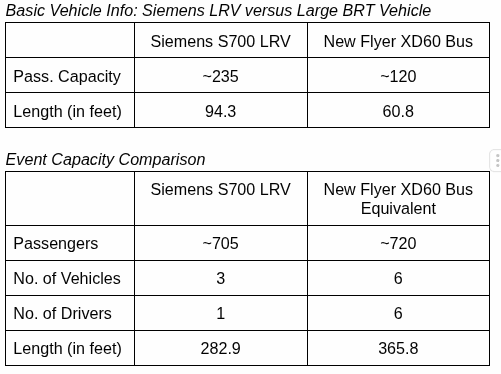
As an LRT operator, I’ve worked countless events and games for the variety of sports teams that call the Twin Cities home. It’s a truly magical experience to be the first train downtown after an event ends, and the next time you return everyone is gone. This is only possible because of the capacity of LRVs. During large events, each train has three LRVs which hold over 235 people in each car when packed to standing room (at least 705 people per train). Articulated buses have a capacity of 120 people and have to fight against the traffic caused by people parking for the event nearby instead of taking transit.
There have been times I’ve gone to the Minnesota State Fair using transit, and the Green Line was the quickest part of the journey. During the last leg of my trip, I had to wait for a massively delayed A Line for what would normally be a 6 minute ride north if it didn’t have to share the lane with hundreds of cars in State Fair traffic. When the bus finally arrived, it ended up being packed to standing room at the very front. This is the typical story of taking buses to events: It takes longer to board, there’s very limited capacity, and the bus has to deal with traffic, which increases the duration of the trip. It takes six articulated buses and six drivers to fill the role of a single three car light rail train with one operator (see the chart below), using scores more resources, personnel, time, and space. This poor level of capacity makes events that aren’t within walking distance of a light rail stop painful to get in and out of. Events happen every now and then, but rush hour happens every weekday, and no matter how many 60 foot buses are running on a line, they can’t compete with light rail.
Transit agencies across the country are still struggling to fill and keep driver positions after COVID-19. Metro Transit has great pay and benefits, but many quit driving due to stress and poor hours, which vary throughout the industry. If we used light rail instead of buses on highly-utilized routes, fewer drivers (with less stress than driving in traffic) would be required to be hired to satisfy service demand.
Comfort
If you asked someone whether they wanted to take a bus or a train to their destination, they would choose the train every time. Acceleration and braking are smooth and speedy. Trains are more spacious and less cramped than buses. Taking the train is comfortable and a common source of joy. Kids love trains — hearing the horn and the clacking of the rails as the train speedily glides across the landscape is delightful! I can’t count the number of times I’ve made people smile by honking my train horn for them and heard kids board the train giddy with excitement.
Buses have to drive over potholes all the time, and if you’ve ever ridden a bus after the spring thaw, you know how much the bus will bounce up and down when hitting them. Due to all that bouncing on the bus, wheelchairs need to be strapped in. Trains are so smooth that there are no straps for wheelchairs; wheelchair users just roll on and lock their wheels.
Not to be controversial among my peers in the transit industry, but there are bad drivers. It’s a real problem. On a bus, your driver could turn too fast and/or accelerate too quickly away from the stop before you find your spot. I’ve had it happen to me more times than I can count. This typically occurs when the bus is running very late and the driver has become impatient after dealing with traffic. In a train, an operator could pull on the accelerator too fast, but most LRVs have a governor that limits how fast they can speed up from a stop, which results in a moderate initial jolt. Otherwise, they could speed over a crossover or on a turn and make passengers sway, but that’s about it. Braking can also be pretty harsh for buses. LRVs brake relatively smoothly when the emergency brake is deployed at high speeds, and braking is only firm when the train is going 20 mph or under (this is why so much focus and observation is required to operate a train). The discomfort you could experience as a light rail passenger with a bad driver is very minor compared to a bad bus driver. That said, bad drivers on buses and trains are rare, but they are notable when you get one.
Flexibility
Light rail is whatever you want it to be. Light rail occupies a space between heavy rail and streetcars, which has a number of advantages for modern urban environments. Our light rail system runs at-grade down the middle of streets and through pedestrian areas, along dedicated right-of-ways, elevated on flyovers, and in tunnels. In downtown sections — and on University Avenue to a lesser degree — our system acts as a walking accelerator with stops every few blocks, similar to a streetcar. Unlike heavy rail, light rail can easily and quickly navigate tight curves and climb steeper grades. The maximum grade for LRVs is typically 14 percent, while heavy rail is typically 5 percent. Due to its electric direct drive, LRVs can quickly and smoothly accelerate and brake better than heavy rail and buses.
When detours are necessary, though, this is where light rail falters. If there are no other rail lines which head in the same direction as your destination, you will have to take a bus. This is where the bus is king. During accidents, system failures, and scheduled track maintenance which shuts down portions of a line, a temporary replacement bus route called a “bus bridge” is created to fill the gap in service. Buses can easily respond to detours almost instantaneously after being issued. Thanks to our grid system in most of the metro, detours for the most part are only a few blocks away and buses can easily drive around a block if part of a street is closed. This, of course, is impossible for rail to accomplish if both tracks are out of service. Only in the event that one track is operational can trains run with potentially significant delays instead of no service at all for that portion of the line. Thankfully, track closures don’t happen too often and are usually short-lived. In the event of an accident, staff responds with urgency and care to clear the scene and keep the system running.
Costs and Benefits
Light rail is an expensive form of transportation, but it has many benefits which are not immediately apparent. Light rail costs vary widely based on quality, station construction, and whether it’s at-grade, street, elevated, or on an underground track. There is also the matter of land acquisition, which can prove expensive depending on the area’s land value. High capital costs have long been a point of contention and anti-transit state lawmakers have consistently insisted that BRT alternatives be studied because of this. Public transportation is not supposed to be a money-maker with immediate returns — it’s supposed to be a dependable public service. Capital costs are a years-long investment with returns over time, not an irrecoverable loss.
The Southwest Extension (SWLRT) for the Green Line has seen costs balloon as the project has experienced multiple years-long delays. In 2015, the Met Council approved a $1.744 billion budget, and as of 2024 the budget has increased to $2.86 billion (in dollars respective to each year). An audit from the state identified delays were caused by the extensive work required for the Kenilworth Tunnel and other tunnels throughout the line, adjacent freight rail barrier wall upgrades, and the re-addition of a deferred Eden Prairie station initially taken out of the proposal in 2015 to lower costs. Most of the coverage of SWLRT’s issues have been hyper-critical (as seen in KSTP’s coverage through the years), but a huge part of ballooning costs which few have discussed has been inflation from COVID-19 supply-chain issues and the economy at large. Inflation spiked at 7 percent in 2021 and slowly declined to 2.7 percent in 2025. If we convert 2015 dollars to 2024 dollars, $1.74 billion becomes $2.3 billion due to a cumulative 32.3% inflation rate. From this simple calculation, it shows how relatively cost-effective Metro Transit has actually been while experiencing years of delays; it is not Metro Transit’s fault that a historic pandemic spiked inflation and caused global supply chain issues which took years to be managed. If you see another story that’s critical of SWLRT’s budget in the next year or two, just think about all that has happened since the start of the second Trump administration that has increased costs for everyone, including public transit projects, notably a global tariff war and war with Iran. Delays are infuriating to everyone, which is why projects like SWLRT should be fully funded and supported at the beginning so they can start sooner, build faster, and experience less inflation.
SWLRT is currently expected to cost $197 million per mile due to the combination of a high number of flyovers, tunneling, and cost-effective sharing of heavy rail right-of-way for sections of the alignment. In 2024 dollars, the Blue Line cost $1.188 billion ($715.3 million in 2004) or $99 million per mile, and the Green Line cost $1.227 billion ($926.5 million in 2014) or $111.5 million per mile. Our metro’s light rail projects therefore have a capital cost range of $99 to $197 million per mile. The proposed Blue Line extension will likely be somewhere toward the middle of this range due to it currently running at-grade, similar to the Green Line, for most of the alignment.
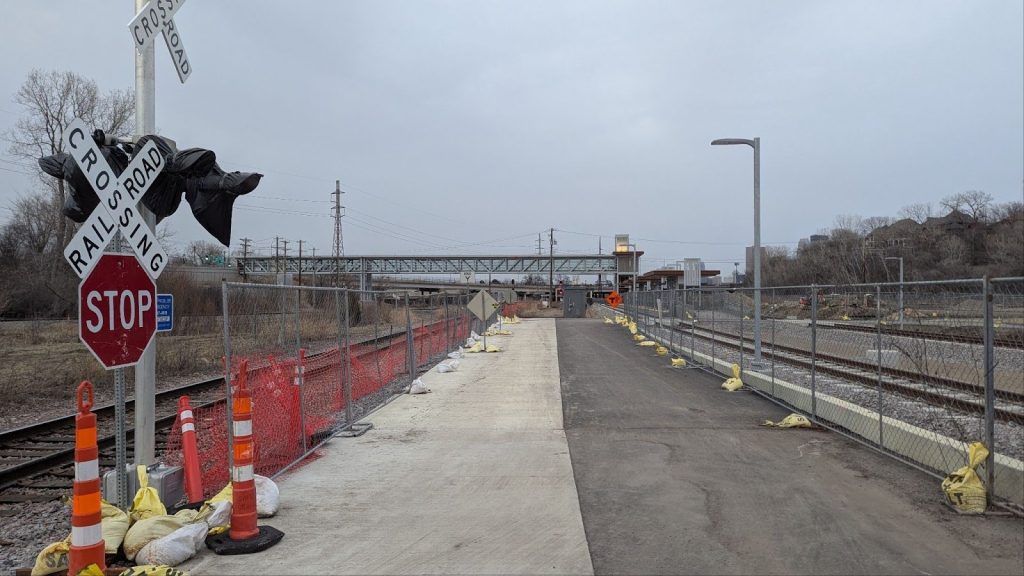
Bus capital costs are much cheaper, even when a comparatively expensive BRT option is used. The Gold Line — Metro Transit’s first near-true BRT — has a dedicated right-of-way along about 70 percent of its route, using bus-only lanes and new bus-only roads. The 10-mile line cost $505.3 million to build, or about $50.5 million per mile.
Cost per mile, however, does not tell the whole story. There are also ongoing costs, including maintenance, where rail reigns supreme. In 2024, Metro Transit service costs per passenger mile averaged $1.97 for LRVs and $3.35 for buses. These figures are also below national averages (in 2022 dollars): $3.20 for LRVs, $3.45 for buses, and $2.45 for heavy rail. This is because buses – even electric – require a much higher amount of maintenance than LRVs. Buses are also heavy vehicles which, when combined with thousands of other vehicles that share the street, create heavy amounts of wear and tear on the pavement they travel on and require expensive maintenance, especially in winter climates like ours. Trains, on the other hand, create relatively minor wear on the rails they travel on and can last years with minimal maintenance. According to Metro Transit’s 2024 fact sheet, the average mileage between service calls is startling: 46,515 for LRVs versus 6,504 for buses. In other words, buses break down at a much higher rate than LRVs and boost costs, proving how truly reliable and cost-effective light rail is during operation.
Light rail has a critical economic impact, which has been held up by urbanists around the world for its role in creating transit-oriented development (TOD). Our light rail system has driven redevelopment to create density near stations and boosted economic activity. Metro Transit fully supports TOD to deliver an economic impact to stakeholder municipalities, connect communities, boost ridership, and decrease car dependence. From 2009 to 2024, $21.9 billion in development was permitted near high-frequency Metro Transit routes. Approximately $14 billion of that was near light rail lines. This densification means a lot of tax revenue can be gathered through subsequent years to recoup capital costs while having low ongoing costs.
BRT just can’t compete, mostly because rails are a lot harder to move than bus stops. Developers want to have a reliable return on their investment, and light rail provides that. Developers know more people today want to live and work near transit; having a light rail stop provides the assurance that their units will be in demand, so they will see plans through to fruition. The $14 billion figure from earlier includes the Blue Line, Green Line, and each of their extension projects. BRT corridor permitted development totaled approximately $11 billion for 9 lines, a much lower rate of return. Let’s compare two suburban transit projects: SWLRT and the Gold Line. SWLRT totaled $3.274 billion in permitted development and $694 million in planned development. Gold Line totaled $968 million in permitted development and $1.298 billion in planned development. This is a disparity of $1.7 billion. Averaged out, in 2024 the rate of return for light rail projects was $7.576 billion each ($30.303 billion total for 4 lines) and BRT projects was $4.277 billion each ($38.497 billion total for 9 lines). If we want to create denser, healthier, more accessible, more people-first and less car-dependent communities — especially in the suburbs — light rail is the way to go every time. The large initial investment made in light rail will pay high dividends in the future; any implementation of BRT just can’t have anywhere near the high return on investment light rail has.
The Case for More Rail
Light rail is much more reliable, especially in extreme weather and traffic conditions, goes much higher speeds, has a higher capacity for events, is much more comfortable, and delivers a powerful economic impact. Buses have great flexibility and much lower initial costs, but lower capacity and higher ongoing costs. Light rail all around is just better.
Winter reliability alone should be a strong indication that the Twin Cities need a lot more rail as part of its transit network. We are fundamentally a winter city. As the old saying goes, “winter’s long and summer’s short” here. My experience riding and driving buses and light rail trains has shown me how critical having rail is to cities like ours. While cars and buses struggle to get around the city and experience massive delays, our light rail system works with ease and safely flies past cars slipping and sliding on hazardous roads. Light rail is also a more relaxed and fun experience from a rider and driver perspective. Light rail trains go on routes where buses and even heavy rail would be impractical and carry out their roles well, allowing riders beautiful, quiet views while they travel to their destination.
Let’s take our transit system in the Twin Cities seriously. Let’s plan for the intense winters we experience every year and create a comprehensive rail system that combats snow and ice with ease. Let’s invest in the future by creating denser, more walkable, accessible, and connected communities across the metro with light rail.