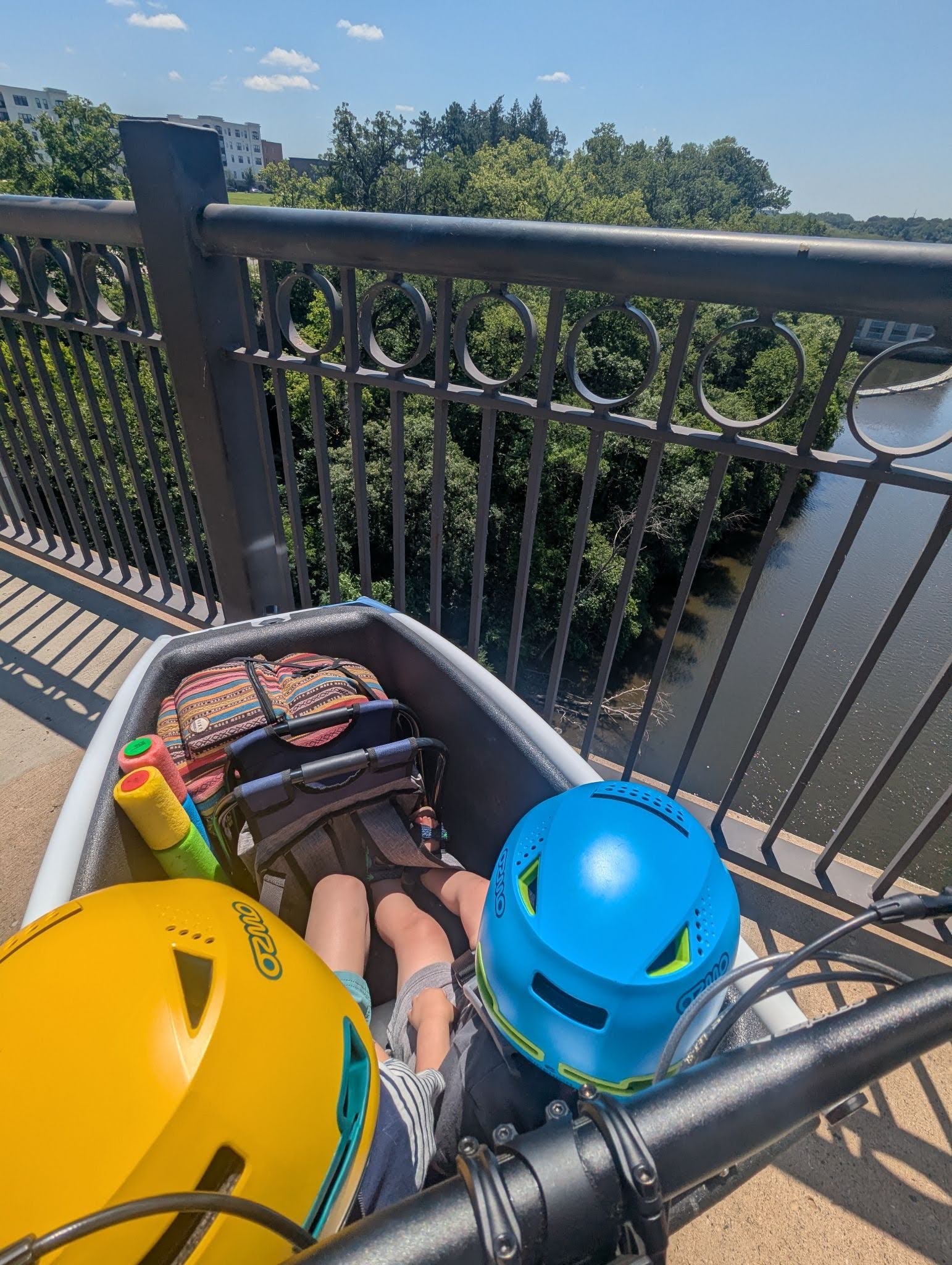
I have always loved bike riding. For fun, for transportation, for exercise, it doesn’t matter, I love all of it (except spin class). While as a child I relied on adult-navigated forms of transport in my day to day life–a bus, a taxi, my parents’ car–it was during the summers that we spent in Florida where I experienced the unbridled joy and freedom that came from having access to and riding a bike.
Now as a parent with two young children, I am committed to introducing them to the joy of bike riding. After moving to Saint Paul in 2025, I saw an opportunity in my neighborhood’s quiet tree-lined streets that look straight out of a Hallmark movie. I bought a cargo bike and after a several-year break from biking after being hit by a car, I am rediscovering how fun it is to ride a bike. One of the things that made it easy to get back into biking are the many passionate groups of people I have met in the cycling community who are not just excited about biking but also about ways to make streets safer and more accessible to everyone. One such group is Kidical Mass Saint Paul, a group that organizes family-friendly bike rides around the city.
Kidical Mass rides are an organized group bicycle ride targeted at children and families using roads and streets. The idea is to make biking more visible, especially children biking, and to help get kids and families more comfortable with biking on the road. The rides also help to remind drivers that streets are shared spaces, that kids have a right to bike in the road too, and that they have a right to independent mobility.
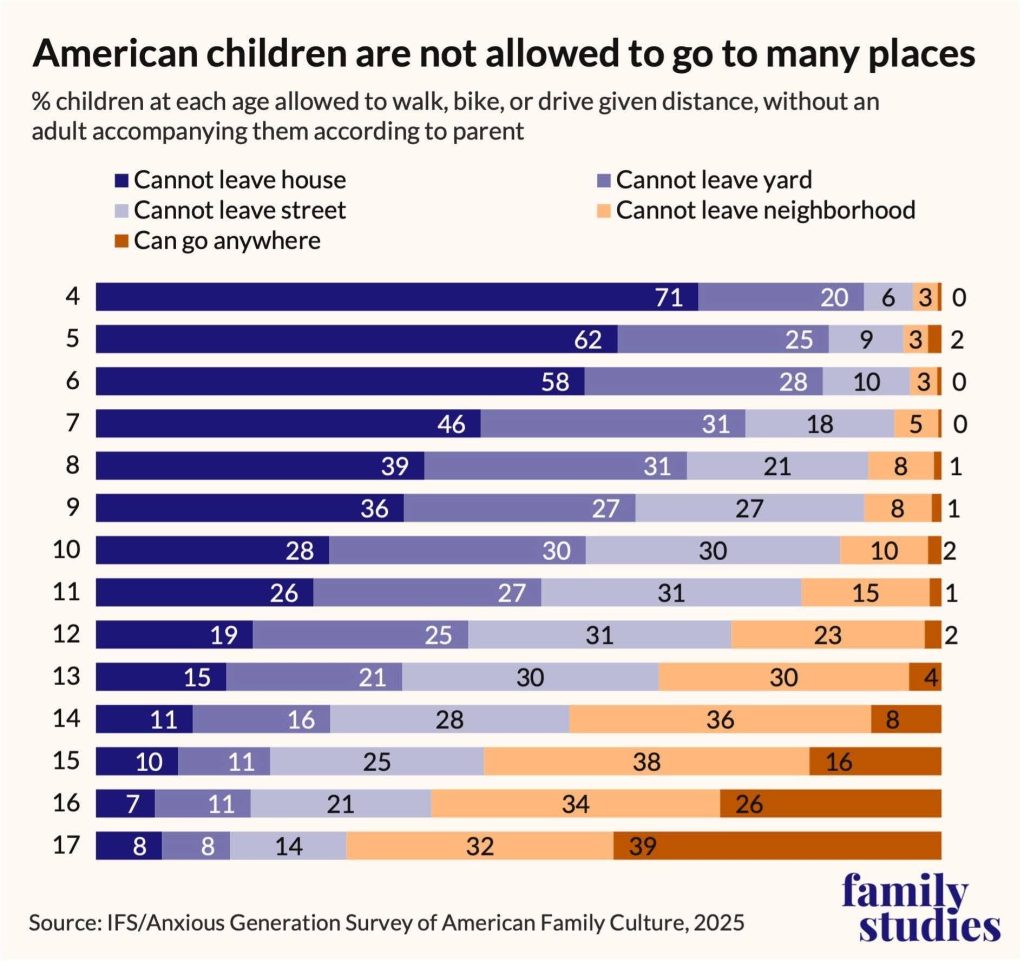
In a recent survey by the American Enterprise Institute, a shocking percentage of children and teens are not allowed to leave even their street unaccompanied by an adult. When I was in middle school I mostly just rode around my suburban neighborhood streets, but biking meant that I could shout, “I’M GOING TO AMANDA’S HOUSE!”, slam the garage door and leave without my mom ever having seen my face that morning. My bike gave me the ability to visit friends and move around my neighborhood on my own, something that nearly a third of 17-year-olds in the United States are not even allowed to do.
The first Kidical Mass ride was in Eugene, Oregon on April 18, 2008 and since then the movement has spread to many cities across the globe. The group takes its name from Critical Mass, group bike rides that take over streets and serve as a protest to bring attention to cyclists and cycling infrastructure. Unlike Critical Mass rides, Kidical Mass are more family and kid-oriented with rides being slow, short (around 3 miles), and on bike-friendly streets or paths.
There are two main Kidical Mass chapters in Minnesota, one in Saint Paul and one in Minneapolis. In Minnesota, rides are typically held from spring through fall and rides usually start and end at a family-friendly destination like a park or playground.
The Saint Paul Kidical Mass group rides are currently organized by Rachel Wiken, a transportation cyclist since college and mom of two in the Macalester-Groveland neighborhood of Saint Paul, and Mary Alivia Tolsma, mom of two and a former Twin Cities year-round cyclist who said she reluctantly started driving for her clinical job at age 27. Wiken is a Senior Transportation Planner at Metropolitan Council and Tolsma is a Certified Physician Assistant. They rebooted the group in 2025 after a hiatus that began in 2020 during the COVID-19 pandemic. In 2019, Tolsma started the Saint Paul chapter with a friend because getting her kids and bikes over the river to participate in the Minneapolis-based rides was challenging. She wanted something more accessible to herself and others in Saint Paul. When Tolsma needed a new co-lead for the reboot, Wiken was already looking for a way to be involved, having enjoyed participating in group rides in the past as an adult. She wanted to introduce that to her kids, “I wanted my kids to experience that fun of being in a big rolling group,” Wiken told me when I asked about her motivations.
Both Wiken and Tolsma believe that the Kidical Mass rides are a good way for kids to learn cycling skills on the street and help build confidence in young riders.
“I feel strongly that having visibility of kids on bikes in the neighborhood encourages other families to bike as well,” said Wiken.

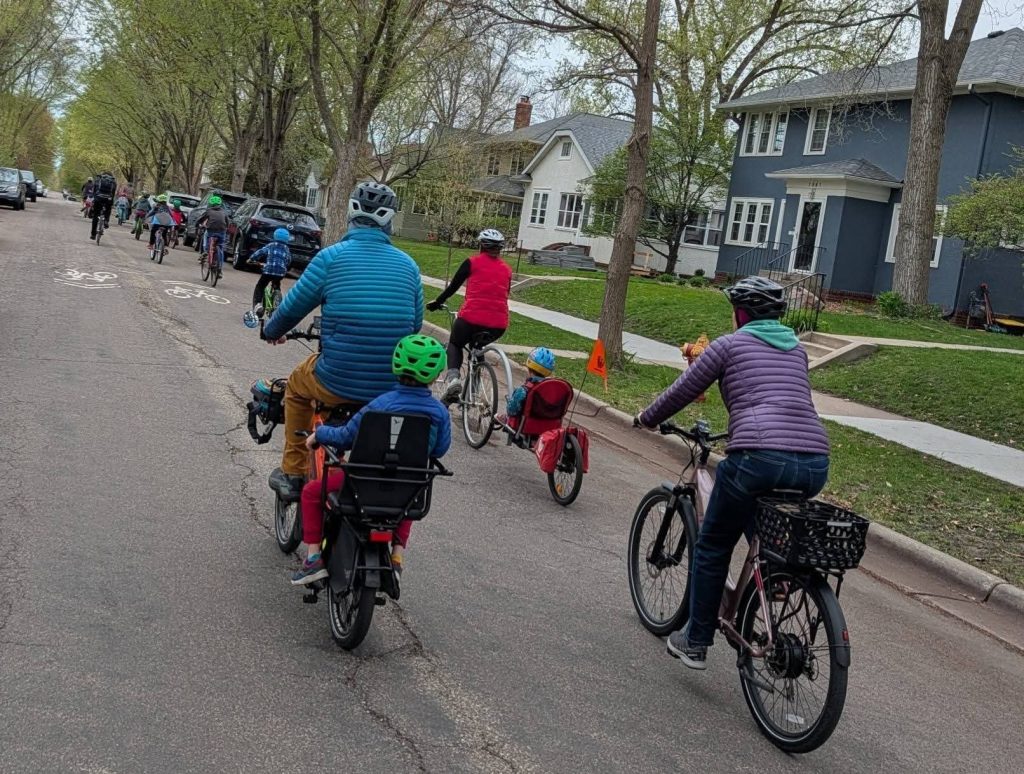
The first ride of the 2026 season kicked off on a chilly Saturday afternoon the last week in April. When I got to the park that was the gathering place for the ride, it was easy to spot who else was there for Kidical Mass – a number of cargo and kid-bikes clustered near a tree. When it was time for the group to roll out, Wiken provided a quick overview of the route before leading the pack on the ride. Of the twenty or so riders, about half were children riding on their own. At least one adult rider was present when crossing intersections to ensure that everyone made it through safely and that no one got separated. We made our way mainly down smaller, quiet streets or streets with bike lanes or paths. The ride had a languid pace suitable for little legs and wheels and most people chatted along the roughly 30-minute, 2.5 mile ride. At one point a large truck headed down the small street towards our group, moving in the opposite direction. The group shifted to accommodate the vehicle. “Car up!” adults called out. “Cars bad,” quipped the kid on a cargo bike next to me.
As we headed down a larger road with little traffic, a car trailed our group. “Should we let this guy pass?” I heard someone ask. Rachel’s husband, Dave, explained that our group was “taking the lane”. Under Minnesota law, cyclists can “take the lane” when the lane is not wide enough to share with a vehicle. This is a safe way to be visible and signals that cars should use the other lane to safely pass. I think this learning through observation and learning by doing are such important parts of Kidical Mass. Most kids will at some point ride their bike in the street and most kids will not have been taught how to safely do so or what rights cyclists have when sharing the road with vehicles. These are lessons I wish I had been exposed to earlier and that would have likely prevented my own bike accident as an adult.
Kidical Mass rides have not been without their challenges.
“Saint Paul bike routes are not protected, do not connect, and do not safely cross busy intersections. Biking a route with the mind “can a five- or six-year-old do this safely?’ really changes what you think is safe. We desperately need more protected bike infrastructure in Saint Paul. And we need lanes and paths to not magically disappear when crossing big streets,” said Wiken, discussing how difficult it can be to find safe routes to lead a group of young and inexperienced riders.
Despite these challenges, Saint Paul Kidical Mass rides are chaperoned by merely a few adults on bikes to assist with crossings and at lights. In Phoenix, Arizona, where I moved from, a Kidical Mass group was formed in 2025. Smart Growth America’s Dangerous by Design 2026 report ranks Arizona as the third deadliest state for people walking. Wide roads with many lanes and few pedestrian crossings make many Phoenix streets dangerous for walkers and cyclists alike. The Phoenix Kidical Mass group only holds one annual ride and they are accompanied by a police escort to assist at particularly difficult crossings and intersections.

Neighborhoods and cities are not built to consider how children will travel and move around and Saint Paul is no exception.
“We have a long way to go before most families would feel comfortable with their young rider biking independently,” Wiken says.
As a pre-driving teenager, my bike rides expanded beyond our neighborhood and my bike became a way for me to explore my broader community independently. What do we lose as a community when kids cannot safely move around in their neighborhoods and streets?
The freedom to play and explore without constantly being under the direct supervision of a parent or other adult is an important part of childhood and beneficial to children’s development. There is a growing body of evidence that independent and collaborative play with peers can help make more focused, happy kids who are able to problem solve, work through conflict, and work cooperatively without an adult stepping in. In an age of tech-saturated childhoods and adolescences, biking offers an activity that can be communal and builds responsibility and fosters connection. Biking is a tool that can connect kids to a play-based childhood. But just having a bike does not mean that you will automatically have the freedom to move around in the community, even as an adult.
As Seth Kaplan writes in “The Real User Interface: Recovering Our Neighborhoods”, “our planners and engineers have built a physical landscape optimized for cars but minimized for relationships…This is especially problematic for children, whose opportunities for spontaneous free play—and the constructive friction that self-organized activities create—are further limited when the physical landscape discourages exploration.”
In many cities in the United States, the physical landscape significantly limits safe independent exploration for children and even adults. According to the National Center for Safe Routes to School, 48% of children 5 to 14 years of age usually walked or bicycled to school in 1969. This number dropped to 13% in 2009 and was at 11% in 2022 according to the National Household Travel Survey. When citing barriers to biking and walking to school, over 60% of parents mentioned distance but another 30% were concerned about traffic-related danger. Formal programs like Minnesota Safe Routes to School and Walk! Bike! Fun! developed and administered by the Bicycle Alliance of Minnesota are working to make walking and biking safer and more accessible to kids and students. Less formal group rides like the ones organized by Kidical Mass groups and local bike shops like the Perennial Cycle Family Fun Rides, help support those goals by providing a fun way for families to bike together. After all, in addition to being a form of transportation, biking is also just plain fun.
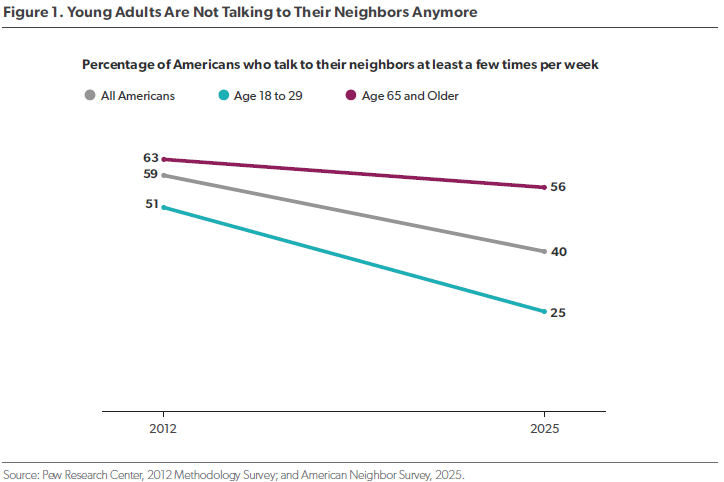
I think biking to bike, not just as a form of transit or sport, is valuable and fosters connection. That limiting physical landscape that Kaplan talks about? That extends to adults as well. According to the American Enterprise Institute, only 25 percent of young adults talk to their neighbors at least a few times per week, down from 51 percent in 2012. One of the best ways to connect with neighbors is simply by walking around the neighborhood – 55 percent of Americans who walk around their neighborhood at least once a week say they talk to their neighbors at least a few times a week. Taking a walk around the neighborhood seems like a simple enough practice to adopt, but not all neighborhoods are structured in such a way to encourage (or even tolerate) pedestrian activity (see “Art-A-Whirl Demonstrates the Need for Better Infrastructure in Northeast MPLS”).
This is where group bike rides can make all the difference. There is safety in numbers, so come on out and let’s bike together.
The Phoenix Kidical Mass group did not exist when I lived there and I never imagined that it could. Over the past few years bike infrastructure has been added and improved. A protected bike lane now runs through the intersection where I got hit. The bikers encourage the infrastructure and the infrastructure creates more bikers.
What’s great about Kidical Mass is that anyone can start a group and it is always a fun time. For Wiken, she saw a missing culture that she wanted to create, “There were family rides happening in Minneapolis but they were too far away to make work logistically and the timing never fit with my kids’ schedule. So I figured if I wanted that culture in my neighborhood, I should build it!” and she did.
I used to love biking for the freedom it enabled me, I could just hop on a bike and go. Now I love biking because it is a way for me to travel through my community while being a part of it, not shut out by a car. I can wave to friends and neighbors or stop to chat. Having lived in deserts for nearly fifteen years of my life, I relish feeling the different weather of each season and experiencing their accompanying scents: firewood in the fall, peonies and lilacs in bloom in the spring, and mowed lawns in the summer. Riding my bike makes me feel like a kid. Given that adults benefit from playing as much as children do, even just riding for fun is beneficial. If you are nervous about biking on your own as a family or want to discover new family-friendly routes (and try out some new playgrounds), organized group rides are a fantastic introduction to biking on streets for all ages. Summer in Minnesota is the perfect time to start riding.