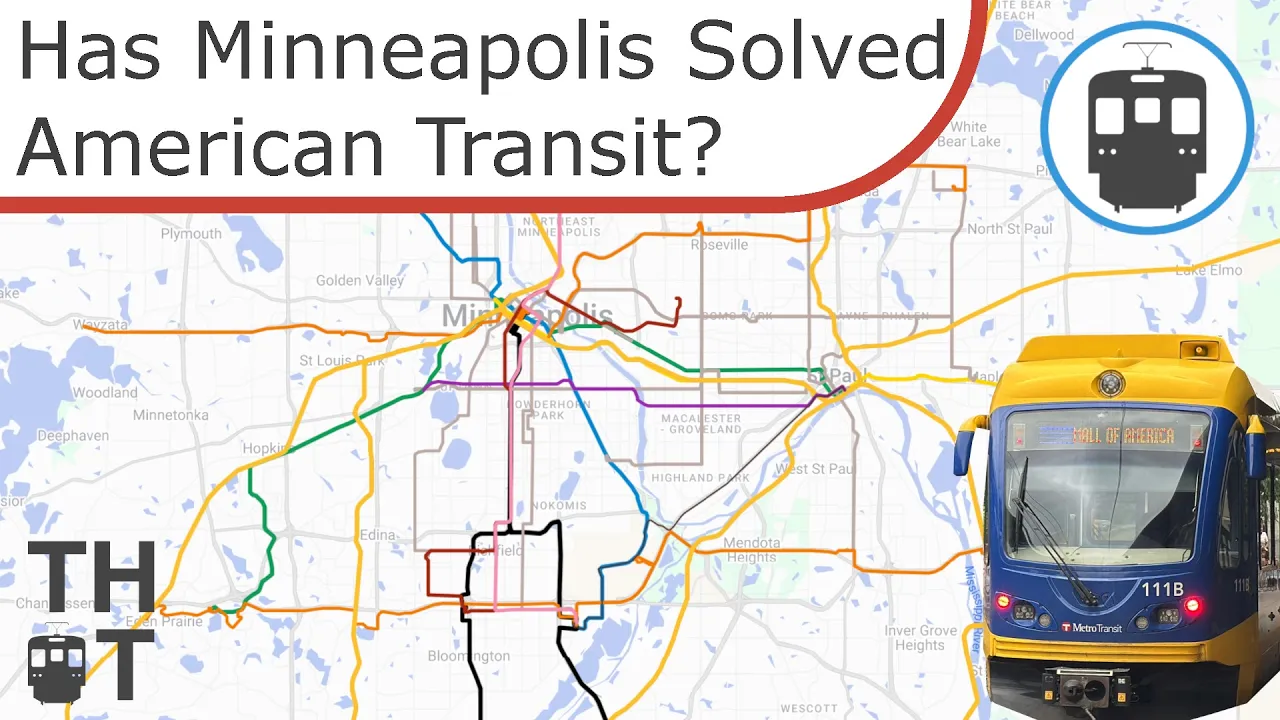
Emmett and Evan from The House of Transit lay out an ambitious expansion concept for the Minneapolis-St Paul METRO system!
Links
Chapters
0:00 Introduction
1:38 Today’s METRO Transit
5:48 The Best We Can Do?
11:03 TwinsLink: Regional Rail for the Twin Cities
15:23 Putting the Metro in METRO
19:44 Light Rail Connections for St Paul
20:19 Wrapping it All Up
Transcript
[00:00:39] Together: The Twin Cities are weird.
[00:00:42] Emmett: Not in a creepy twins kind of way. In the Midwest that’d probably be like St. Louis and East St. Louis, but strange nonetheless. Urban prairie, Target and Best Buy, suburban hell, middle of nowhere, what possible use for all those freeways? Come on, this is the state that voted against Reagan. I expect better. Geez guys, it does get better, because while other Midwest cities twiddle their thumbs on urban policy issues, Minneapolis St. Paul is making tangible improvements.
[00:01:12] Evan: If you like biking, Minneapolis is constantly touted as one of the cycling-friendliest cities in the U.S.
[00:01:18] Emmett: Just look at this before and after on Bryant Avenue. It’s awesome.
[00:01:22] Evan: It was also the first major American city to do away with single-family zoning, and Minneapolis rents have gone down despite skyrocketing nationally in recent years. To support that urban growth, the Twin Cities is doing something else right. Investing in public transit.
Part 1: Today’s Metro Transit
[00:01:44] Emmett: Metro Transit’s light rail was born the same year I was, which means it’s now old enough to drink legally. Today’s network comprises a pair of lines connecting the two downtowns, as well as the airport and Mall of America.
[00:01:56] Evan: Both lines are in the process of being extended, including the massive Southwest LRT project, which has been sitting virtually complete for almost two years now, but won’t open until 2027. That project extends light rail 14.5 miles into the southwestern suburbs, serving lots of business parks, but few areas of dense walkability. At one time, the extension was planned to run through the core of urban Minneapolis by using the Midtown Greenway and then tunneling up Nicollet Avenue. This would have brought rail service to loads more people, but it was deemed too great of a political reach and got canned in favor of just continuing along the same rail line. The rest of the extension follows. So rather than serving businesses and residents in Midtown, the line will run through rich, low-density Kenwood, where local opposition means that an expensive tunnel is being built anyway.
[00:02:45] Drive through: Welcome to Hardee’s. Would you like to try our new chicken tendie and french fry combo?
[00:02:48] Customer: Hell no. Can I get a chicken tendie combo please?
[00:03:00] Emmett: But there is a light at the end of the utterly useless tunnel, because the other major light rail extension in Minneapolis is on a much better path. In the reverse story of the Green Line, the Blue Line’s extension was initially going to follow a secluded rail right of way into downtown, but the railroad said no. Good for you, BNSF. Way to set boundaries. Instead, the future Bottineau LRT extension will run right through North Minneapolis, serving stations with creative solutions to separating pedestrian and vehicle traffic.
[00:03:29] Evan: While the light rail extensions may be impressive, they play a small part in Metro Transit’s overall system expansion. Instead, Metro has pivoted to a focus on buses.
[00:03:40] Emmett: The new B line was kind enough to open while we’re in town. It connects St. Paul with the Lake Street corridor in Minneapolis’ uptown neighborhood. Despite all the density and activity, this area is absent of rail transit, having been totally missed by the southwest extension of the Green Line. To help fill in, the B line rapid bus connects with future light rail at its western end. After passing through urban Minneapolis, the route darts across the Mississippi and through quieter neighborhoods until reaching downtown St. Paul. Stops along the route are very typical of the stations found on BRT light routes in the urban Twin Cities region. You have clear wayfinding, in fact stellar wayfinding, that’s something that the Twin Cities does very well, and protected shelter, good lighting, I feel very safe here despite it being like 10 p.m. in the middle of Ghost Town. However, there’s not much on the street to differentiate this from a regular bus route.
[00:04:32] Evan: That’s not to say Metro doesn’t have other tricks up its sleeves. Take the Metro Gold Line for example, a bus rapid transit project that’s unlike anything else in the United States.
[00:04:43] Emmett: The Gold Line BRT runs 10 miles east from St. Paul into sprawling suburbia.
[00:04:49] Evan: Metro Transit essentially built a new roadway entirely dedicated to just a singular bus route.
[00:04:54] Emmett: The infrastructure is impressive with several new bridges and off-street stations, but confoundingly the entire thing parallels a freeway. Still though, it’s succeeding at attracting new development. Check out this TOD, that stands for Transit Oriented Driving Range. Oh, and here’s 3M’s headquarters. Way out in the suburbs, 10 minute headways are nothing to shake a finger at either.
[00:05:19] Evan: In a couple of years, the Gold Line will be extended to downtown Minneapolis. This was a last minute addition to the project, but it’s a pretty good idea. If you look at the map, you’ll see that the Green Line light rail already serves a similar corridor, but it runs on city streets the whole way and makes a bunch of stops. There is a clear need for a high frequency and high speed connection between the two downtowns, and the Gold Line will partially help fill that role. This won’t be the first expressway BRT route, with the Orange Line already serving fancy stations along I-35.
Part 2: The Best We Can Do
[00:05:56] Evan: Minneapolis has gotten really good at building quality bus infrastructure along key corridors.
[00:06:02] Emmett: But here’s where we have to step back and ask ourselves, what does all this transit really accomplish? Rather than shifting the status quo, it seems to merely accommodate it. It’s a story we’ve heard in city after city in the US. Park and ride oriented freeway buses and light rail reaching out into the suburbs, with dense walkable neighborhoods getting nothing more than an upgraded bus, and often just a sucky local bus that gets stuck in traffic.
[00:06:24] Evan: And let’s talk about the city’s commuter rail line, North Star. Trains never made it to the intended destination of St. Cloud, leaving a stub of a line which wasn’t really that popular to begin with. It was shut down in January 2026 and replaced with express buses. Master Oogway: My time has come. You must continue your journey without me. Master Shifu: What are you-?
[00:06:54] Evan: So despite the improvements, Minneapolis transit story is murky. Is this really the future that Twin Cities should be aiming for?
[00:07:02] Emmett: We go now to former US President Joe Biden for the answer. Joe Biden: Minnesota!
[00:07:09] Evan: Okay, great. Expanding on this point, the first step of a sustainable transportation system is giving people the option not to drive. And Minneapolis is doing a fine job of that. But to make active transportation and transit the norm, cars need to be de-prioritized. And when you look at Lake Street or I-94, any of the light rail corridors for that matter, it becomes clear that that simply is not happening.
[00:07:33] Emmett: Wait, did you say I-94? Let’s pause here, because the interstate connecting Minneapolis and St. Paul is a particularly egregious example of what the Twin Cities, and really the United States as a whole, gets wrong with respect to transportation planning. By the middle of the 20th century, St. Paul’s Rondo neighborhood had cemented itself as the beating heart of the city’s black community. More than 80% of St. Paul’s African American community lived in the neighborhood, and the vibrant area was home to families on all levels of the income spectrum. Rondo was a cultural hub not just for St. Paul’s black residents, but for the city as a whole, playing host to hundreds of local businesses and community centers.
[00:08:14] Evan: When the Federal Highway Act of 1956 was passed, construction promptly started on interstate I-94 through the Twin Cities. The path of I-94 bisects Rondo, displacing 700 families and leading to the destruction of 300 businesses. Over the past couple of years, CityNerd has put out a great video all about the destructive freeway, but suffice to say, Rondo has never recovered, and everyone who remains in the neighborhood is now exposed to the near-constant drone of cars and carcinogens they bring.
[00:08:43] Emmett: The construction of I-94 would be balked at if it was proposed today, and it feels kind of absurd to just accept this scar on the urban landscape as a given. Well, for once, a State Department of Transportation is actually listening to common sense, because MnDOT is currently engaged in a study called Rethinking I-94 to determine whether this freeway really deserves a future.
[00:09:04] Evan: Wait, wait, wait, wait, wait, wait, wait. Surely this has to be too good to be true, right?
[00:09:09] Plankton: Correct!
[00:09:10] Emmett: Because while MnDOT has studied a variety of alternatives for the future of I-94, including removing it and replacing it with an urban boulevard, their current recommendations are to… change the number of lanes on the freeway and add a managed bus lane? What the f- Let’s see why they didn’t recommend advancing the freeway removal, shall we? Okay, so this would “reduce mobility and air quality.” That seems doubtful. “The number of crashes would increase. And the mobility for people in cars would decrease.” Alright, I’ve heard enough of this garbage.
[00:09:46] Evan: What the I-94 study completely fails to acknowledge is the frankly quite basic concept of modal shift.
[00:09:52] Emmett: Believe it or not, people’s behavior can change. Obviously if your goal is for everyone traveling between Minneapolis and St. Paul to drive, then I-94 is the best way to accomplish that.
[00:10:05] Evan: But if you want to move as many people along this corridor as possible, this paradigm sucks. Rethinking I-94 can’t be taken seriously in its current form because it doesn’t propose a viable alternative to the freeway, and no, bus lanes don’t cut it.
[00:10:22] Emmett: There’s a better path forward, one proposed by a group known as the I-94 Rail Coalition. This is a grassroots effort to not only bury or remove Interstate 94, but to replace it with a mainline rail corridor between the two hubs of the region. The brilliance here is that, while the obstructive freeway would be taken away, residents would be provided with a new connection that could be even faster, and certainly higher capacity. This would lengthen the time to drive between Minneapolis and St. Paul, but it would create a vastly more sustainable means of transportation between the two downtowns, while improving the quality of life for the communities along it. Let’s envision what the Minnesota DOT proposal should be, drawing considerable inspiration from the work done by the great people behind the I-94 Rail Coalition.
Part 3: The System We Deserve
[00:11:09] Emmett: We propose this project be called TwinsLink, maybe not so subtly taking inspiration from London’s cross-city Thameslink network. Starting at St. Paul’s impressive Union Depot, trains would enter a tunnel, swinging beneath Fifth Street to pick up the I-94 right-of-way at Marion Street. Trains would enter their first station at Dale Street. Speeding west another two miles, the most important intermediate station would be Snelling Midway, near the midpoint of the two downtowns. With the freeway gone, this station would provide seamless access to the Allianz Field MLS stadium and loads of prime developable land. Further west, trains would start to parallel an existing rail line. While tracks already exist connecting Minneapolis and St. Paul, they are curvy and slowed by the complex freight operations in the area. TwinsLink would enable a much faster and more reliable connection. Continuing along the I-94 right-of-way, trains would cross the Mississippi, serving a new station in Cedar Riverside. After this point, a tunnel would be constructed under Eighth Street, with trains serving new stations at Elliott Park and Minneapolis City Center before emerging into the platforms of Target Field, the former terminus of North Star, with a connection to both light rail lines.
[00:12:16] Evan: Speaking of North Star, TwinsLink would not just run between Minneapolis and St. Paul, but would form the core of a regional rail network spreading across the broader region. This would of course include the line to Big Lake, which could finally be extended to St. Cloud. A branch of this line could follow down the future Northern Lights Express as far as Cambridge, though trains from Duluth could even use the tunnel, too.
[00:12:36] Emmett: Rather than serving Target Field, another pair of lines could turn south to parallel the Green Line extension. The first of those would serve the Dan Patch line, a long proposed commuter rail corridor along a seldom used freight line. Trains would run through Edina, Bloomington, Burnsville, and Lakeville before terminating at Northfield, home of first place… second place frisbee program Carlton College. The second would drive further southwest, connecting to the Southwest Green Line at Downtown Hopkins and serving another stop in Eden Prairie before crossing the Minnesota River on a new bridge and entering Shakopee. From here the line would follow UP’s Mankato subdivision to, you guessed it, Mankato. It’s worth noting that this whole system should be electrified and would probably be contingent on building new parallel tracks next to existing freight lines. But on a single track line like this one, that doesn’t seem totally out of the question.
[00:13:27] Evan: Heading over to the St. Paul side of things, a line heading north out of the city would serve areas like Little Canada, a name that could really describe the entirety of Minnesota if we’re being honest, and then turn northeast all the way up to Hugo. White Bear already shut down a proposed BRT line, so they probably won’t be super receptive to a train, but eh, we’re making them play ball. Further south a line can head past Lake Elmo and even dipping in the Packers territory. Another route historically started for commuter rails, the Red Rock corridor to Hastings, and we’ll tack that on here too. Additionally, a branch from Newport would cross the Mississippi on a restored Rock Island swing bridge and then split in two. One end would follow Union Pacific Track South, connecting with the Dan Patch Line and Northfield. Trains would continue as far south as Owatonna (Wapapata). Finally, along yet another proposed corridor for the region, trains could run in the median of Highway 52 all the way to Rochester. This corridor has also been proposed as part of a high-speed rail alignment to Chicago, so regional rail and high-speed trains could share the tracks with proper coordination.
[00:14:29] Emmett: In addition to all these Twins Link services, we proposed one light regional rail service dubbed the Minnesota River Line as yet another not-so-subtle nod to a similar service in New Jersey. Starting at Shakopee, the line would run east, connecting to the Dan Patch Line in Savage. Trains would then depart Rail Right-of-Way to instead follow the Sioux Trail with connections to the Burnsville Transit Center and Metro’s Red Line BRT at Cedar Grove. A little further north and trains would re-enter the Rail Right-of-Way, running all the way to St. Paul Union Depot. This line could provide lots of valuable circumferential connections along the Minnesota River.
[00:15:05] Evan: Stepping back, TwinsLink would become an expansive rail system serving not just suburban areas, but the broader region too. Central to that entire vision is a critical 10-mile rail connection between the downtowns of Minneapolis and St. Paul. And with that connection in place, well, we can finally get rid of the urban blight that is Interstate 94. Now let’s pivot to a focus on the urban Twin Cities where transit expansion is needed the most.
[00:15:28] Emmett: To help reimagine the next phase in the Twin Cities transit journey, we’re going to… This is taking a while… Northern France! Welcome to Lille, a city whose tram network looks suspiciously similar to Minneapolis’. But unlike the Twin Cities, trains aren’t the backbone of the transit network here. Oh no. Because in the 80s, Lille took a gamble on a wacky new technology and it absolutely paid off. This is the Lille Metro, and it might look familiar if you’ve ever taken an airport people mover. Built using off-the-shelf VAL, or Automated Light Metro, technology and developed in France, Lille’s Metro became the first ever driverless metro system when it opened in 1983. Two-car trains meant small platforms, and that meant lower costs. The two-line network expanded rapidly and by the year 2000 had reached its current extent of 28 miles and 60 stations. With stations on average less than half a mile apart, rubber-tired trains with rapid acceleration keep travel times competitive with driving. And if you were worried about capacity with those short trains, 90-second headways allowed the system to reach a staggering 270,000 daily riders by the 2010s. With that said, Line 1 is busy enough that platforms have now been extended to accommodate longer four-car trains. If Lille had never built the Metro, its transit would kind of suck.
[00:17:13] Evan: Right now, the Twin Cities have a bunch of low-capacity transit lines running all over the place, like headless chickens, without much of a core network to set things straight. That’s where Light Metro comes in. To start, tracks could run elevated along Central Avenue through the currently underserved northeast of the city. We’ll call this the Pink Line. A Maroon Line would start at St. Paul campus of the University of Minnesota, taking over existing University Transit Way until dipping underground at Stadium Village. From here, the line would run along University Avenue on the route of today’s E Line bus until meeting the Pink Line. The two lines could share a crossing of the Mississippi River and turn under Nicollet Mall, the first transit and pedestrian mall in the United States. The Metro would continue to follow Nicollet Mall past the Convention Center and the dense Whittier neighborhood.
[00:18:00] Emmett: A big selling point of a Metro is up-zoning the areas around it to support new urban growth. And if your main goal is to promote transit-oriented development, then you want to follow the cheapest right-of-way possible. There aren’t really any good corridors to follow through this part of Minneapolis, with one glaring and unfortunate exception – Interstate 35. Without an enormous funding influx, anything else is unattainable, so we’re slapping the Metro right down the middle as a replacement for the Orange Line. The central location would still provide a spine for surrounding neighborhoods, and development on nearby Nicollet Ave would be within walking distance. Continuing south, the lines would depart the freeway and branch once more to serve suburban job centers like Southdale Mall, the Best Buy Headquarters, and of course, another connection to Mall of America.
[00:18:43] Evan: Would such a system be cheap? Absolutely not. But even in a region three times the size of Lille… Lille? Lyle? Two-car trains would be a reasonable starting point given lower densities, which would offer dramatic cost savings for the dozens of stations across the system. The most important part is that areas around the Metro lines would need to be massively up-zoned to allow for the kinds of housing that would support their existence in the first place.
[00:19:10] Emmett: In an even more distant future, Interstate 35 probably deserves to be vanquished, too. If we want to go really bananas, we can fully de-interline the Metro by quad-tracking this portion and turning the Pink Line into a Mall of America express service. North of Lake Street, the line would stick to the I-35 right-of-way, then tunnel to connect to Twinslink and US Bank Stadium. We’ll assume cross-platform transfers with the Maroon Line at Gateway and River North on either side of the Mississippi, quad-tracking the crossing itself, too. If this feels too far-fetched, it’d be nice to at least toll and lid the freeway to promote development directly on top of the Metro.
[00:19:44] Evan: Fear not, St. Paul fans, we have not forgotten near half of the region. The once-proposed and now-forgotten Riverview Corridor connecting St. Paul with the airport and Mall of America should still be explored, but as a proper light rail line instead of the crummy streetcar they proposed before. This would finally complete the Triangle of Transit between the region’s largest employment centers. At the same time, a tramway running along Wide Summit Avenue would serve walkable neighborhoods and two universities. Once crossing the river, it could go along Minneapolis’ Midtown Greenway, interchanging with both Metro lines and terminating at Lake Street station on the Green Line extension.
[00:20:19] Emmett: This is what the Twin Cities transit system could look like with a little love and a whole lot of cash. What’s already in place is a great start, and what’s planned will take the system further than most American cities. But like anywhere else in the United States, these transit investments are being planned to slip quietly into Minneapolis’ urban fabric when really they should be ripping out the stitches.
[00:20:39] Evan: Bus rapid transit is a great tool for suburban connections like the Orange and Gold Lines, but centering the focus of the entire urban transit network on buses undermines the city’s pro-housing policies. By delivering investments in local and regional rapid transit services that directly serve the places where the most people live and work, the Twin Cities could swing from a car-oriented region with high hopes to a place where walking, biking, and transit are not only normalized, but are the easiest ways to get around. The Twin Cities are getting a lot of things right, but their plans are accommodating of the city of today, rather than planning for the growth of tomorrow.
[00:21:16] Emmett: The bike and transit networks are accordingly impressive for the U.S. But Minneapolis-St. Paul needs to aim higher if it wants to follow through on higher aspirations. As in any great city,
[00:21:27] Together: You only get what you give.