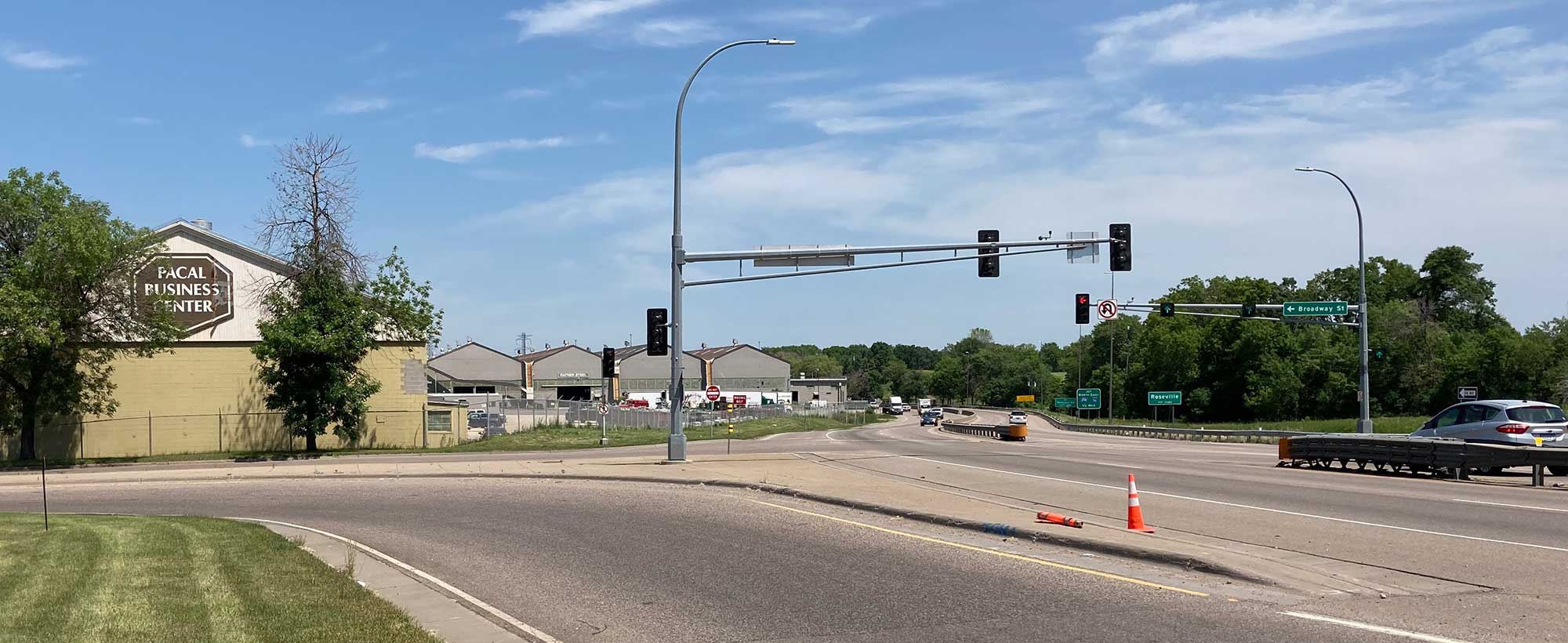
There is something deeply ambitious about naming a street Broadway.
Across the United States, the name appears on street signs in communities large and small. Some Broadways run through the hearts of downtowns, while others serve as neighborhood commercial corridors. Some carry streetcars or cross rivers. Others are lined with theaters, restaurants, apartment buildings and small neighborhood businesses. They share a name, but not necessarily an origin story.
Manhattan’s Broadway—known to the Dutch settlers as Heeren Wegh, or “Gentleman’s Way”— follows portions of an Indigenous route known as the Wickquasgeck Trail, later incorporated into the street network of Dutch New Amsterdam. Even before Times Square glowed with neon, Broadway stood for something specific in the American urban imagination.
Throughout the 19th century, Manhattan’s Broadway emerged as a center of commerce, transportation and public life. Its department stores, hotels, theaters and sidewalks made it a destination in its own right. In December 1880, the Brush Electric Company began illuminating portions of Broadway with electric streetlights, helping establish its association with technological progress and metropolitan spectacle.
But not every American Broadway was necessarily named with Manhattan in mind. The word itself was also a straightforward description of a wide thoroughfare. It is not always possible to know why a city chose to name a street Broadway.
In Buffalo, New York, Broadway became the commercial heart of a neighborhood shaped by Polish and other Eastern European immigrants. Originally known as Batavia Street, Buffalo’s Broadway received its current name in 1877. The Broadway-Fillmore neighborhood subsequently developed into an important center of Polish immigrant residential, commercial and cultural life.
In Los Angeles, a campaign to rename Fort Street gained momentum in the late 1880s. The street, which had been named for a military fort, was developing into an important commercial corridor. Businessman and printer Fred Alles advocated for a new name that would better reflect its future. According to historical research published by PBS SoCal, supporters considered Market Street before ultimately settling on Broadway. The Los Angeles City Council approved the change on February 17, 1890.
Chicago followed a similar path. In August 1913, Evanston Avenue on the city’s North Side became Broadway as part of a much larger municipal street-renaming effort. Local business owners had advocated for the name, drawing on the reputation of New York’s entertainment district. Chicago’s Uptown neighborhood would subsequently become home to elaborate entertainment venues and movie palaces.
In Portland, Oregon, the construction of the Broadway Bridge, which opened in 1913, prompted a campaign to rename Seventh Street on the west side of the Willamette River. Advocates wanted a continuous street name across the river, anticipating increased traffic, streetcar connections and commercial development. In Portland, the name Broadway helped establish a shared identity for a newly connected corridor.
Minnesota was hardly immune to the appeal of the name. In Rochester, Broadway formed one of the two principal axes of the original street grid. A municipal historic designation study traces the name to the ambitions of the city’s early settlers, at a time when its future commercial thoroughfare was still being cleared of brush. Broadway was, in this instance, a statement about the future rather than a description of the present.
The Two Streets Minneapolis Connected
By the 1880s, the Mississippi riverfront north of downtown Minneapolis had become a major industrial landscape. Sawmills, lumberyards and other manufacturing operations occupied the riverbanks, while residential neighborhoods expanded farther inland.Long before Minneapolis had a street named West Broadway, North Minneapolis had a growing commercial corridor along 20th Avenue North. Originally platted as a residential street leading toward Crystal Lake Road, the avenue developed alongside the industrial expansion of the city’s northern riverfront.
Between 1880 and 1920, much of North Minneapolis was platted and developed. The neighborhoods attracted successive generations of immigrants, including German, Scandinavian and Eastern European Jewish families. Alongside residential development emerged commercial districts that provided goods, services and gathering places for the North Side’s growing population.
The city’s 2025 African American Historic and Cultural Context Study identifies the avenue as an early industrial and commercial center. Its proximity to churches, North High School and residential development helped establish its importance within the Near North community.
And between 1880 and 1895, Minneapolis’ population more than quadrupled, reaching 192,833. The city’s expansion during this period resulted in the construction of seven road bridges and six railroad bridges.
Residents of North and Northeast Minneapolis first petitioned the City Council for a bridge at 20th Avenue North in September 1884. Not everyone agreed on where those crossings should be built. In an 1887 letter to the Minneapolis Tribune, reproduced in the Historic American Engineering Record’s study of the Broadway Bridge, a supporter of the proposed crossing predicted that the crossing would “develop an important suburban business center along the whole length of the avenue.”
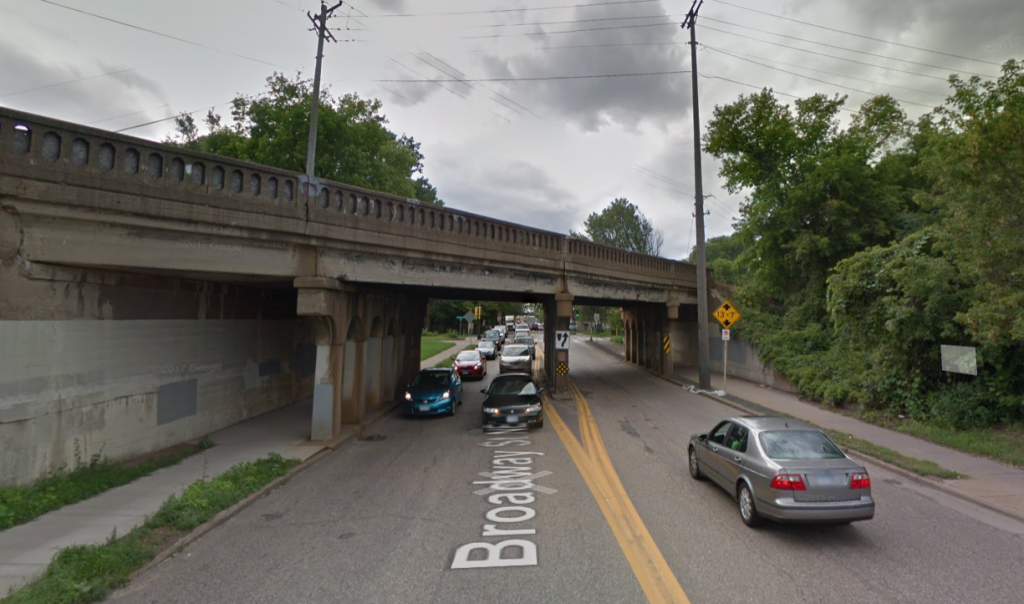
The letter also argued that the bridge could facilitate connections between the city’s streetcar lines. It was an early recognition of the relationship between transportation infrastructure and neighborhood commercial development.
By February 1888, the 20th Avenue North Bridge was open to travelers. But the bridge did not initially connect the two streets we recognize as Broadway today. Its western terminus was 20th Avenue North, while its eastern terminus was 13th Avenue Northeast. Broadway Street already existed farther east but did not extend directly to the bridge.
Connecting the existing Broadway Street to the bridge proved surprisingly controversial. The City Council directed the city engineer to study the extension in 1887, only to abandon the proposal following opposition from affected property owners. The issue would remain contested for decades.
The street we recognize today as West Broadway also incorporated an older route extending northwest through North Minneapolis. The 1914 Minneapolis city directory identified Crystal Lake Avenue as a continuation of 20th Avenue North, beginning at Humboldt Avenue and extending northwest toward the city’s limits. Creating a continuous Broadway required more than extending a street or changing its name. Minneapolis had to contend with misaligned street grids and the diagonal route of the old Crystal Lake Avenue. The resulting thoroughfare incorporated pieces of the city’s earlier geography.
Public transportation reinforced that development. By 1891, streetcar tracks extended along Crystal Lake Avenue to the Minneapolis city limits, establishing a transportation connection that would help shape commercial development for decades to come.
And as early as 1895, streetcar service connected Robbinsdale with the streetcar network at Emerson Avenue and 20th Avenue North. Streetcar tracks were subsequently installed across the bridge in 1914—six years before West Broadway received its name.
According to engineering maps examined by the Historic American Engineering Record, Broadway had yet to be extended to the bridge in 1919, but the connection appeared on maps the following year.
In August 1920, 20th Avenue North was renamed West Broadway Avenue, and the bridge subsequently became known as the Broadway Bridge. Unlike in Los Angeles and Chicago, it is less clear whether Minneapolis’ adoption of the Broadway name reflected an aspiration toward metropolitan grandeur or simply the practical need to establish a shared identity for a newly connected corridor.
Living Up to the Name: Streetcars, Theaters, and a Commercial Spine
West Broadway’s emergence as a commercial destination was closely tied to Minneapolis’ streetcar network. Before widespread automobile ownership, intersections where multiple streetcar routes converged offered businesses access to customers from several neighborhoods.
One such intersection was West Broadway and Penn Avenue North.
A historical architectural survey conducted for the Bottineau Transitway Project identifies the intersection of the Penn and Robbinsdale streetcar routes as an important transfer point and commercial center. By 1930, city directories documented a collection of businesses offering everything from everyday household necessities to entertainment and medical services.
The streetcar helped shape the physical landscape of the surrounding neighborhoods, too. The extension of the Broadway streetcar line in 1923, for example, preceded the construction of the buildings that now comprise the Golden Valley Road Apartments Historic District.
And, appropriately enough for a street named Broadway, there were theaters.
In 1927, a movie theater opened at what is now 2027 West Broadway Avenue. Originally known as the Logan Theater, it operated for much of its history as the Paradise Theater before being renamed the Capri in 1967. According to the Capri’s own historical account, it is the last surviving theater of the 13 that once operated in North Minneapolis.
The Paradise was hardly alone. At various points in the early and mid-20th century, North Minneapolis was home to neighborhood movie houses such as the Empress, Iris, Lyndale, Alhambra, Homewood, Camden and Emerson theaters. Broadway itself was home to several cinemas, including the Cozy Theater at 2221 West Broadway, later known as the New Penn Theater.
On January 5 and 6, 1979, a young Minneapolis musician named Prince Rogers Nelson performed his first shows as a solo artist at the Capri.
But the significance of the Capri extends well beyond Prince. Neighborhood theaters were part of the social infrastructure of American cities. They were places where people spent their evenings, gathered with friends and participated in a cultural life that did not require traveling downtown.
The Capri Theater reopened in October 2021 following an extensive renovation and expansion, continuing its role as a North Side cultural institution nearly a century after its original construction.
What “Broadway” Means on the North Side Today
By the middle of the 20th century, West Broadway was firmly established as one of North Minneapolis’ principal commercial destinations. In a 2001 Minnesota Public Radio report, longtime residents recalled the corridor as a major destination for shopping and entertainment.
But their recollections also reveal the limitations of romanticizing Broadway’s commercial heyday. For Black North Minneapolis residents, access to the housing and economic opportunities surrounding Broadway was constrained by racial discrimination. The prosperity associated with the corridor was not equally accessible to everyone.
During the 1950–1951 reconstruction of the Broadway Bridge, workers removed its streetcar tracks. The bridge was raised to accommodate river navigation, and the resulting steeper approaches could no longer accommodate the tracks. The infrastructure that had helped establish Broadway as a commercial destination was disappearing as Minneapolis reorganized its transportation system around the automobile.
Racially restrictive housing practices, highway construction and urban renewal altered the geography of the North Side. The construction of Interstate 94 created a barrier between residential neighborhoods and the Mississippi River, while other redevelopment projects displaced homes and businesses throughout the area.
The city’s 2025 African American Historic and Cultural Context Study documents how the destruction of other North Minneapolis commercial areas contributed to the concentration of economic activity around West Broadway and Penn Avenue North, as well as around Plymouth and Penn.
The corridor became home to institutions that served not only as businesses but also as spaces for community building. In 2012, entrepreneur Sammy McDowell opened Sammy’s Avenue Eatery at 1101 West Broadway. In 2015, Appetite For Change opened Breaking Bread Café at 1210 West Broadway, with Lachelle Cunningham as its founding executive chef. Although the café closed in 2023, its work represents part of the corridor’s more recent history of community-based economic development.

West Broadway is also one of Minneapolis’ seven designated cultural districts, a designation established in 2020 that recognizes the significance of historically underserved communities and their cultural and economic contributions to the city.
Organizations such as the West Broadway Business and Area Coalition continue to support local entrepreneurship, commercial property improvements and economic development throughout the corridor.
More than a century after streetcars helped establish Broadway as a commercial destination, rail transportation is once again part of discussions about its future.
The proposed METRO Blue Line Extension would bring light rail along portions of West Broadway. In some respects, the proposal echoes conversations Minneapolis residents were having in the late 19th century, when a bridge across the Mississippi promised to transform the economic geography of the North Side.