
Editor’s note: This is part two of an ongoing series about femme/trans/women (FTW) who are leaders — either quietly or overtly — in transportation issues and advocacy throughout Minnesota.
As we continue to highlight aunties of active mobility in Streets.mn (where I recently became a board member!), I’m happy to offer the next installment in this series featuring two metro-area aunties with unique and inspiring stories.
I’m going to tell you about Rose Dillon, an “IT auntie” working in the tech industry (do I need to explain the lack of gender diversity in the tech world?), whom I met during one of the Bicycle Alliance of Minnesota’s first Adult Learn to Ride classes in the summer of 2021. Rose, who lives and works in southeast St. Paul, was a brand new rider then, but has greatly expanded her biking and advocacy skills since that summer, even becoming a League Certified Instructor.
A private person who declined to include any photos of herself for this series, she nonetheless allowed me the honor of sharing her story.
I’m also going to tell you about Laura Groenjes Mitchell, someone who inspires me daily with her seemingly endless supply of energy for equity-driven activism. Through my work as deputy director of BikeMN, I collaborated with Laura recently — along with the folks at Cyclehoop and the Lyndale Neighborhood Association — to launch the Minneapolis Cargo Bike Library. To say that Minneapolis would be a less bike-, pedestrian- and transit-friendly place to live without her is an understatement.
As you read the stories of these two powerhouses, I hope you’ll think about the aunties in your own life — the underrepresented folks working hard in sometimes-small-but-always-impactful ways to make our lives easier and safer. I’ve got more auntie stories lined up that I can’t wait to share with you.
Rose Dillon: St. Paul
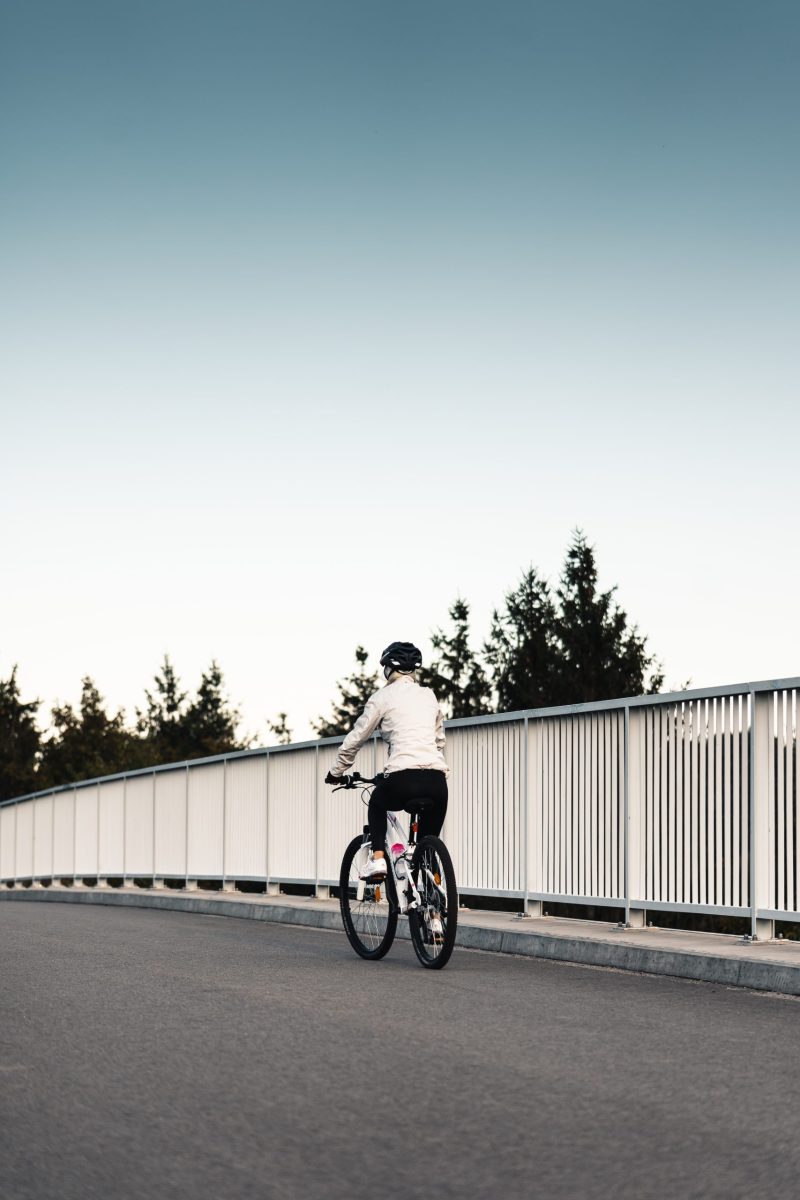
I first met Rose when she attended one of BikeMN’s first “Adult Learn to Ride” classes in 2021. The last time I saw her, she was completing her certification as a “League Cycling Instructor” with the League of American Bicyclists. I’m inspired by her journey from new rider to certified instructor, and I have never walked away from Rose with anything but a smile on my face.
I remember her determination when learning bike-handling skills, her budding interest in what active mobility advocacy looks like and her pure joy while cheering on the other participants. Her effervescence is unparalleled, and it comes through when she talks about gender equality.
“I advocate for women and underrepresented groups in the tech industry. I understand how crucial it is to create safe, welcoming and accessible spaces,” Rose explains. “Being part of a diverse community, we can create opportunities that provide access, foster independence and nurture a sense of belonging for everyone. Together, we can make a meaningful difference in one another’s lives.”
Rose didn’t learn to bike as a kid, and for a long time she felt that cycling just “wasn’t for me,” but when she did finally learn to ride, it unlocked a sense of freedom she didn’t know she could access. Being mobile, for Rose, is about so much more than getting from point A to B. It’s about “building confidence, making connections and enjoying the movement.”
This is a story I hear often — that biking, taking transit and learning safe pedestrian skills just “aren’t for” a person who identifies as FTW (femme/trans/women). We have this idea that our bodies need to fit the bike or society, when in reality it’s the opposite.
Rose is a living example of what it means to learn that we deserve to get around safely, and the role gender plays in how we do that is not lost on her: “Gender significantly influences our experiences in public spaces, often in ways that others may not notice,” she explains. “It is essential to recognize that women and gender-diverse individuals typically face unique safety challenges, particularly concerns about harassment.”
Lack of sidewalks, cracked or uneven walkways, notoriously unsafe “sharrows” in place of more practical bike infrastructure, dimly lit bus stops: These are all poor substitutions for designs that actually prioritize safety, especially of FTW folks. As Rose says, “the existing infrastructure may not always prioritize the safety of these groups.”
Talking to Rose has me reflecting on what these disparities communicate: “Look, we’ve got a sidewalk. Sure, it’s cracked and not wide enough for a mobility device or a stroller, but you asked for a sidewalk and here it is. Your safety is secondary.” It’s simply not enough! To combat this bias and inequality, Rose stresses the importance of inclusive and welcoming spaces, open conversation about challenges and celebrating the joy that the freedom to move provides us.
To Rose, an auntie is a nurturer, protector and cheerleader, and they needn’t be middle-aged or older to qualify. Further, an auntie is “someone who alleviates the intimidation that can accompany the journey.” Rose considers many of her friends her “bike aunties” because of the support they’ve given her while building her biking skills.
Rose is an advocate for inclusion in the IT field as well as active mobility. As an IT professional, she works to foster the next generation of technology leaders, supporting underrepresented individuals as they navigate their entry into the IT field.
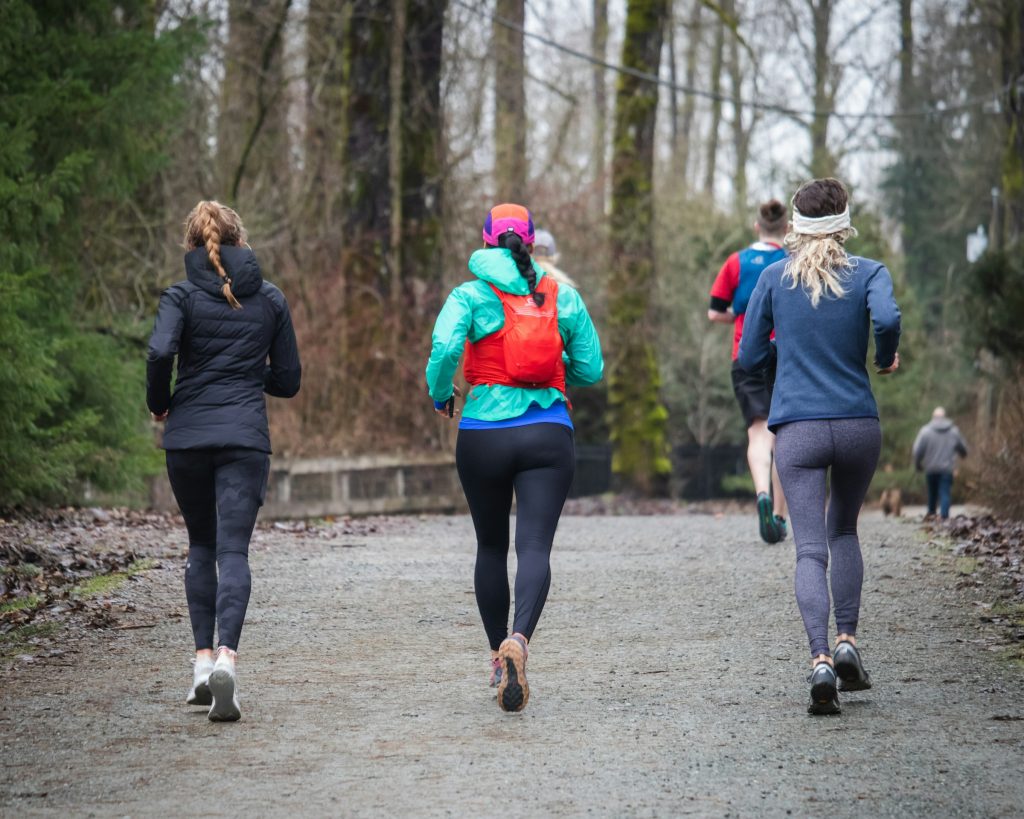
She has also added running to her growing list of hobbies, recently completing her first 5K. “It was my first official race,” she said, “and I can’t wait to do more!” Since we first talked, she’s completed a few 5Ks (3.1 miles), a 10K (6.2 miles) and a 10-mile race. “Each has been transformative,” she told me, “as it has required me to pull from a different bucket, whether it is digging deep and focusing on my why or being grateful for the privilege to move.”
Laura Groenjes Mitchell: Minneapolis
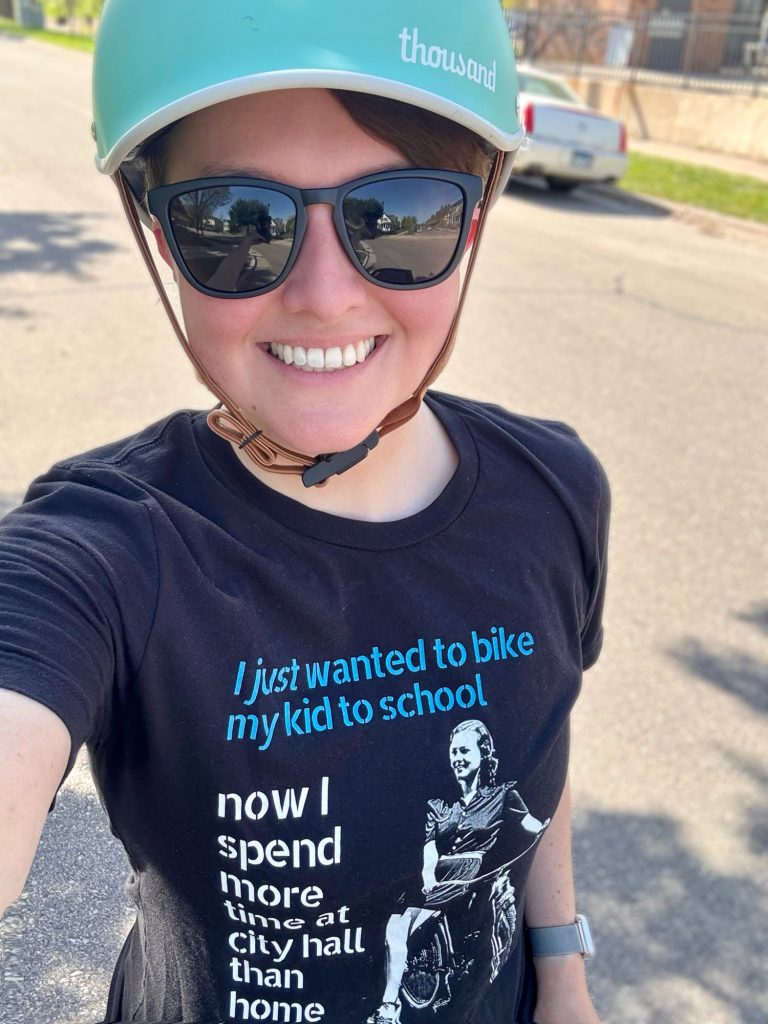
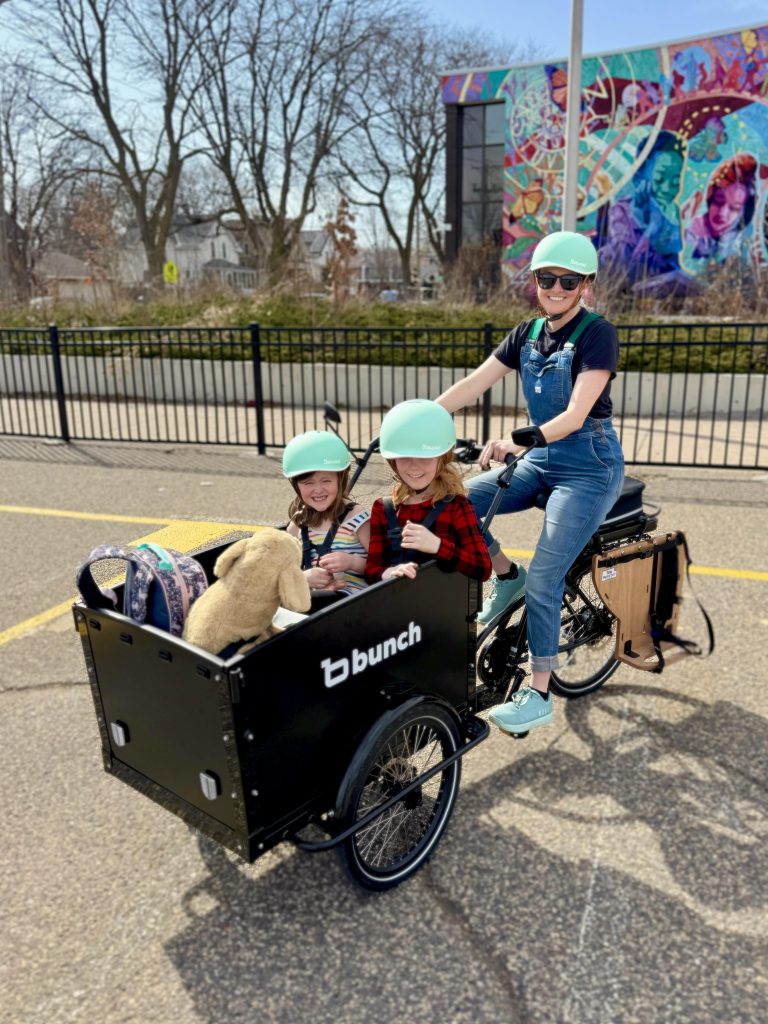
If you’re into active transportation “hot takes” and social commentary about Minneapolis, then you likely already know Laura. She’s a parent, educator, advocate and writer living in South Minneapolis with her wife and two kiddos (whom she totes around in a Bunch cargo bike).
Laura has the energy and intelligence of someone you just want to know. I had admired Laura’s takes on active transportation issues in Minneapolis for a while before finally meeting her in 2023. She loves living in an area where she can bike, walk and take transit easily, and she works fiercely to preserve and advance those rights. “There’s so much pressure to raise your family the ‘right’ way through what we see in the media,” she says. “Oftentimes, the better place to have kids seems to be the suburbs, but I want parents to know that you can raise your family in urban areas and that there are so many perks to living in a walkable community.”
Laura grew up in the suburbs and had to drive or be driven everywhere she wanted to go. “I just thought: That’s how America is, you drive everywhere,” she says, “but I went to college in St. Peter and my mind was blown!”
Living in a community of some 13,000 people with a Main Street of thriving businesses and a college campus on a hill nearby meant she could get around without a car. “I could walk or bike anywhere,” she says. She brought that mindset with her when she began commuting by bike to her first “professional” job in Colorado. “I could get some exercise, save money [to pay off my student loans] and see my city in a whole new way!”
Laura cares deeply about everyone’s right to get around safely, and she recognizes the pitfalls of current infrastructure and street design. “It is a mistake to assume that everyone has the same experience getting around as does a cisgender man,” she says, referencing that street and city designs are largely by men for men. For example, women with children will often “trip chain” — making multiple stops in a single trip to pick up kids, stop at the store, go to school. All of that is more difficult if you’re taking transit or traveling by foot.
“Gender presentation is just such a critical factor for so many of us getting around,” Laura told me. I asked whether her gender ever was a factor in the way she is treated when out on her bike.
“I really wish my answer was no,” Laura says, “but I’ve had too many close calls. When I’m in stealth mode in all my winter gear, I look more like a man. I get so much more room when people pass me in their cars compared to when I’m in more so-called feminine clothing. It’s wild!”
To Laura, an auntie feels like a mix of a caretaker and a friend, someone to learn from. She’s a mentor with whom you also feel safe enough to share your experience. “You know, someone who has been in the active mobility space and has all the skills and knowledge I want to learn from,” is how she puts it.
Laura sent me an initial list of 14 folks she considers an “auntie of active mobility.” In our conversation, she highlighted author Melissa Bruntlett, a Dutch urban mobility activist and co-founder of Modacity, a creative agency supporting human-centered urban design. “She does so much in the active transformation space,” Laura told me, “especially for FTW folks and other areas examining intersectionality.”
In her spare time, Laura loves to hang with her kids and wife, biking and walking to neighborhood places as a family. She also has a 3-year-old sourdough starter from which she still bakes bread.
Laura is an avid reader, especially of books about active mobility, and her recommendation list could rival Oprah’s. Some recent favorites:
- “When Driving is Not an Option” by Anna Letitia Zivarts (Island Press, 2024), who visited Minnesota last January at the invitation of BikeMN.
- “Curbing Traffic” by Melissa Bruntlett (Island Press, 2021), the aforementioned urban mobility activist.
- “Invisible Women: Data Bias in a World Designed for Men” by Caroline Criado-Perez (Chatto & Windus, Abrams, 2019), which exposes how data bias disadvantages FTW folks.
As if all that weren’t enough, Laura is the board chair at Our Streets and cofounder of the Minneapolis Cargo Bike Library, which experienced a recent bike theft. Read more about the theft via the Minnesota Star Tribune, listen to Laura’s interview on the Streets.mn podcast and donate to the recovery fund here.