
Metro Transit makes schedule changes four times a year, referred to in-house as “picks.” The process, governed by the drivers’ union contract, has the operators pick their work on the basis of seniority. Most picks are intra-garage; however, once a year Metro Transit holds a “system pick” allowing drivers to move between garages. Alongside sorting out work assignments, the picks are timed to address seasonal service changes.
The big news from the most recent (June 14) schedule change is the replacement of the historic streetcar and current bus Route 21 Selby Avenue-Lake Street with the B Line BRT (Bus Rapid Transit) and a pair of replacement local routes.
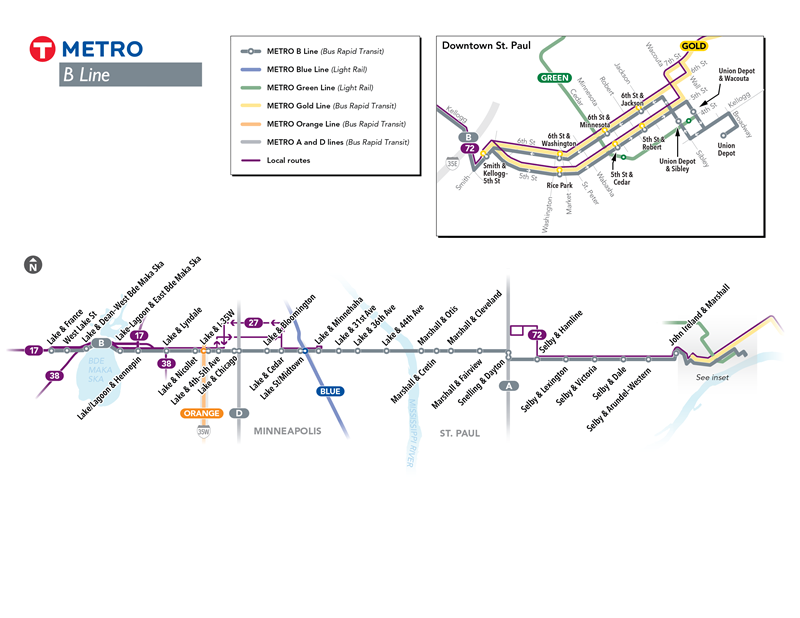
The Selby-Lake line has been around, largely unchanged, since 1907. It has been a heavily patronized workhorse; however, from a combination of traffic congestion and stops at almost every block across south Minneapolis, it has also been an agonizingly slow trip — one that I’ve personally avoided. For its historical importance to the City of Minneapolis, the route is immortalized as its own character in Kevin Kling’s play “21A.”
The B Line now extends beyond the traditional Uptown terminal so it can feed the Green Line light rail extension, opening in 2027. In the process, it also brings more service to the cluster of high-rise apartments around the planned West Lake Street Green Line LRT (Light Rail Transit) station. However, while the area will be more connected, the last mile to the Lake Street and France Avenue terminus is already a notorious afternoon bottleneck that may throw the line off schedule.
That’s a design mistake, but it can be corrected. An alternative path would loop past the West Lake Street Green Line LRT station via Excelsior Boulevard, Abbott Avenue, Chowan Avenue and 32nd Street. That route has much less traffic but is currently closed for construction. I hope Metro Transit will make the change when the roads reopen.
Speeding Up the Bus
I have to give the City of Minneapolis and Hennepin County a Profile in Courage award for carving 7.5 miles of all-day bus lane out of Lake Street and Lagoon Avenue. That’s huge. It’s bold, given there’s only so much street width, but necessary to make on-time performance reliable with Lake Street’s traffic backups. Here are the bus lane locations:
Eastbound:
Excelsior Boulevard to Dupont Avenue
Blaisdell Avenue to Second Avenue
Portland Avenue to Elliot Avenue
East River Parkway to Otis Street
Westbound:
On the Lake Street bridge
47th Avenue to 27th Avenue
21st Avenue to Excelsior Boulevard
Traffic signal priority (TSP)
For those unacquainted with it, the TSP system recognizes an approaching bus or train and either shortens a red light or holds a green light longer. This is not the same as signal preemption, which flips the signal to green regardless of where it is in the cycle. Emergency vehicles get preemption, as do Blue Line trains along Hiawatha Avenue. Green Line trains have preemption at all but a handful of intersections, receiving TSP alongside Bus Rapid Transit lines at the rest, which does not guarantee a green light, but increases the probability of a green. The result is a faster trip overall.
I was pleasantly surprised — no, astonished — to discover that all but three of the intersections west of downtown St. Paul are employing transit TSP. That’s 61 intersections in all. The only exceptions are downtown St. Paul, Snelling and Selby, Snelling and Marshall and, in Minneapolis, Lake and Chicago. Furthermore, it was a surprise to learn that the TSP in St. Paul, and west of Minnehaha Avenue in Minneapolis, has been active for Route 21 since mid-2024.
In addition to TSP, the B Line gets the benefit of queue jumps at several intersections. A queue jump lets the bus go ahead of other traffic when merging from a stop or a bus lane. Queue jumps use a white bar signal (like LRT) so other traffic does not get confused.
The intersections with queue jumps are:
Lake Street and Dupont Avenue, eastbound
Lake Street and Elliot Avenue, eastbound
Marshall and Cretin avenues, eastbound
Marshall and Fairview avenues, eastbound
The B Line vs. Route 21
So, how will the B Line compare with Route 21, which is notoriously slow?
- Between downtown St. Paul and 27th Avenue South in Minneapolis, the frequency will improve from every 15 minutes to every 10 minutes.
- From 27th Avenue to France Avenue, performance will get a little worse. Route 21 buses alternate every 6 and every 9 minutes; the B Line will arrive every 10 minutes.
- Stopping only every half mile or so, the B Line will generally travel faster. For anyone west of Snelling headed toward downtown St. Paul and vice-versa, eliminating the jog up to University Avenue should save 5 minutes, but at the cost of losing the transfer connection to the Green Line, as well as access to everyday shopping at Cub Foods, Target and other retailers on or just off University.
Previous improvements to Route 21 over the last year, such as bus lanes and TSP, make the comparison with the B Line look less impressive.
The time savings vary greatly by time of day and day of week from changes in traffic conditions and ridership. Note in the table below how on Saturday and Sunday, the B Line saves no time heading west from downtown St. Paul to Hamline Avenue; yet, saves as much as 7 minutes (29 percent of travel time) at midday during the weekdays. From Snelling Avenue all the way across Lake Street, the savings range from 3 minutes (6 percent of travel time) on Sundays to 9 minutes (16 percent of travel time) in the weekday PM rush hour. The biggest time savings go to any trip that previously included the jog to Snelling and University. Traveling the length of the line yields a range of time savings of 11 minutes (14 percent of travel time) on a Sunday to 21 minutes (22 percent of travel time) in the weekday PM rush hour.
Despite the faster times, the most congested segment from Hiawatha to Hennepin will only average 9 mph. For comparison, on most center-city local routes, 12 mph is typical.
B Line compared with Route 21
| Segment | Time period (westbound) | Route 21 minutes westbound | B Line minutes westbound |
| St. Paul Union Depot to Selby-Hamline | Weekday AM peak | 23 | 19 |
| St. Paul Union Depot to Selby-Hamline | Weekday midday | 24 | 17 |
| St. Paul Union Depot to Selby-Hamline | Weekday PM peak | 27 | 23 |
| St. Paul Union Depot to Selby-Hamline | Saturday | 22 | 22 |
| St. Paul Union Depot to Selby-Hamline | Sunday | 22 | 22 |
| Snelling to France Ave | Weekday AM peak | 43 | 39 |
| Snelling to France Ave | Weekday midday | 50 | 45 |
| Snelling to France Ave | Weekday PM peak | 57 | 46 |
| Snelling to France Ave | Saturday | 49 | 44 |
| Snelling to France Ave | Sunday | 47 | 44 |
| Hiawatha to Hennepin | Weekday AM peak | 20 | 16 |
| Hiawatha to Hennepin | Weekday midday | 25 | 20 |
| Hiawatha to Hennepin | Weekday PM peak | 28 | 21 |
| Hiawatha to Hennepin | Saturday | 25 | 20 |
| Hiawatha to Hennepin | Sunday | 23 | 20 |
| St. Paul Union Depot to France Avenue | Weekday AM peak | 73 | 60 |
| St. Paul Union Depot to France Avenue | Weekday midday | 83 | 67 |
| St. Paul Union Depot to France Avenue | Weekday PM peak | 94 | 73 |
| St. Paul Union Depot to France Avenue | Saturday | 80 | 66 |
| St. Paul Union Depot to France Avenue | Sunday | 77 | 66 |
Local Service Replacements
The B Line bypasses the Route 21 jog via Snelling and University, so Selby Avenue residents can’t use it to access retail such as the University Avenue Target store or the connection to the Green Line to get to Minneapolis. The B Line also eliminated service to many of the local bus stops along Selby east of Hamline Avenue. New Route 72 was created to prevent these losses. It will run the old 21 route from downtown to Snelling and University every 30 minutes. It will also be through-routed with the old Route 70 to the Dayton’s Bluff neighborhood and the Sunray Transit Center, improving that segment from 60-minute to 30-minute service.
For local service, the new Route 27 will function as a replacement for Route 21, providing hourly service on Lake Street from Hennepin Avenue to Fourth Avenue. There it jogs north to 28th Street, reviving the original Route 27 crosstown service on 28th and 26th streets as far east as Cedar Avenue, then back to Lake Street, ending at 27th Avenue.
The original Route 27 was not well patronized, though, so I’m skeptical whether the new one will last long.
Frequency Improvements Elsewhere
Metro Transit has been able to hire more bus drivers and has been steadily increasing service. In several cases this involved restoring service that had been curtailed post-COVID. Highlights include:
- Route 2 Franklin Crosstown: Upgrade from 15-minute to 10-minute weekday service.
- Route 7 Plymouth-Minnehaha Avenue: Upgrade from 60-minute to 30-minute service. Rerouted from First Street in the North Loop and the Third and Fourth street pair downtown to all Washington Avenue, thus returning it to the historic streetcar routing.
- A Line and Route 10 Central Avenue: Upgrade from 15-minute to 10-minute weekend service.
- Route 54 from downtown St. Paul to Maplewood Mall Transit Center: New 30-minute Sunday service.
- Route 71 Concord Avenue to South St. Paul: New hourly Sunday service.
- Route 94 downtown-to-downtown express: New 30-minute weeknight and weekend service.
- Route 515 Southdale–Mall of America via 66th Street: Upgrade from 20- to 15-minute service.
- Route 542 American Boulevard: First time 30-minute midday service.
- A smattering of restored commuter express trips, including the revival of Route 860 Blaine to St. Paul.
- The temporary end-to-end combination of Route 23 38th Street Crosstown and Route 612 Excelsior Boulevard has been made permanent as the new appropriately numbered Route 38.
New Bus Lanes
In addition to the 7.5 miles on Lake Street for the B Line, the City of Minneapolis and Hennepin County have quietly been creating exclusive bus lanes where traffic congestion gets bad. As I mentioned above, the city deserves all sorts of credit for taking away mixed traffic lanes and giving them to transit.
The first was on Seventh Street through downtown from Chicago Avenue to First Avenue North. It’s currently used by the C Line, D Line, and Routes 5, 9, 22, 94, 355 and 363. The Network Now plan calls for upgrading Route 94 to BRT as an extension of the Gold Line.
What took me by surprise — a rather pleasant surprise — were the bus lanes in both directions through the notorious Hennepin-Lyndale “bottleneck,” between Dunwoody Boulevard to Douglas Avenue. I commuted on Route 6 for many years. During the afternoon rush hour we would turn onto Hennepin by the Sculpture Garden to find all three lanes backed up to Dunwoody Boulevard. It would take two long light cycles to make it to Vineland Place by Walker Art Center. Now it’s a clear shot and will really help the new E Line BRT, as well as Route 4. Thank you, Minneapolis.
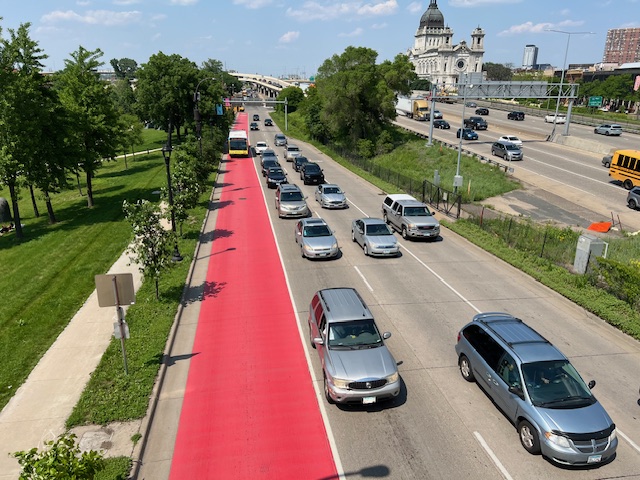
New bus lanes are being installed on the one-way pair of Hennepin Avenue and First Avenue Northeast through Old St. Anthony between Main Street and Central Avenue, benefitting the E Line and Routes 4, 61 and 824.
Last and not as good are the rush hour-only bus lanes on Hennepin between Franklin Avenue and the Uptown transit station. The portion of the bus lane south of 26th Street opened last year; Franklin to 26th is under construction. The problem is ensuring people do not park in the lane during the time it’s designated bus-only. All it takes is one illegally parked car per block to negate the lane’s utility, and it’s a never-ending problem.