Two transportation conversations may converge in transportation policy circles, stemming from efforts to rethink our car-oriented transportation system as aging interstates need to be replaced.
In cities like Minneapolis and St. Paul and across the country, communities are reconsidering urban highways that once divided neighborhoods and instead exploring removal and reconnection projects. The Minnesota Legislature has also moved toward redefining highways as multi-modal corridors in statute, allowing highway funds to support transit and active transportation alongside vehicles as highways are.
Outside of the urban core, the need to connect cities while reducing dependence on highways points to high-speed rail (HSR) as a potential solution. However, America’s HSR ambitions remain largely stalled, shown by examples in “Abundance,” the recently published book by New York Times opinion writer (and podcaster) Ezra Klein and The Atlantic contributing writer (and Plain English podcaster) Derek Thompson. Projects in California, Texas and elsewhere face massive costs, regulatory hurdles and the daunting challenge of acquiring continuous strips of land through already-developed areas.
A friend and I recently mused about the idea of bringing these two discourses together, asking the question, “as we rethink aging infrastructures that shape the way we move, would it be possible to build high-speed rail along existing highways’ right-of-way?”
Right-of-way refers to the strips of land, often wider than the actual roadway, that governments own to build and maintain highways. These corridors are carved through Minnesota and communities across the country. Today, they serve only the movement of cars and trucks.
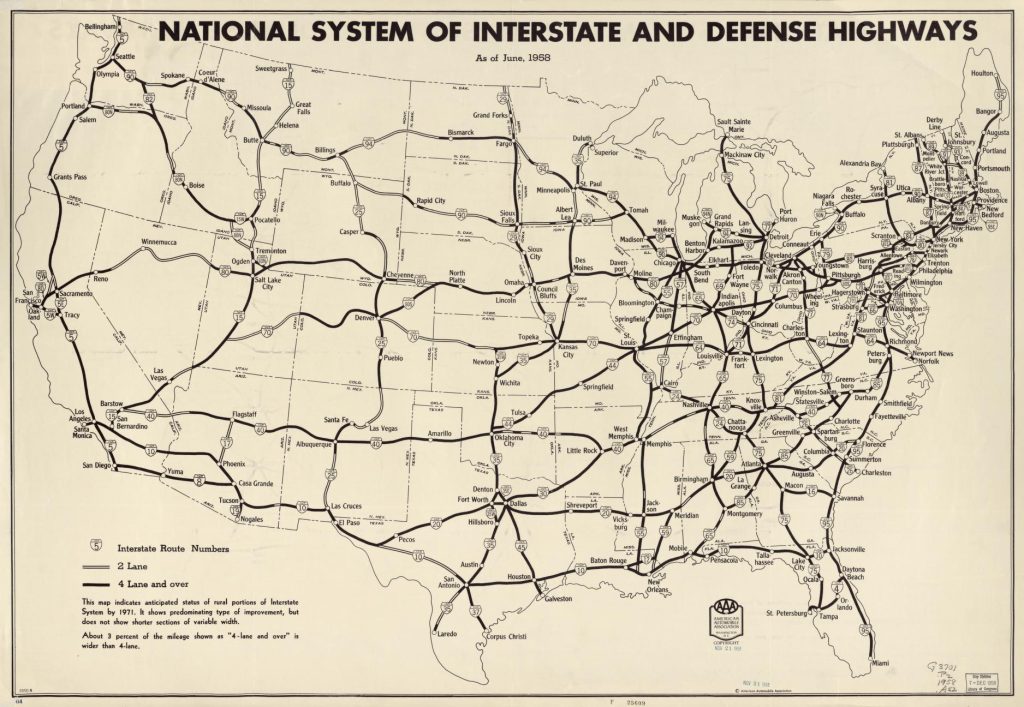
These corridors consumed enormous swaths of land at great cost — financial, human and environmental — when communities were divided by construction and productive land was transformed into asphalt serving cars and trucks.
Aging infrastructure, climate change and rising transportation costs demand we make better use of these transportation corridors. Building high-speed rail could be the answer to more efficiently and effectively connecting cities, potentially replacing some flights and car travel between neighboring cities in our largest and best-connected urban regions. On a broader scale, high-speed rail could afford us the convenience of interstates without the human and environmental costs.
A History of Highway Rail Studies
Building high-speed rail along highway corridors is not new from a logistical and theoretical standpoint.
A 1985 report commissioned by the Texas Department of Transportation evaluated building high-speed rail corridors along interstates to connect Texas’ major cities.
The report evaluated various human, environmental, economic and engineering realities of these highway corridors to define the feasibility of building the proposed rail system. It concluded that, from a technical standpoint, it would be feasible to construct a competitive high-speed rail system mostly within highway rights-of-way.


Similar studies also evaluated high-speed rail connections in other contexts, such as in Florida (connecting cities along the Florida Turnpike, I-4 and I-95), New York to Montreal (largely along I-87) and between Las Vegas and Los Angeles.
U.S. law sets out provisions for making highway rights-of-way previously acquired with federal funds available for mass transit projects, though largely at the discretion of state DOT’s and Federal Highway administrators. This provision both allows for the construction of more traditional facilities, including high-occupancy vehicle (HOV) lanes along highways, but also facilitates the repurposing of highway rights-of-way to include rail and other forms of transit.
Four decades since these studies were completed, however, none of these corridors have high-speed rail connectivity, with the exception of Las Vegas and Los Angeles, where a privately owned rail project is underway to connect the two cities.
Further Investigation why reveals both the promise and the pitfalls of this approach, and why countless city pairings — like between the Twin Cities and Chicago, for example — still rely on traditional rail, flying and driving to connect.
Real-World Obstacles
A variety of practical concerns with such a system make this only a partial solution to our lack of high-speed rail.
According to the High Speed Rail Alliance, a rail industry group, one of the biggest challenges with highway-aligned high-speed rail is the need for long, straight sections of track and wide median areas to support construction HSR.
The Texas study illustrated this clearly: Alignments that stayed entirely within highway corridors (Options A and B in the images below) required significant speed restrictions, while those that departed from the highway where needed (Option C,D, and E) could maintain higher speeds but required additional land acquisition.


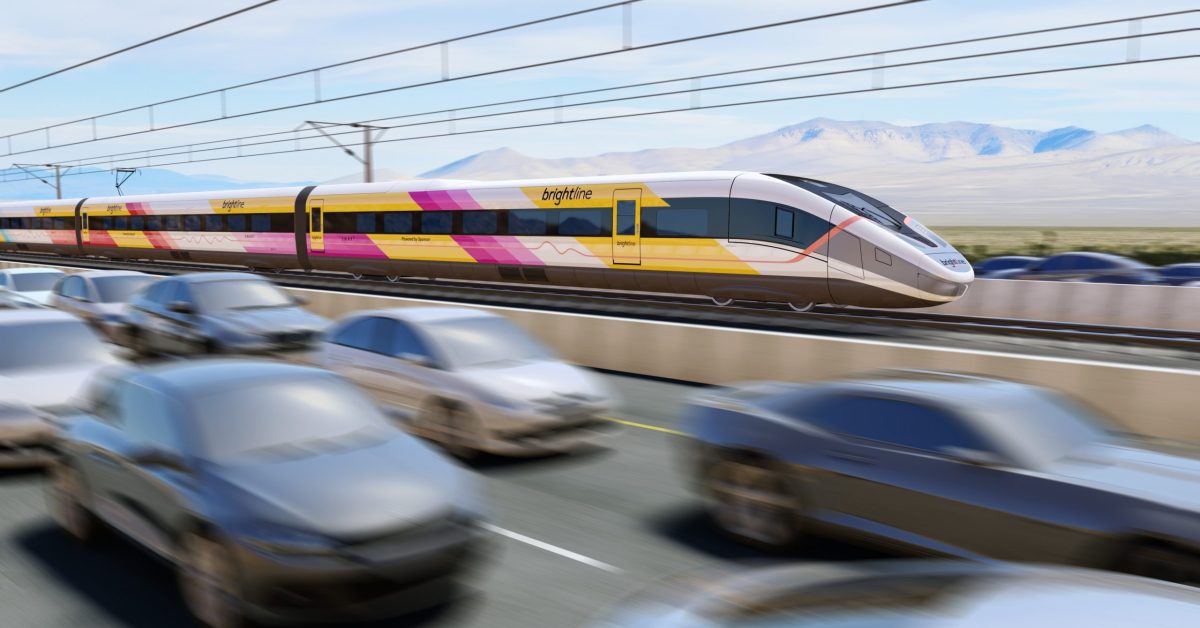
This isn’t necessarily a deal breaker. Some trains, like the Brightline West — a privately owned, future rail line under construction from Las Vegas to Los Angeles — are moving forward with a highway-aligned high-speed rail project along I-15, despite these limitations. Developers are mitigating these challenges by planning for slower travel speeds and building a single track with points for trains traveling in opposite directions to pass each other.
Given that highway-aligned rail has been technically feasible since at least 1985, why does Brightline West stand alone as the only project actually being built? The answers reveal deep structural challenges in American transportation planning that continue to put cars at a structural advantage when prioritizing which infrastructures to build.
A Reality Check
Even if building completely within highway land, building high-speed rail there would still be an administrative, engineering and construction mega-project on nearly unparalleled scale, one that would take enormous resources and political will. In our current environment, most of those ingredients are missing, meaning high-speed rail — along a highway or not — connecting cities in Minnesota or beyond is far-fetched.
Regardless of the type of mass transit along highways, some issues remain the same.
Federal law also still prioritizes the ability to expand highways rather than invest in transit on highway land, allowing transit construction using highway rights-of-way only if projects won’t “impair future highway improvements or the safety of highway users.” Many state transportation departments still interpret “improvements” as endless highway expansion, potentially limiting transit development.
Perhaps pursuing smaller-scale investments in inter-city rail and bus within Minnesota is more practical, especially as the Legislature continues to make progress toward reimagining the transportation purposes highways can serve, including to move transit, bikes and pedestrians.
On a basic level, any transit, whether it be high-speed rail or other non-car alternatives along highways, faces a fundamental challenge: the trap of expanding highways at the same time, making transportation alternatives less competitive.
It’s not necessarily uncommon to see mass transit run along highway corridors, especially in the Twin Cities, with the Gold, Orange and Red BRT lines running parallel or within the median of highways. More similar BRT corridors are also in the works, like the F Line project that will improve state highways 47 and 65 in the process.
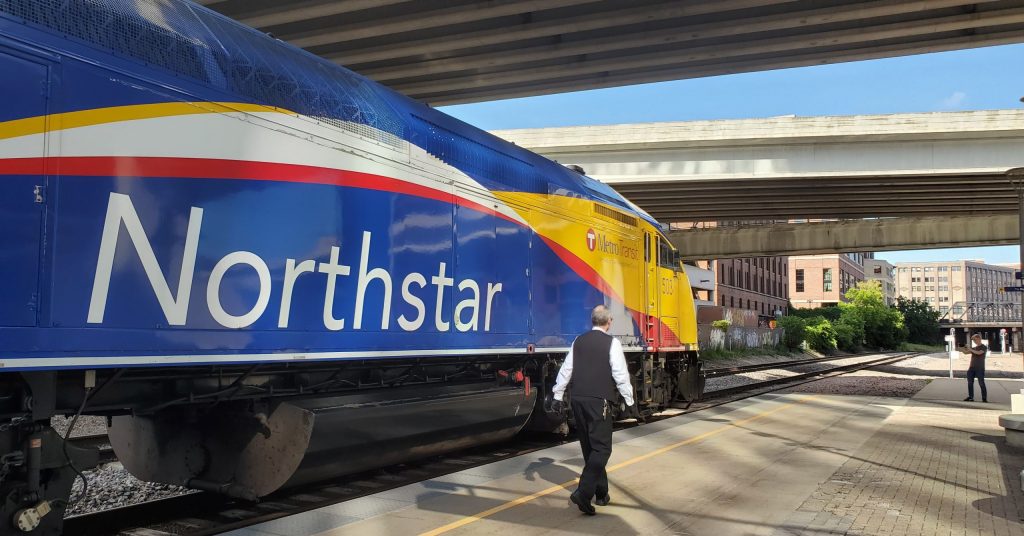
Though it seems logical to improve both transit and a highway at once, making driving easier by expanding or improving a highway while introducing transit alternatives can undermine transit’s competitiveness. This phenomenon has been seen with Minnesota’s soon-to-be-discontinued Northstar Commuter Rail, which was introduced alongside major improvements to parallel Highway 10.
Perhaps considering road diets alongside rail investments would solve this problem, but could present political pitfalls for rail advocates, in the face of entrenched pro-highway interests.
America’s highways represent an enormous sunk cost — financially, in divided communities, consumed land and environmental damage. While we work to revitalize and reconnect communities within cities to repair harms and undo these impacts, we should also consider how the non-urban interstate sections can transform from single-purpose car corridors into adaptable multi-modal corridors with multi-modal transportation alternatives. In that spirit, I make the case for considering highway-aligned high-speed rail.
This solution is no silver bullet. It faces real technical constraints, political obstacles and competition from entrenched interests. But, in an era demanding creative infrastructure solutions, it offers one path forward: retrofitting what we’ve already built while moving toward a more sustainable, equitable transportation future. Along with removing and rightsizing freeways in urban centers, these two solutions could work together as we build a transportation system for the future.
Editor’s note: “Street Views” appears in Streets.mn twice monthly. Respond to columnist and board member Joe Harrington directly at [email protected]. You may also comment at our Streets.mn pages on Bluesky and Facebook.