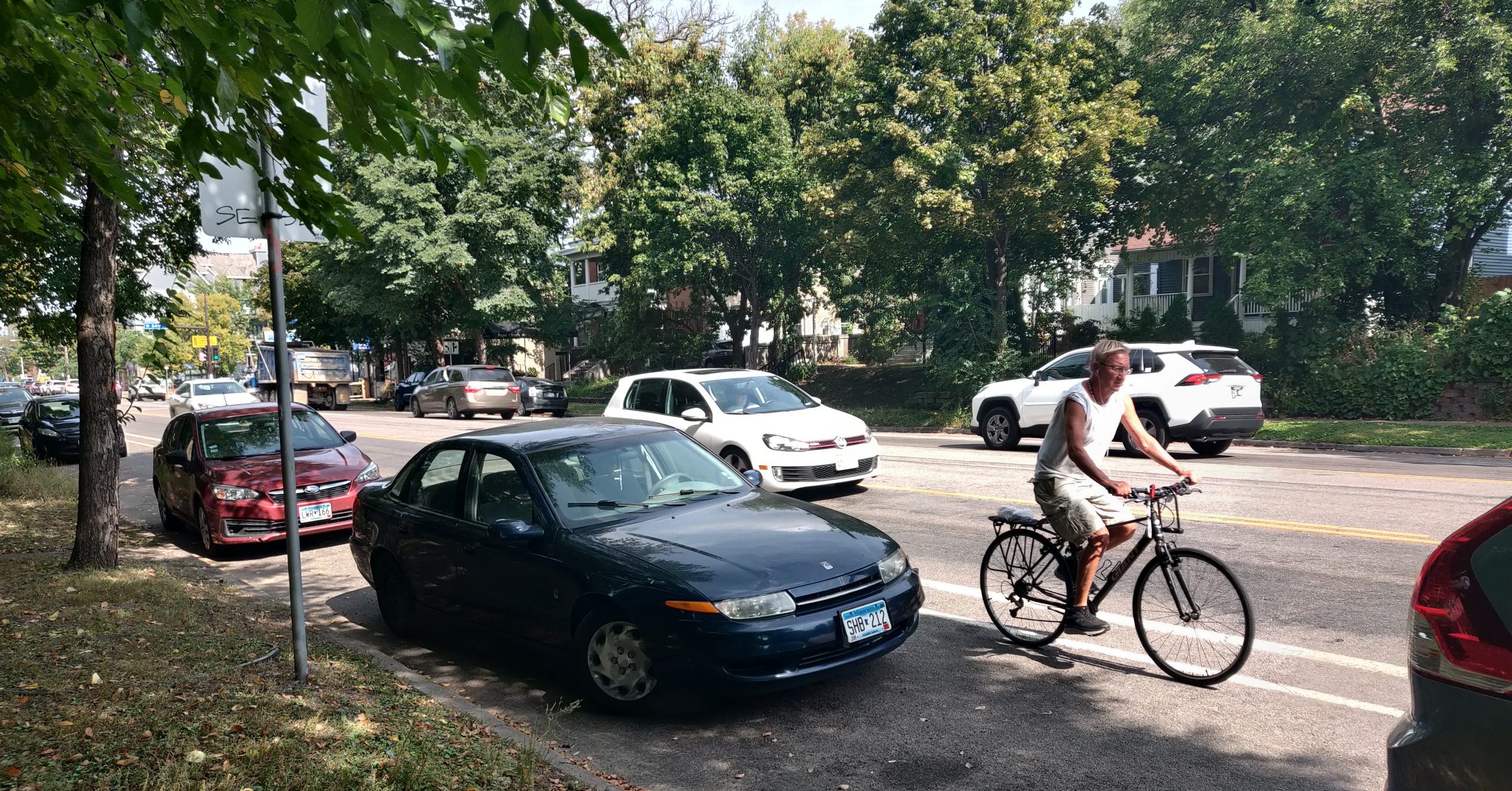
In 2016, the City of Minneapolis adopted its first Complete Streets Policy. Between the approval of that initial version and the most recent update in 2021, the city also passed its Vision Zero Action Plan, 2040 Plan and Transportation Action Plan, all of which set ambitious goals for reducing car dependency and making our city safer and more accessible to people who use other modes of transportation.
Despite this, there have been many obstacles to actually implementing these policies, with local businesses routinely opposing complete street projects. But is their opposition warranted? Before we can answer that question, let’s clarify what we mean by “complete street.”
What is a complete street?
A complete street is one that’s designed and implemented with all users in mind, including pedestrians, bicyclists, motorists and transit users. Moreover, this should include people of all ages and abilities, making it easy for children and people with limited mobility to move through their neighborhoods safely.
Elements of a complete street can include wider sidewalks, separated bike lanes, street trees, transit lanes, better bus shelters, benches and improved lighting, along with lower speed limits and physical traffic calming elements such as speed bumps, chicanes, pinch points and raised sidewalks. Because right-of-way is constrained, new features like bikeways, bus lanes, and street trees often replace street parking. (More on this in a moment.)
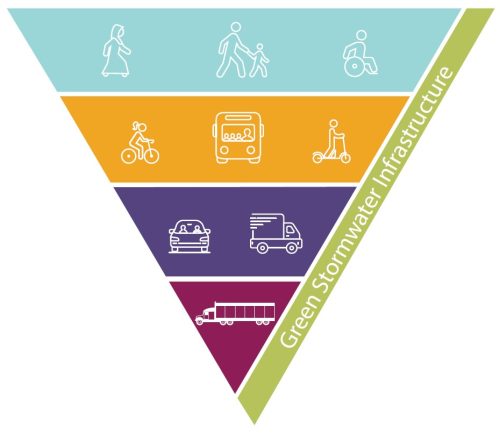
Complete streets solve many of the problems created by vehicle-centric design. They reduce rates of injury, improve air quality and its impacts on public health and can even reduce congestion and improve travel times for all modes of travel, through both improved traffic flow management and by converting more car trips to other modes.
Furthermore, complete streets provide the additional public health benefits of promoting active transportation and reducing noise, which is itself a major contributor to many health issues. And, by dramatically reducing the amount of heat-absorbing pavement and increasing tree canopy and other sources of shade, a complete street can even reduce the urban heat island effect and lower the temperature in the city.
The business case for complete streets
The most common argument in opposition to these kinds of improvements revolves around the potential loss of street parking, which business owners routinely claim will have a devastating effect on their bottom line and possibly even put them out of business. However, in contrast to this apocalyptic rhetoric, the benefits of bicycle lanes to businesses — even at the expense of street parking — are well documented, with businesses consistently seeing increases in their revenue when a new bike lane is installed.
How can this be? For one thing, business owners — who often drive themselves — consistently overestimate the share of their customer base who arrive by car, often by enormous margins. In one notable case, a 2012 study conducted in Los Angeles (of all places!), the majority of business owners on a corridor with bike lanes estimated that over half of their customers drove there when, in fact, the actual number was less than 30%, and perhaps as low as 15%.
The overwhelming majority of data shows that while bicyclists generally spend less per shopping trip, they tend to make more return visits and thus end up spending more overall. While this can be attributed to many factors, a few stand out. First, because bicycles are best suited for traveling relatively short distances, cyclists generally shop closer to home. Second, because they spend less on things like gas and vehicle maintenance, they have more money to spend. Finally, people spend more when they’re in a good mood — and riding a bike makes you happy.

The benefits to businesses aren’t just on the sales end either. Convenient access to transit has been shown to improve employee retention and reduce the costs associated with turnover.
“Well and good,” you may say, “but I drive a car to get around. Isn’t all this going to make my life harder?” To answer this question, consider the Netherlands, which, in addition to being rightfully recognized as a world leader in bicycling infrastructure and culture, has also been identified as home to the world’s happiest drivers, “outrank[ing] all other countries with the least amount of traffic.” This should come as no surprise, given that about half of all trips in the Netherlands are taken by some mode other than driving. Fewer cars on the road means fewer people to contend with for space. Everyone wins.
A brief note on mitigating construction impact
The fact that we drive vehicles on our roads at all means that they will inevitably need to undergo reconstruction from time to time, and it’s not uncommon for businesses to lose revenue during construction periods. A practical solution would be for the city or county to offer financial assistance to businesses whenever access to their location is disrupted. This can take the form of a tax credit, low- or no-interest loan, or direct payment — an idea the city of San Antonio is already implementing.
Case Study: Bloor Street, Toronto
A common argument against complete streets is that, while bike lanes may be good for business in those cities, they won’t work here, with our long, cold, snowy winters. But this, too, ignores the fact that the feasibility of winter cycling in harsh climates is purely a matter of policy.
For an example relatively close to home, we turn to Bloor Street, an east-west arterial that cuts across the southwestern portion of Toronto — and, more specifically, a seven-block commercial stretch in the Bloor West Village neighborhood, where in 2016, parking was removed to install bike lanes. Even before this redesign was implemented, Bloor Street carried an average of 3,300 cyclists per day. Following the installation, that number increased by 56% within the project area and 49% along Bloor Street as a whole. Despite this increase, “safety improved for all users with a 44% decrease in all conflicts.”
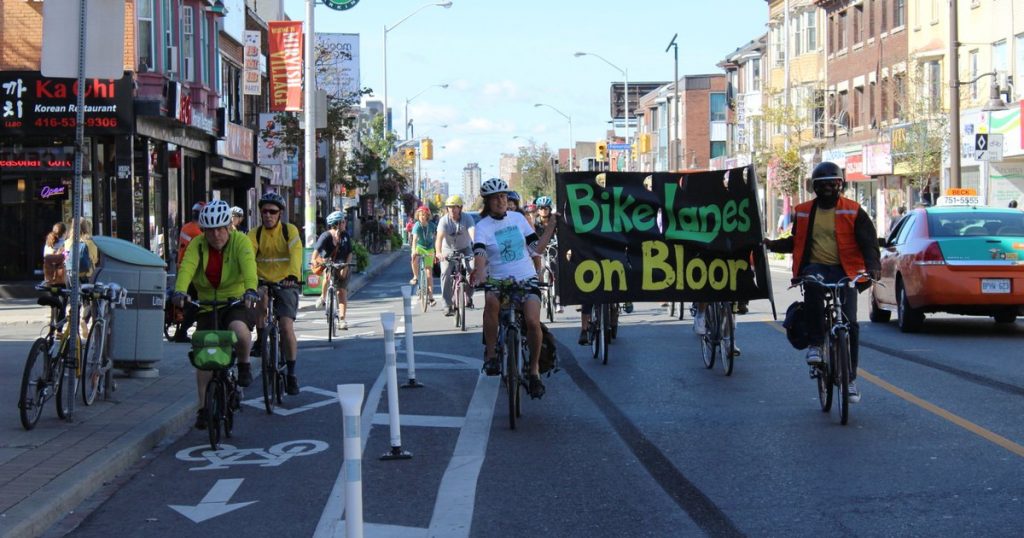
While the new configuration initially resulted in increased vehicle travel times, much of that increase was mitigated in the ensuing months by retiming traffic signals along the corridor. And despite the usual misgivings from businesses affected by the project, a 2017 study conducted by the City of Toronto in partnership with the Bloor Annex Business Improvement Area (BIA) and Korea Town BIA found that “most merchants reported an increase in the number of customers, most visitors reported spending more and visiting more frequently and […] vacancy rates are stable.”
But most importantly, as David Simor, director of The Centre for Active Transportation, emphasized in a 2022 interview with Doug Schairer for Streets.mn, “making streets better for people should be reason enough to move forward without having to prove anything else.” Indeed, the Bloor Street reconstruction has resulted in safety improvements for all road users, including drivers, with the number of conflicts between vehicles actually seeing the greatest improvement — an almost unbelievable 71% reduction.
In a timely development, Ontario Premier Doug Ford recently put forward legislation that would effectively give the provincial government veto power over any new bike lanes in Ontario cities. He has even stated that he intends to remove existing bike lanes, including those on Bloor Street. In response, not only has the Toronto cycling community turned out in large numbers to oppose this action, but Bloor Street business owners are also speaking out in favor of keeping the bike lanes, with the Bloor Annex BIA saying that removing the lanes would be “disastrous to the neighbourhood.”
The Future of Lyndale Avenue
In recent years, a similar fight has been going on around the main commercial stretch of Lyndale Avenue South, which is scheduled for a top-to-bottom rebuild starting in 2027 — its first in about 90 years. What follows is a brief summary of the project, concluding with action steps readers can take during this critical moment to push for a true “complete street” redesign.
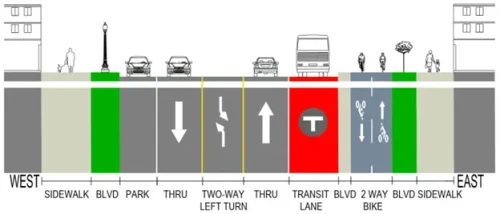
Planning for this project officially began in 2023, and during the first two years, the county held three open house events to develop designs and gather feedback, with the last of these taking place on October 23rd of last year. You can still view the previous design layouts on the Hennepin County website, including the orange option, which featured both dedicated transit lanes and a fully separated bike path — all at the cost of only a few parking spaces relative to the blue and purple options, which only included one or the other. Attendees of one open house expressed a clear consensus that preserving on-street parking was among their lowest priorities.
Then, on August 14th of this year, the county suddenly announced that they had landed on a final design. Notably, this design deviated from any of the earlier proposals by featuring a “shared use path” along the east side of the corridor, the impracticality and hazards of which has already been detailed in this publication.
The comment map for this design currently lists 20 pages of overwhelmingly negative feedback, and this consensus was further reinforced during the final open house that was held on September 10th, where well over a dozen attendees wore orange to signify their support for the orange option — an initiative announced less than 24 hours before the event — and many more expressed their dissatisfaction to the project team. From my own observations during the event, at least one project team member shared their own frustrations, noting that their job was only to turn directive into design, and that they would not have chosen this design had the decision been theirs to make.
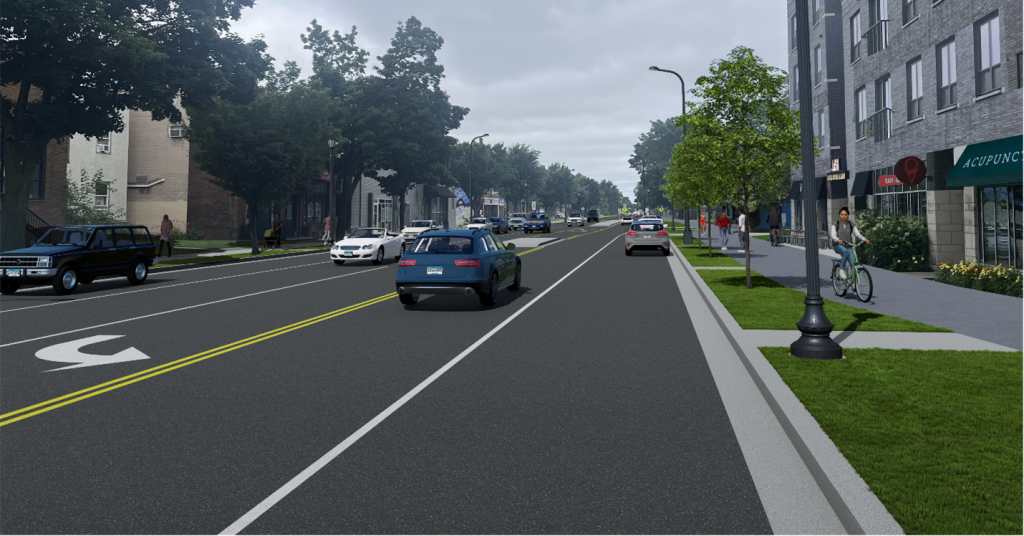
The general consensus among supporters of a less car-centric Lyndale has been one of deep frustration, and a feeling that the overwhelming preference of the community is being ignored in favor of the (misguided, as demonstrated above) concerns of a small number of very vocal business owners.
The project will go before the Minneapolis City Council Climate & Infrastructure Committee as early as October 30th for a vote of approval which, if passed, will then go before the full council at their next meeting. In the meantime, supporters of the community preferred option are encouraged to contact the members of the committee (Katie Cashman, Emily Koski, Michael Rainville, LaTrisha Vetaw, Jamal Osman and Jason Chavez), and tell them why you support a Lyndale Avenue that accommodates all modes of transportation in equal measure, instead of doubling down on car dependency for another 70+ years.
Other individuals worth contacting include Josh Potter, the Lyndale reconstruction project lead; Hennepin County District 3 Commissioner Marion Greene; and Ward 10 councilmember and Minneapolis City Council Vice President Aisha Chughtai. You may also consider attending the Climate & Infrastructure Committee meeting when the project is brought forward — watch the schedule for the latest information — as well as the subsequent full council meeting.
You can subscribe to email updates through the Hennepin County project page, as well as through Move Minnesota’s Livable Lyndale initiative.
Streets for People
Complete streets offer the possibility of transforming mobility options and making it accessible, even enjoyable, for people of all ages and abilities to move around the city with or without a car. They produce benefits across the board — to drivers, pedestrians, transit users, bicyclists, residents as well as business owners. It is impossible to overstate the positive effects they have on the environment, public health, and local economies. Nevertheless, change will always face pushback, and complete streets are no exception. That’s why it’s crucial to be aware of street projects happening near you and let decision-makers know what kinds of changes you support. By staying engaged, we can transform our city for the better, one street at a time.
Editor’s Note: This article was originally published by Our Streets. You may find the original article by clicking here.