In early September of this year, the city of Brooklyn Park adopted a vision to guide the development of over 700 acres of undeveloped land in the northwest corner of the city. This came after many months of consultation with planners and community members since the fall of 2024.
Akin to other large-scale development projects around the Twin Cities metro, like the Highland Bridge development in St. Paul, the Northwest Growth Area Plan will help guide the construction of the city’s Biotech Innovation District established by the Minnesota State Legislature.
This ambitious plan stems from economic and tax base issues that Brooklyn Park currently faces today. However, the plan received some pushback from neighboring city leaders of Champlin and Maple Grove. Despite this, Brooklyn Park pushed to bring forth a vision that could transform the city and my hometown forever.
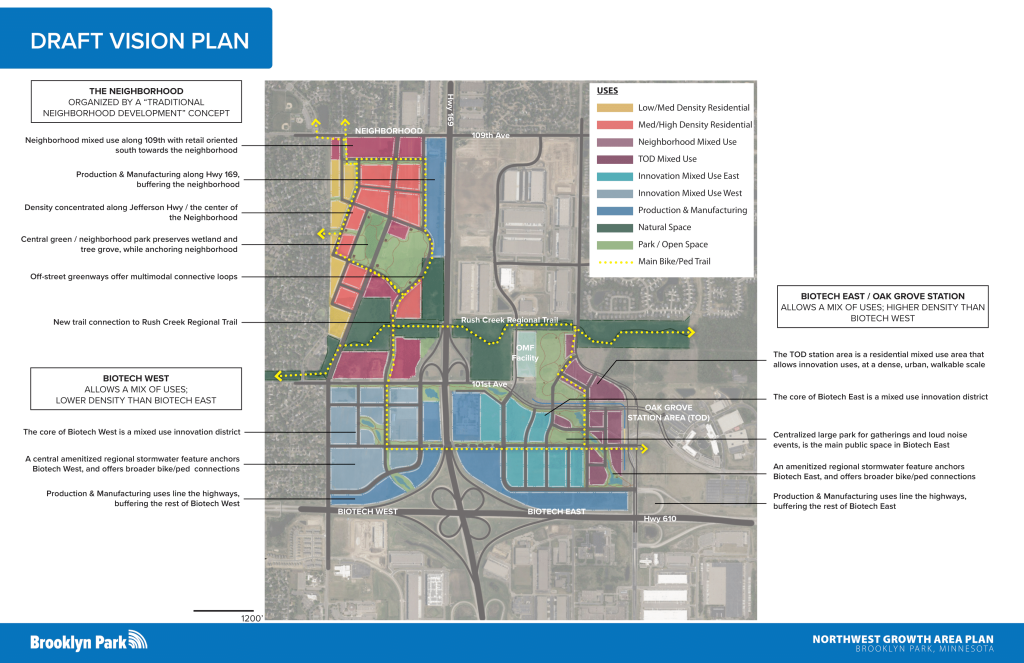
Located near State Highway 610 and U.S. Highway 169, the designated Northwest Growth area could draw in as many as 10,000 new biotech and manufacturing jobs, alongside new housing and commercial spaces near the proposed METRO Blue Line light rail extension. This could help transform the economy and tax base of not only Brooklyn Park, but the entire region.
A Glimpse of Challenges Brooklyn Park Faces Today
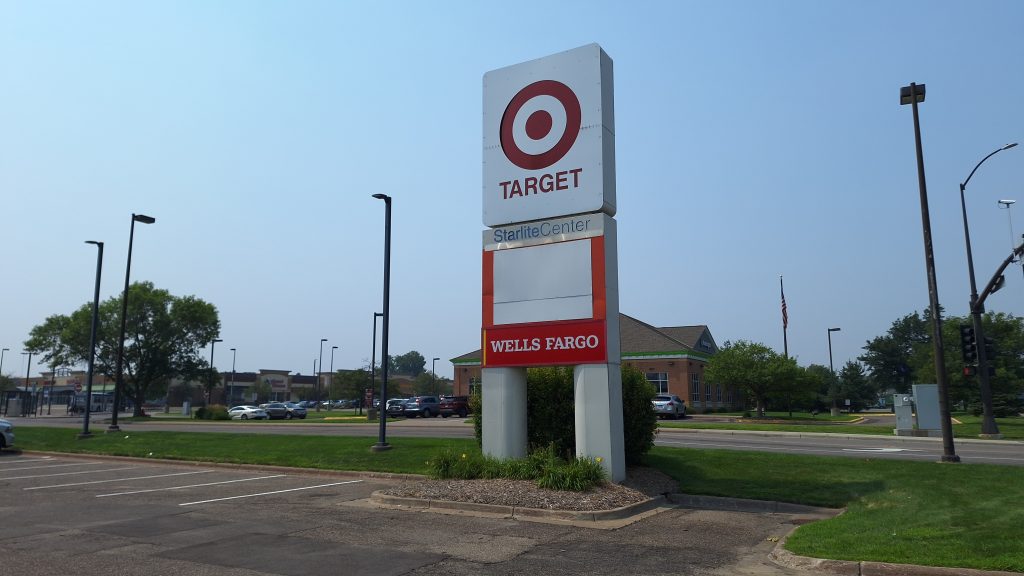
Just about 2.6 miles south of the Northwest Growth Area site stands the Starlite Center. In mid-September 2024, United Natural Foods Inc. (UNFI) Retail, the parent company of Cub, announced that the grocery chain would close its Brooklyn Park South location at Starlite Center on November 16 that same year. Some local residents expressed that the Cub was “very convenient” for them and that this loss would deeply affect this predominantly Black and Asian neighborhood.
Cub customers at the time who spoke to CCX Media, a local news agency for the northwest metro, said that high levels of theft and crime caused the Cub to close. However, according to Brooklyn Park police data, theft and calls for service, which remained relatively low and even declined at the former Cub, didn’t appear to be a major cause of the closure. In April of this year, the city touted a “historically low” level of crime thanks in part to community intervention programs and other public safety efforts.
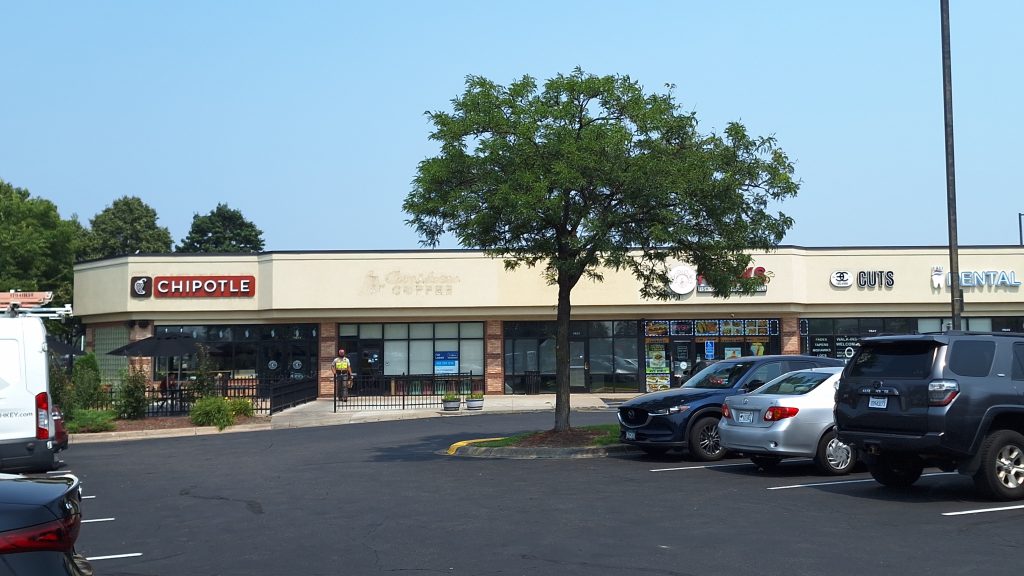
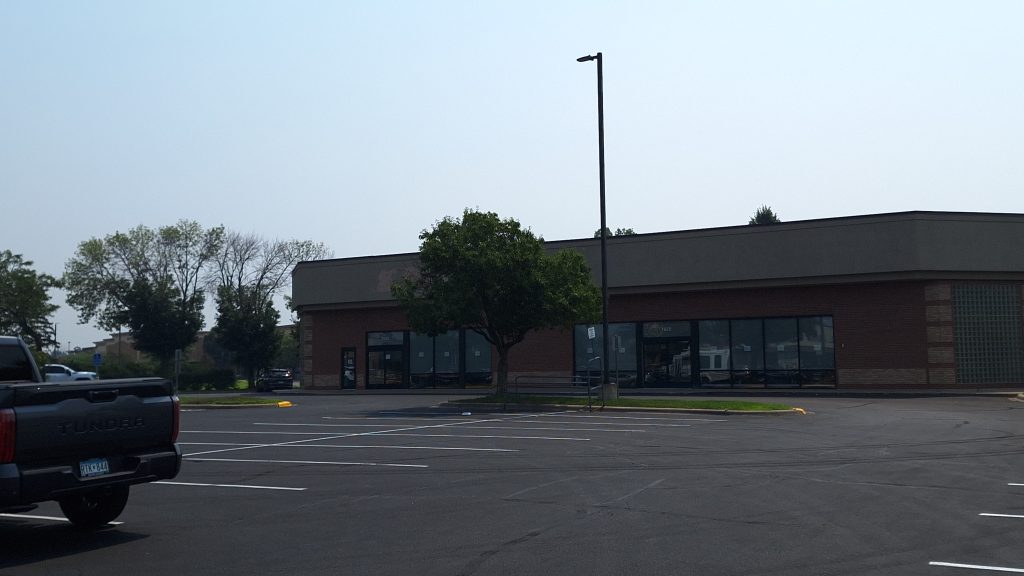
Following the Cub closure, long-time Brooklyn Park businesses Petco, Caribou Coffee and Jimmy Johns almost simultaneously closed their doors in the Park Commons shopping center near Starlite Center. Despite these closures, and from what I have experienced as a Brooklyn Park resident, the standing restaurants in the area remain a fairly busy spot for local residents and employees of nearby offices and manufacturers.
Amid this wave of closures, the city of Brooklyn Park took action by reaching out to community members to see how the area and city could be revitalized. Based on community feedback, the city now seeks to change zoning codes, create smaller business spaces and potentially add more drive-thrus in the area, one of which was recently approved for the Chipotle at Park Commons and comes with additional infrastructure and landscaping improvements to the surrounding site.
While I welcome ways to entice more customers to businesses, adding new drive thrus near the planned Blue Line Extension should be heavily discouraged. This is because drive-thrus enhance car dependency, take up a lot of space and degrade the walkability of a place; all outcomes generally not compatible with successful light rail (or public transit in general).
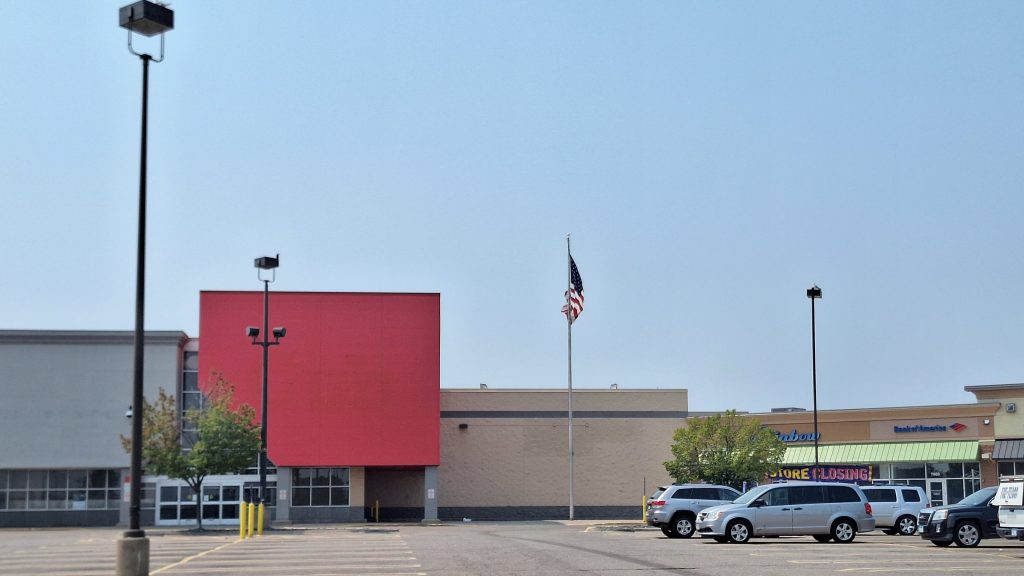
Based off of a visit to Starlite Center on August 1 of this year, Rainbow Shops, a women’s clothing store, had acquired a store closing banner – less than eight months after Cub’s closure. Not long after that previous visit, Rainbow Shops permanently shuttered its doors.
From what I can see, it appears that the amount of foot traffic Cub had once attracted to the area doesn’t persist throughout the shopping center anymore. Other big-box retail space at Starlite Center remains underutilized, aside from the seasonal Spirit Halloween store. Currently, vacancies in adjacent business centers are relatively low and remain well-occupied.
Thanks to a recent planning grant from Hennepin County to the city of Brooklyn Park, the city will now begin a study similar to the Northwest Growth Area Plan for the Brooklyn Boulevard corridor. Brooklyn Park intended to begin the Brooklyn Boulevard study after the conclusion of the growth area plan, but this new grant made it possible to start the study now.
The Brooklyn Boulevard corridor study will span from the Starlite Center area east to The Villages, an area near Brooklyn Boulevard and Zane Avenue. The study seeks to redevelop under-utilized properties, encourage economic prosperity throughout some of the oldest parts of Brooklyn Park and greatly complement the coming Blue Line Extension.
Brooklyn Park Mayor Hollies Winston said that the city has “been drastically underinvested in” by the state because of the lack of legislative assistance. Additionally, the city has a $3.5 billion tax revenue gap in comparison to the city of Bloomington, a similarly sized city to Brooklyn Park. This comes as homeowners and property owners in Brooklyn Park “pay disproportionately high property taxes.”
These city-wide issues have led to initiatives that address these problems, which gave rise to the Northwest Growth Area plan, the last piece of Brooklyn Park that has not yet been widely developed. This plan is not without its own controversies.
Northwest Growth Area Plan
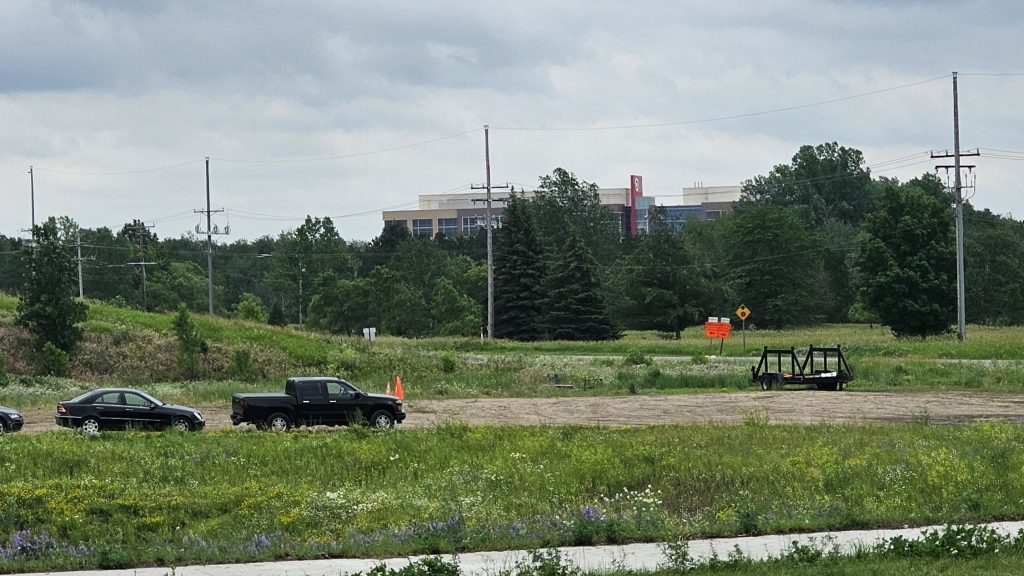
Further development of the Northwest Growth Area Plan in early 2025 prompted the mayors of Champlin and Maple Grove to send a letter to Mayor Winston, citing their concerns over the potential for increased traffic, crime and tall apartment buildings near single-family homes. The letter came attached with a map showing what they would better support for the site in Brooklyn Park.
Winston called this letter “alarming” and stated that “[Champlin and Maple Grove] have developed their neighborhoods in a certain way and are suggesting we develop in a similar manner. The problem is, I think they’re interested in regional redlining.”
“We shouldn’t say we don’t deserve some of the things Bloomington has and [that instead we should] drive 30 minutes away or to Maple Grove, a city telling us how to develop. We deserve those things in-house,” Mayor Winston said at a city council meeting in February about the letter.
Champlin Mayor Ryan Sabas said that was a “far reach” and that Champlin and Maple Grove only wanted a “seat at the table” on the development plan.
To view Mayor Winston’s full remarks at the 2/24/2025 council meeting, skip to 1:51:43 in the video here.
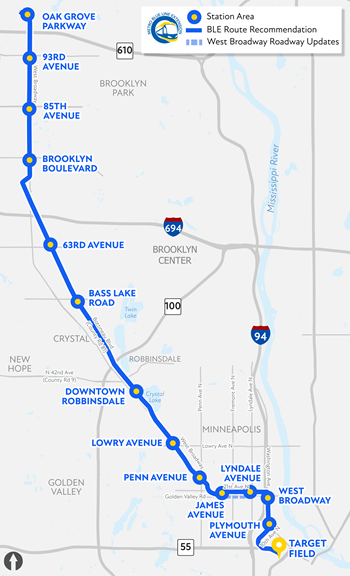
Brooklyn Park’s development plan hinges on the planned Blue Line Extension which will extend the existing Blue Line light rail line from downtown Minneapolis northwest to Brooklyn Park. The light rail extension will add 13.4 miles of new track and 13 stations to the communities of North Minneapolis, Robbinsdale, Crystal and Brooklyn Park. Five of those 13 stations are located in Brooklyn Park.
This $3.4 billion light rail line is expected to begin construction as soon as 2027 with an anticipated opening year of 2030. When open for service, the Blue Line Extension will give riders in the northwest metro a one-seat ride to local destinations, downtown Minneapolis, the Minneapolis-St. Paul International Airport, and the Mall of America with numerous connections to other transit lines.
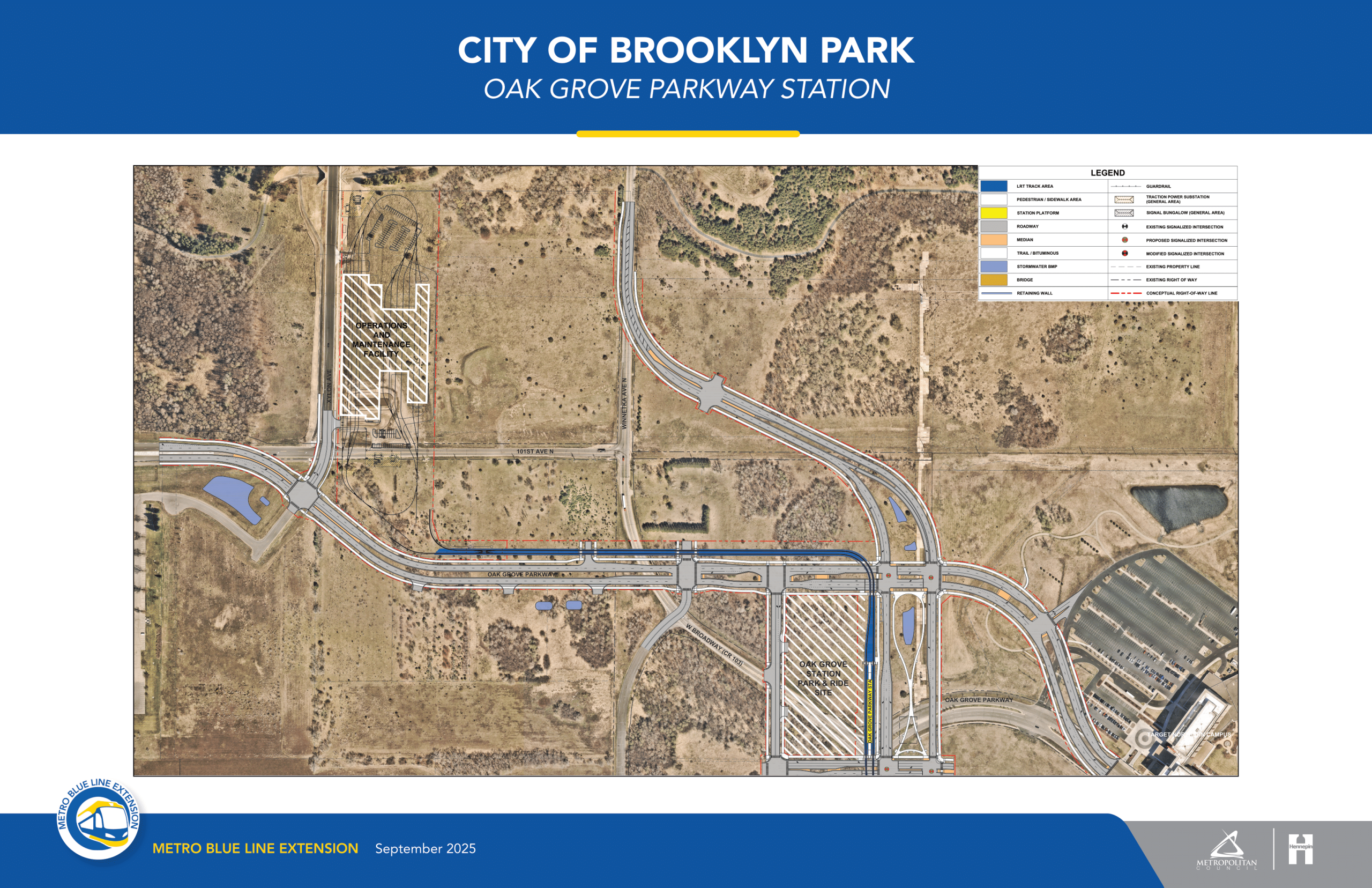
As I reported in 2024, forests and farmland primarily surround the immediate area of the future northern terminus of the Blue Line. While the Target Northern Campus offices employ thousands just steps away, the station area doesn’t currently serve much of a purpose to most people.
During the 2025 Minnesota state legislative session, Brooklyn Park requested that the legislature provide $12 million in funding to construct a new 2-million gallon water tower and three large water mains for the area.
According to Tim Gladhill, Brooklyn Park’s Community Development Director, this request was ultimately not successful, but the city looks to make a similar request in the 2026 legislative session. If secured, the new water infrastructure can help sustain future growth and kickstart renewed economic activity.
Gladhill did say that the city was able to secure the establishment of the Biotech Innovation District by state statue, which provides the city with Port Authority powers. They were also granted Tax Increment Financing (TIF) flexibility, giving the city the ability to establish a 26 Year Redevelopment District.
Initial Package Plans
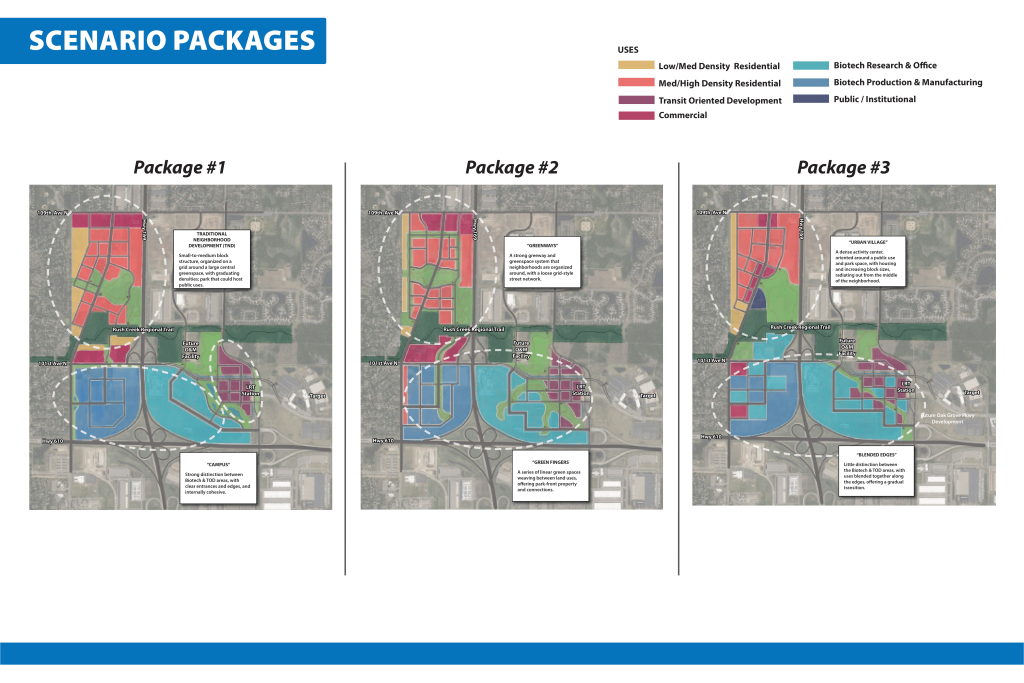
After kickstarting the Northwest Growth Area Plan in fall 2024, Brooklyn Park engaged the public at a community meeting in January 2025 about the three proposed scenario packages that will guide development. The meeting sought to see what people did and did not like about the plans, and what else they wanted to see for the undeveloped site.
Scenario package one separates each land use type into one specific area with not many mixed-use cases. There are clear distinctions between the traditional neighborhood development, commercial spaces, transit-oriented development (TOD) and the biotech district. I personally dislike this scenario plan because of the lack of mixed-use land use. More mixed-use developments can help enhance walkability and foster a sense of place, among other community benefits.
Scenario package two resembles some features of scenario package one, but instead incorporates greenways into the neighborhoods and biotech districts. I do like that the greenways help better connect the areas and provide more greenspace, but otherwise, this scenario package is not the greatest.
My personal favorite of the scenarios, package three, offers the highest amount of mixed-use opportunities throughout the growth area. An urban village in the neighborhood helps build a stronger sense of place and encourages commercial activity through its main street-like character. I really like that every area has some combination of commercial, residential, office or greenspace mixed into it.
Preferred Vision Plan
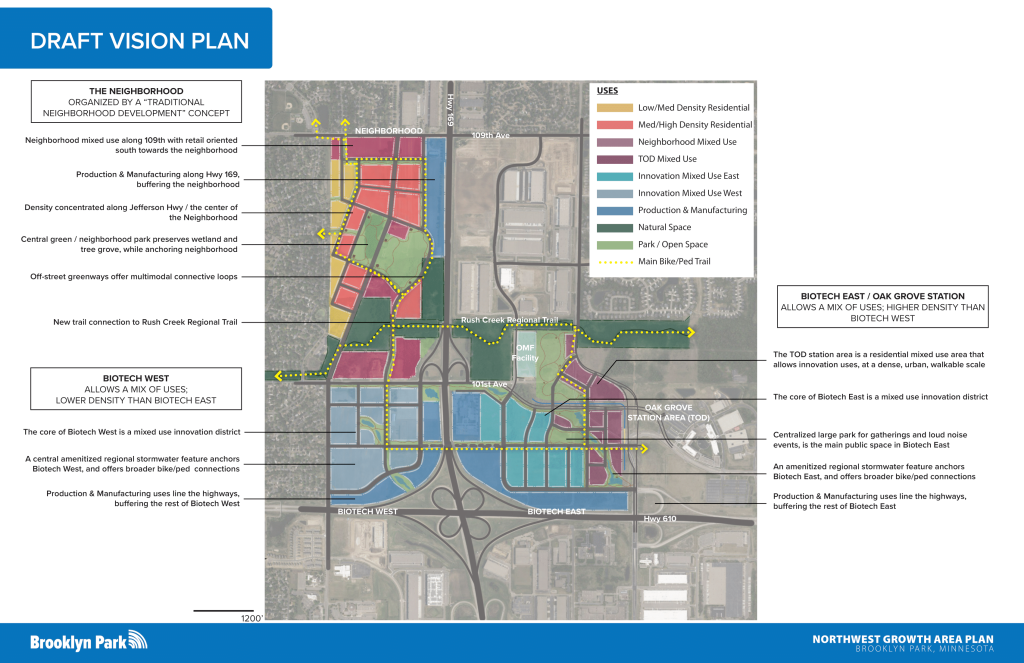
In early September of this year, Brooklyn Park unveiled its preferred vision plan for the growth area. This vision seems to mash all three scenario packages together with its incorporation of greenways, mixed-use areas and a traditional neighborhood development while adding new elements. This new plan will create walkable and bike-friendly neighborhoods that encourage residents to not go far to reach essential needs, like a 15-minute city.
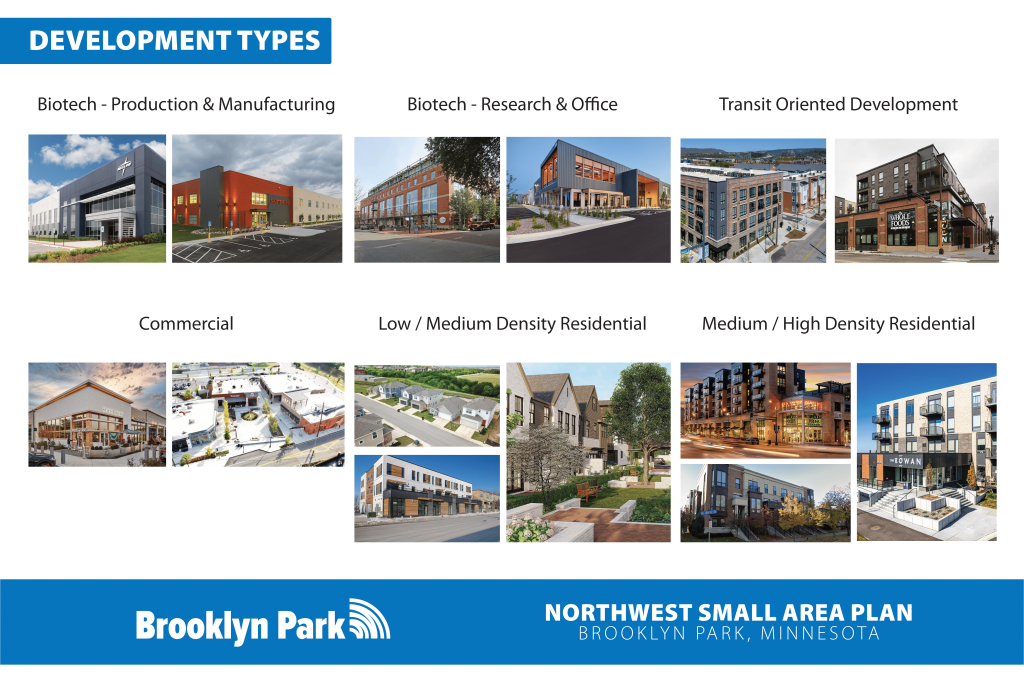
The southern half of the growth area will primarily be reserved for mixed-use (multi-family residential, office, research/labs, retail, etc.) biotech opportunities, dense transit-oriented development near the light rail station and ample greenspace.
The northern half will instead mainly consist of townhomes, missing middle housing, apartments, retail spaces, offices, another large park and other uses. Production and manufacturing facilities that line the highways will be designed in a way that’s residential and mixed-use friendly.
Brooklyn Park will construct key streets and bikeways and have private developers fill out the rest of the street network that will follow street design guidelines set by the city. The remaining area east of the Oak Grove Parkway light rail station will be developed separately as part of an earlier station area planning initiative from 2016.
What’s Next for Brooklyn Park?
After the adoption of the growth area plan, the Brooklyn Park city council now looks to move the plan even further. In the coming city council sessions, the council will discuss where housing or job sites will be, what development or the layout looks like, locations for greenspace, who will develop the area and narrow down other specifics.
I hope to see development that prioritizes people who walk, bike, roll and take transit, rather than development centered around cars. Maybe Brooklyn Park could look at Carmel, Indiana or Nanaimo, British Columbia (who took a page from the Dutch), and design the Northwest Growth Area with high-quality bike and pedestrian infrastructure.
Big challenges could lie ahead for Brooklyn Park, as some other grand development plans across the Twin Cities metro area have faced issues (see Highland Bridge in St. Paul or Rice Creek Commons in Arden Hills) which have resulted in stalled or slimmed down development. That is to not say the Northwest Growth Area plan or other ambitious projects won’t be successful or beneficial, because success is possible.
With the outer Twin Cities suburbs projected to keep growing, initiatives like the Northwest Growth Area plan could help mitigate urban sprawl by concentrating growth into dense and efficient land uses instead of sprawling single-family homes and large big-box developments.
This plan would not only potentially help attract thousands of new residents and jobs, but also improve the economy of Brooklyn Park and the region, improve the health of residents and our planet, bring riders to the Blue Line light rail extension, reduce inequalities and create a vibrant place for the city’s future. The Northwest Growth Area Plan is truly a one-of-a-kind investment.