Metro Transit makes route and schedule changes four times each year. Each quarter, retired transit planner Aaron Isaacs explains them and gives an insider’s perspective on what’s happening.
E Line BRT replaces most of Route 6
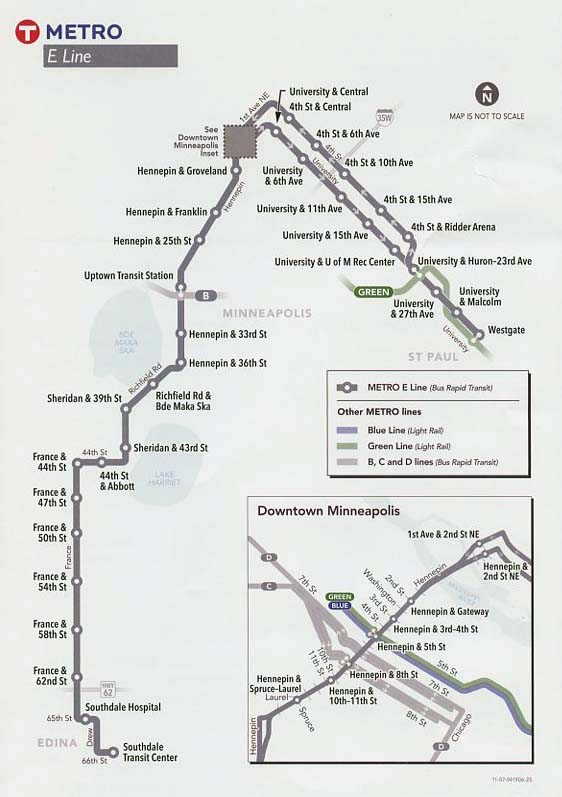
December 6 sees the inauguration of the latest arterial bus rapid transit (BRT), the E Line. It replaces all of Route 6 except the 6E Xerxes south of the Uptown Transit Center, which becomes Route 36. Like all BRT replacements of local buses, there are tradeoffs. Because most stops are about a half mile apart, access is reduced in favor of faster speeds. However, because the missed stops have the lowest ridership, the majority of existing riders get more frequent, faster service. In a few places small segments of local service by other routes remains. That would be Route 36 in Linden Hills, Route 2 on the University Avenue-4th Street pair near the U of M, Route 4 on Hennepin between the Walker Art Center and the Old St. Anthony neighborhood, and Route 17 in Uptown. The biggest loss of local service is the former Route 6D on 39th Street and France Avenue north of 44th Street.
Route 36 will continue to serve the area south of Southdale, so any riders who want to go beyond the Uptown Transit Center to downtown, the Wedge or Loring Park will have to transfer.
The E Line has a major design flaw in Uptown, where transfers to the Lake Street B Line are extremely inconvenient. That’s because the only E Line stop is at the Uptown Transit Station, two blocks away from Lake Street. This is especially galling for northbound E Line riders transferring to the eastbound B Line, and there are many of them. Instead of stopping at Lake Street and walking around the corner to board the B Line, they have to travel two more blocks to the Uptown Station, then walk back to Lake Street. If held up by red lights crossing Lagoon and Lake Street, that could add several minutes to the trip, causing missed connections and negating the BRT travel time advantage. This can be fixed by adding a northbound E Line stop at Lake Street where the 6 stops today. There is already a waiting shelter built into the building face and fare machines for the B Line are right around the corner.
So what gets better? The frequency from the terminus at the Green Line Westgate Station in the St. Paul Midway through Southeast Minneapolis and downtown to Bde Maka Ska (39th Street & Sheridan Ave. S.) improves from every 15 minutes to every 10 minutes. From there to Southdale it improves from every 30 minutes to every 10 minutes.
How much faster will it be? That depends on where and how far you ride. Ridership turns over in downtown, so let’s analyze three typical trips:
8th & Hennepin to Westgate Station
8th & Hennepin to 36th & Hennepin
8th & Hennepin to Southdale
Uptown to Southdale
These are weekday midday times. Rush hour times are longer for both old and new services.
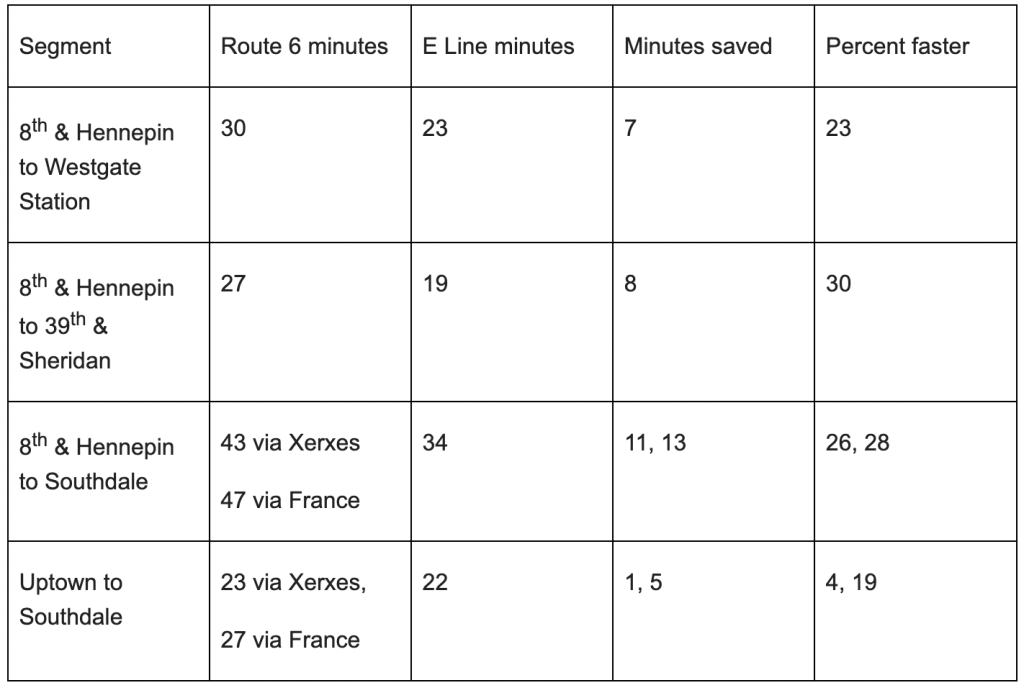
From 36th and Hennepin to Southdale, transit access has been sacrificed for a trivial improvement in travel time. The speed improvement is small because the 6 didn’t have to stop very often. When the E Line was being planned, I argued unsuccessfully for keeping the old, frequent bus stops on the route segments where the local bus was just as fast as the BRT. This also argues against Metro Transit’s shift to quarter mile stop spacing on local routes. Except for the neighborhoods near downtown where buses stop frequently, it reduces access but travel times remain the same.
Route 345: Woodbury — West St. Paul — Airport — Mall of America (MOA)
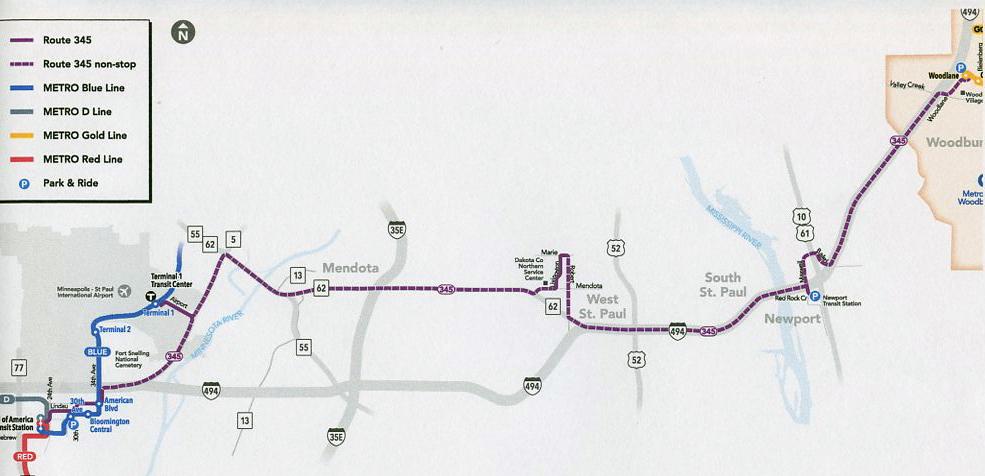
Traveling between any combination of these previously would have required a circuitous route via downtown St. Paul and a transfer. Now there’s a direct bus seven days a week, although it only runs once an hour. It’s anchored by a park-ride lot in Woodbury and connections to the Gold Line, Route 323 to Sunray and a Metro Micro dial-a-ride. The Network Now plan calls for a future feeder bus from Cottage Grove. There’s an intermediate stop at the Newport park-ride. After crossing the Mississippi on the I-494 bridge, it detours up Robert Street to make reasonably timed connections with Route 68 from West St. Paul, South St. Paul and Inver Grove Heights. There are poorly timed connections with Route 75, which runs every 45 minutes. If the new route survives, it will be fed by the future Robert Street BRT. The northern Dakota County suburbs finally have a suburban outlet for their previously dead-ended routes.
The 345 continues on Highway 62. On the way to the Mendota Bridge it misses an opportunity to gain more badly needed riders by failing to stop at the signalized intersections of Delaware Avenue, Dodd Road and Lexington Avenue (where there is currently no transit service). All three have development, sidewalk connections and a nice wide shoulder for stopping safely. Delaware Avenue is close to Two Rivers High School. Dodd Road has a concentration of apartments and a shopping center.
Serving the airport comes with a connection to the Blue Line light rail transit (LRT) into Minneapolis and Route 54 into St. Paul. Because airport parking is so expensive, hopefully the new route will attract employees and even travelers. My other criticism is that it fails to serve the huge airport work shift that starts at 5am, a missed opportunity for sure. Then it’s on to the Mall of America, a major destination with transit connections to Richfield, Bloomington, Burnsville, Savage, Shakopee, Eden Prairie, Eagan and Apple Valley.
Route 725: Blaine — Brooklyn Park — Osseo
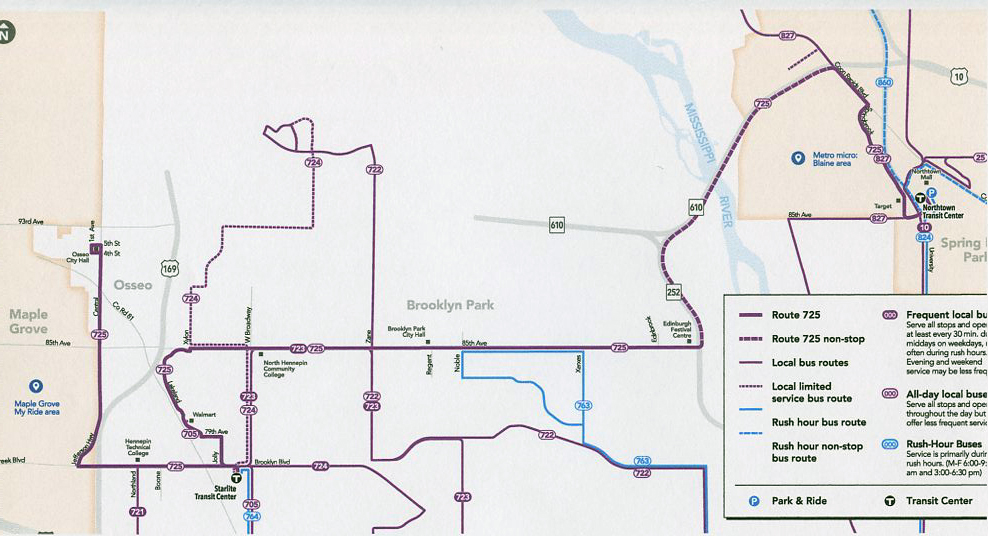
This new hourly route via the Highway 610 bridge over the Mississippi will connect the Northtown Transit Center in Blaine with the Starlite Transit Center in Brooklyn Park, previously a two-transfer trip that no one would even attempt. It will bring all day, seven days a week service to Osseo for the first time. Along the way it serves North Hennepin College and Hennepin Technical College.
Hourly suburban routes are only as good as their timed transfer waits at the transit centers, hopefully less than 15 minutes. At Northtown Transit Center it’s a mixed bag, with decent connections to Routes 10 and 805. At some point Route 10 will be replaced by BRT. Connections with Routes 804 and 827 work in only one direction. Northtown also has a park-ride lot, potentially attracting college students.
On the Starlite Transit Center end, the new route creates a link for Routes 705, 723 and 724 to access Hennepin Technical College and Osseo. Connections are good with Route 724, which runs every 15 minutes, but not so good with the other routes.
Replacing the Northstar commuter train: Route 852 to Route 827
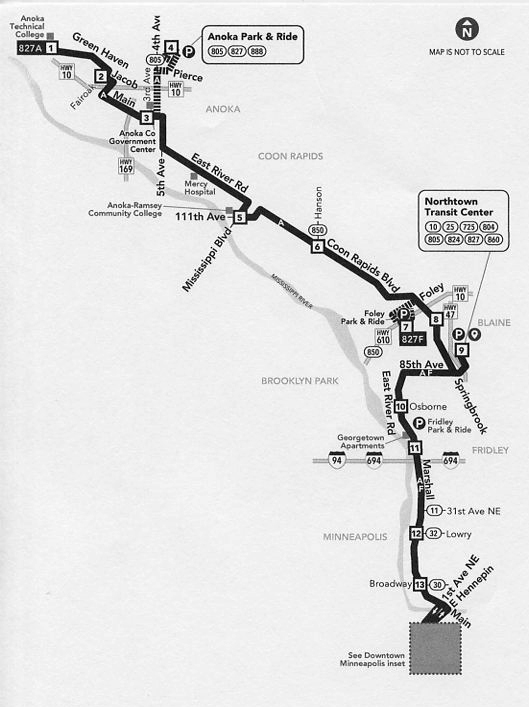
There has been transit between downtown Minneapolis and Anoka through Fridley and Coon Rapids since 1915. The electric trolleys of the Minneapolis Anoka & Cuyuna Range Railroad provided the link until 1939, when buses replaced them. The Anoka-Minneapolis Bus Company was succeeded in the 1960s by Dickenson Lines, which was incorporated into the Metro Transit system in 1972. The arrival of the Northstar Line added a fast service to the corridor, but the buses never went away. Route 852 continued to provide all-day service along East River Road/Coon Raids Blvd. Express Route 850 from the Coon Rapids Foley Park-ride competed with the Northstar for rush hour passengers.
The Northstar trains will disappear after January 4. Starting on December 6, part of the Northstar replacement package is the conversion of Route 852 to new Route 827. Basically, it’s an upgrade from every 90 minutes on weekdays to hourly middays and half-hourly rush hours. The 80-minute Saturday frequency improves to hourly.
There are two parts of the new Route 827 that I question. All day long it diverts to the Foley park-ride lot. That time-consuming jog shouldn’t be needed because Express Route 850 now has hourly midday service to Foley. That should be sufficient for half-day commuters.
The other questionable decision was to reroute the 852/827 from the freeway route to downtown. Instead it takes Marshall Street NE all the way to downtown, increasing travel time by 10 minutes. The idea is to serve some new development along the way, plus new transfer connections to the Route 32 Lowry Crosstown and Route 30 Broadway Crosstown, but is that worth slowing the route? The one benefit to riders is that it reclassifies the route from express to local, which reduces the fare.
The trains will be replaced by new Route 888 serving the Ramsey, Anoka and Coon Rapids park-ride lots at the Northstar stations. Compared to the Northstar schedule of eight weekday trips, Route 888 will provide 32 trips, plus six on weekends. Northstar only runs weekends for special events like Twins games. From Ramsey and Anoka, Route 888 is projected to be slower than the train. That’s mostly due to the detour required to reach the Coon Rapids station, which is located well off Highway 10. If that stop were eliminated, the bus travel time to the center of downtown would be about the same as the train, which currently requires transferring to light rail or walking half a mile. Given the available park-ride capacity at the Foley Boulevard lot, I predict the Coon Rapids stop won’t last.
Sherburne County has committed to fund three daily round trips from Big Lake and Elk River to test the market.
More rush hour expresses
As downtown commuters gradually return to the office, more rush hour expresses are being added.
Route 156 from southwest Minneapolis to Minneapolis has been revived from suspension, with three morning and three afternoon trips.
Route 275 Centerville and Vadnais Heights to St. Paul adds three morning and three afternoon trips.
Route 781 Maple Grove to Minneapolis adds one morning and two afternoon trips.
Route 789 Maple Grove to Minneapolis adds one morning and one afternoon trip.
And one more improvement:
Route 9 St. Louis Park — Bryn Mawr — Seward — Longfellow: Sunday service doubles from 60 minute to 30 minute frequency.