
Across the country various freeway removal proposals show great promise for making cities better for the people that live there. There are those that have been done such as the Embacadero Freeway in San Francisco that have shown how cities can be made more livable without impacting traffic. The Inner Loop project in Rochester has also been a project with positive results in this respect.
Locally there are proposals for Rethinking I-94 that many people continue to advocate for removing I-94 between the downtowns. Another project that has been discussed in the past and shown considerable public support for is the North Loop Viaduct just northwest of Downtown Minneapolis. Past articles have touted the urban benefits to the now popular North Loop neighborhood and the people that live there.
The urban fabric is certainly important. However, revising this topic, there is a far more substantial argument to see the viaducts removed and filled in with new development : money.
Viaduct History
The North Loop Viaduct, or Bridges 27816N and 27816S to MnDOT, were constructed in 1982 and opened to traffic in 1983 as part of a wider project of constructing I-94 north of Downtown Minneapolis to connect to 694 and the north Twin Cities Metro. The viaducts act as long ramps that connect I-94 to 3rd and 4th St near Hennepin Ave. At the time of construction the North Loop neighborhood on the periphery of Downtown was a collection of warehouses and other industrial facilities.
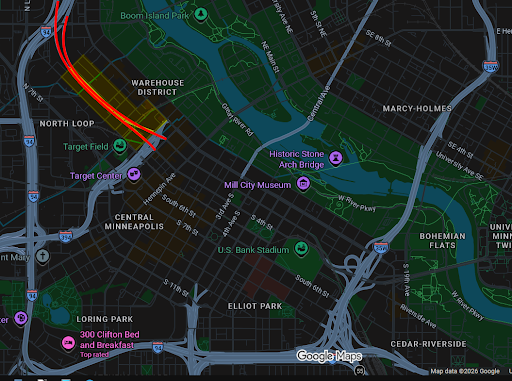
As time has marched on the neighborhood has seen extensive redevelopment of residential and mixed use buildings that have become a very desirable place to live. Increased calls have been made to remove the viaducts as their structures have aged and the benefit to drivers called into question with alternatives along Floyd Olson and Lyndale are readily available. In addition, removing the viaducts would open up large tracts of land for further infill development in a very popular neighborhood that people are eager to reside in.
The arguments for a better urban fabric are very important to this conversation. Equally important is the financial implications of the viaducts versus neighborhood expansion. How does the present situation compare to a hypothetical future with infill and no viaduct?
Current Parking Infrastructure
Currently under the viaduct there are two parking lots for drivers coming into the city. This excludes over I-394 (no parking obviously) and next to the North Loop Green towers (not a paid parking lot). There is the larger lot owned by MPLS Parking to the north and a smaller lot that is part of the Ford Center on 5th Street to the south. Public revenue figures could not be found for the specific lots so estimates will have to be made.
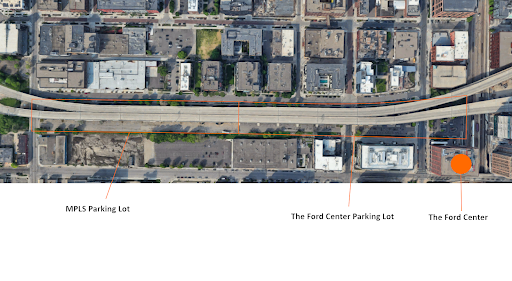
Going by available public street views the MPLS lot has 353 spots available. There is the option to get a parking contract starting at $95 per month, an option that most regular commuters would likely make use of. Event parking is also an option at $15 for the day. Going by the number of spots available, the amount of money made is as follows.
If everyone were to park with the monthly $95 and park daily, this would net approximately $400,000 of parking revenue. If everyone were to do event parking every day of the year the number goes as high as $1.9 million. Most drivers will probably be daily commuters so it is safe to assume that the revenue generated is on the lower end. Let’s go with one-third of the way between and say approximately $900,000 per year.
The Ford Center parking lots are more tricky since public pricing for contract parking is not available. There are three lots to the Ford Center. The two to the northwest are contract lots with a combined 245 spaces available. The third lot is a visitor lot at 56 spaces and thus won’t be counted.
For the sake of discussion, an estimate can be made using the previous parking rates. Using the same numbers and methods as before we get a low end of $300,000 and a high end of $1.3 million. With the same low end assumption of before we can safely assume around $600,000 per year of parking revenue generated.
Thus between the two parking lots that are paid there is approx $1.5 million of revenue generated per year.
Potential Tax Revenue from Infill Development
Looking at a time when the viaducts are removed and expanded infill development is allowed to proceed, one does have to ask if the addition of new buildings would compare to the existing parking lots. To see how this compares, let’s look at the block of existing buildings to the north of the viaduct as a case study of nearby buildings that cover roughly the same area.
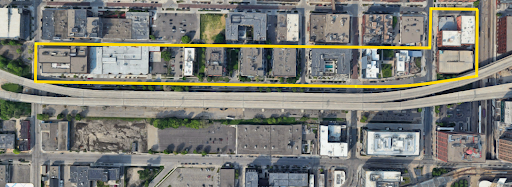
Using the Hennepin County GIS, we can estimate the tax revenue the highlighted block generates per year. For condominium buildings, a total tax estimate is made by multiplying the total number of units by the yearly property tax of the first available unit. For the remaining buildings (commercial, apartments, etc) the total tax revenue is listed.
With this approach, how does the estimated potential property tax revenue compare to the parking lots?
Based on the analysis, a block of buildings of equal value would generate approximately $6.8 million dollars every year. This far exceeds the current parking lots that are on site. Even a partial infill would match what the parking lots currently generate. Also to note is that there is land on the north end of the viaduct that could be graded down and also filled in with new development as well as adjacent land to the south that is still vacant.
On that note, if we take the entire block of buildings and properties from the yellow highlight on the map at the start of this article, this one section of the North Loop neighborhood generates an estimated $18.1 million dollars every year of tax revenue.
The financial potential, improved quality of life, and redundancy of the viaduct all show strong arguments in favor of removal. If the community and governments want to get serious about freeway removal projects that would greatly improve the quality of life for residents as well as help contribute to the financial health of the local government, this is an excellent opportunity to undertake for the now and future.