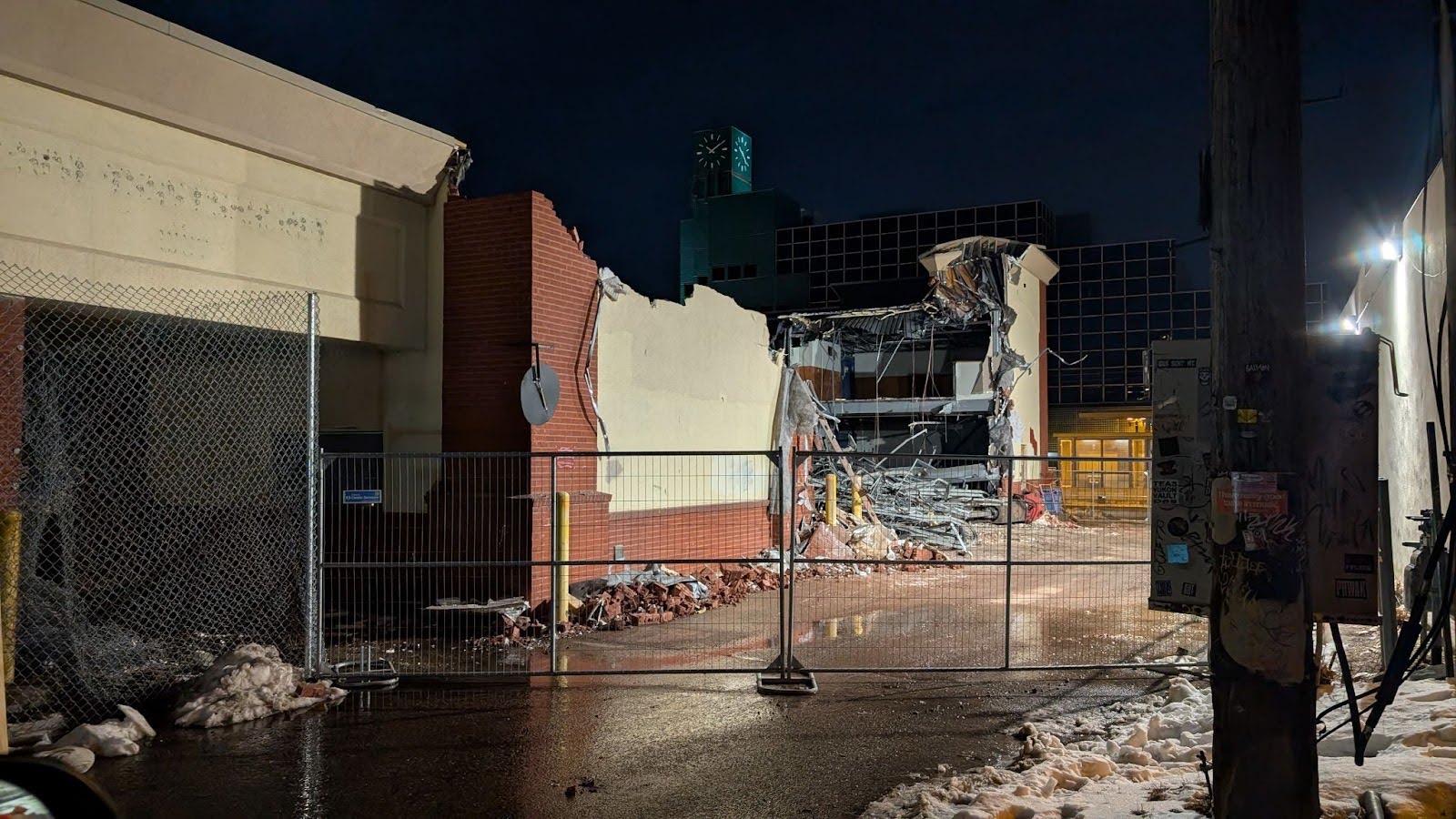
If you’ve ridden the Green Line through the Midway in the last few years, you know the building. Northwest corner of Snelling and University. Boarded windows. Chain-link fence. A treacherous light rail platform. The parking lot that used to serve a functioning pharmacy quietly converted into an open-air stage for fentanyl sales, fights, and the kind of slow-motion disorder that city officials describe as a “nuisance” and residents describe, more accurately, as abandonment.
Finally, after nearly two decades of life and immiserating after-life, the city of St. Paul tore it down.
The demolition of the Midway CVS – started the week of March 16th after two previous false starts – had been a long time coming. Long enough that the neighborhood organizations pitched it on social media and bars opened early to mark the occasion. When the first scheduled demolition date was pushed back due to contractor issues, neighbors who’d made plans to witness it went back to work and waited again with jokes at the ready. That’s where we were: people scheduling celebrations around a demolition.
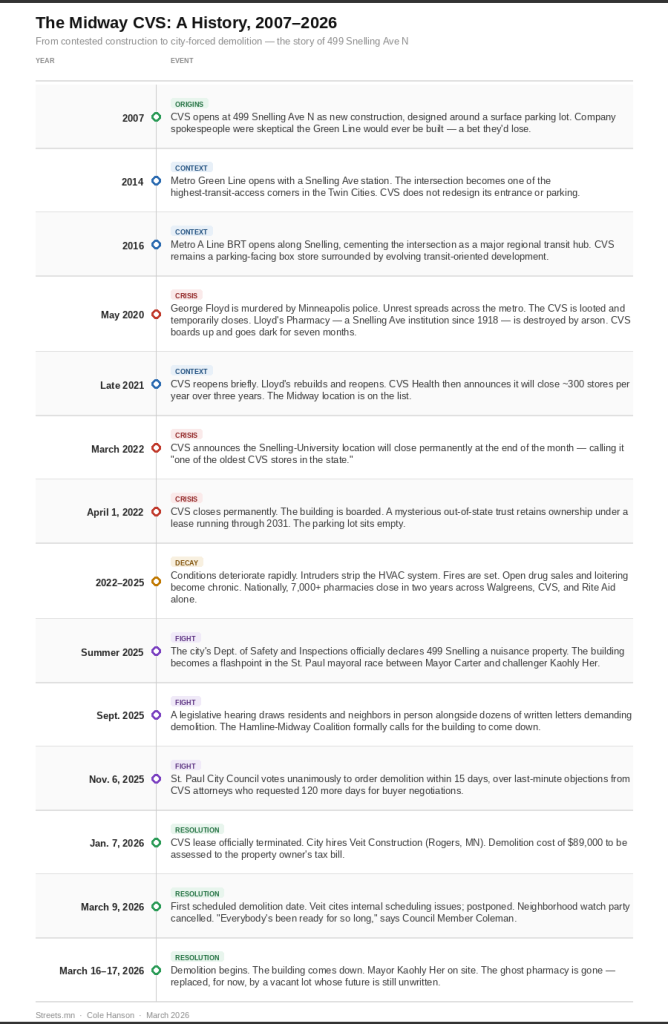
To understand why this moment mattered, you have to go back to the beginning of this entire mess.
A Contested Beginning
The building at 499 Snelling Ave N didn’t arrive quietly. When CVS first pitched its store to the Midway community in the mid-2000s, the chain was in the middle of an aggressive national expansion – buying up corner parcels at signalized intersections across the country, designing the same suburban-facing box store over and over again, and planting flags in neighborhoods whose demographics suggested enough foot traffic to justify a long-term lease.
What’s notable, in retrospect, is what CVS said during those early community meetings. According to meeting minutes cited by MinnPost, CVS spokespeople were skeptical that the proposed light rail line would ever be built — which is why they designed the store around parking rather than pedestrian access. They bet against transit, and built a large surface lot compared to their much busier neighbor, the Turf Club. They put the entrance on the wrong side for walkers off a future Green Line platform that, as of 2014, would sit about 25 feet from their front door.
The store opened in 2007 as new construction, anchoring the northwest corner of Snelling and University. It was, by the standards of chain pharmacy retail, a successful location for over a decade, yet only if measured against that original assumption of a cars-only intersection (like the rest of the University corridor). Less than a decade later, in 2014 the Green Line opened, became the most-ridden transit line in Minnesota history, and was carrying over 40,000 riders a day before the pandemic. The A Line BRT opened along Snelling in 2016, making the intersection a genuine regional transit hub. CVS had one of the best-positioned storefronts in the entire metro — and mostly ignored what was happening around it.
While the Green Line and its advocates have reshaped University Avenue into a denser, more walkable corridor, the CVS building remained exactly what it had always been: a box store designed for a neighborhood that no longer quite existed in the same form. A parking lot that, as transit-oriented development spread east and west along the line, looked more and more like wasted land at a critical intersection.
May 2020: The Uprising
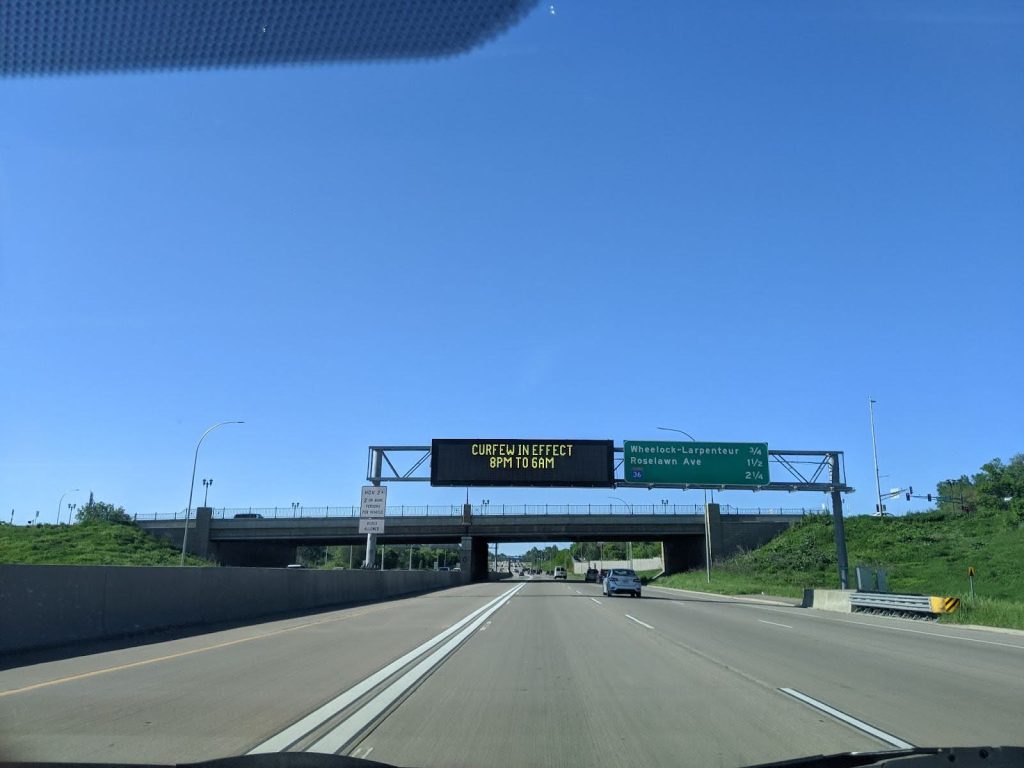
On May 25, 2020, Minneapolis police officer Derek Chauvin murdered George Floyd. The uprising that followed rippled outward across the metro, and the Midway — already a neighborhood navigating years of disinvestment and demographic transition — bore some of its heaviest impacts. University Avenue saw fires, looting, and destruction concentrated in a way that hit locally-owned businesses alongside national chains like CVS.
The building was boarded up and remained shuttered for seven months. Down the street, Lloyd’s Pharmacy — a Snelling Avenue institution, operating for over 100 years at that point — was destroyed by looting and arson. Lloyd’s rebuilt and reopened in 2021. CVS eventually reopened too, months later. But the reopening was already provisional. The chain had announced in late 2021 that it would be closing roughly 300 stores annually over three years as part of a national restructuring. The Midway location, old enough and complicated enough, was on the list.
On March 9, 2022, CVS announced the Snelling and University store would close permanently at the end of the month. It was, the company noted in a statement, “one of the oldest CVS stores in the state.” The closure was framed as strategic realignment. The doors closed April 1, 2022. The boarding went back up. The parking lot sat empty… sort of.
The Ghost Pharmacy Problem
The Midway CVS wasn’t a local story playing out against a national backdrop — it was the national story in miniature. Since 2022, more than 2,000 stores have closed across Walgreens, CVS, and Rite Aid alone. Rite Aid filed for bankruptcy in late 2023 and ceased all operations in 2025, closing its final 1,300 stores. CVS has shuttered more than 1,100 locations since 2022. Walgreens is working through a plan to close 1,200 stores over three years.
The drivers are structural: decades of overexpansion, falling prescription reimbursement rates, competition from Amazon Pharmacy and big-box retailers, and a post-pandemic normalization of healthcare delivery that no longer required a CVS on every corner. What’s left behind is a peculiar real estate problem: the ghost or “zombie” pharmacy. Pharmacies were historically built on the most strategic retail corners in America — high visibility, good traffic counts, accessible from transit and cars. But many are owned by entities with no local ties and no particular incentive to redevelop quickly. The result is the ghost pharmacy: a building in a good location, owned by someone far away, deteriorating on the inside while the neighborhood deteriorates around it.
The national public health picture worsened, yet the Midway was well positioned from a pharmacy standpoint. Over the two years from 2022 through 2024, more than 7,000 pharmacies closed nationwide. In 2024 alone, 2,800 closed. Nearly 50 million Americans — one in seven — now live in pharmacy deserts, defined as areas more than a mile from a pharmacy in urban settings. Midway continued recovering from 2020 for the next few years, all the while watching its most prominent commercial corner become a monument to a corporation’s exit strategy.
St. Paul had two of these properties simultaneously. The CVS on Maryland Avenue on the East Side also closed in 2022, and became the same kind of magnet for loitering and vandalism. At a January 2026 hearing on the Maryland property, Council Member Molly Coleman put it plainly: “I’ve been a member of this body for four months, and this is the second time that we are dealing with a CVS property that is a nuisance property, that is causing immense harm in our community.”
Three Years of Neglect, and a Fight to Get It Down
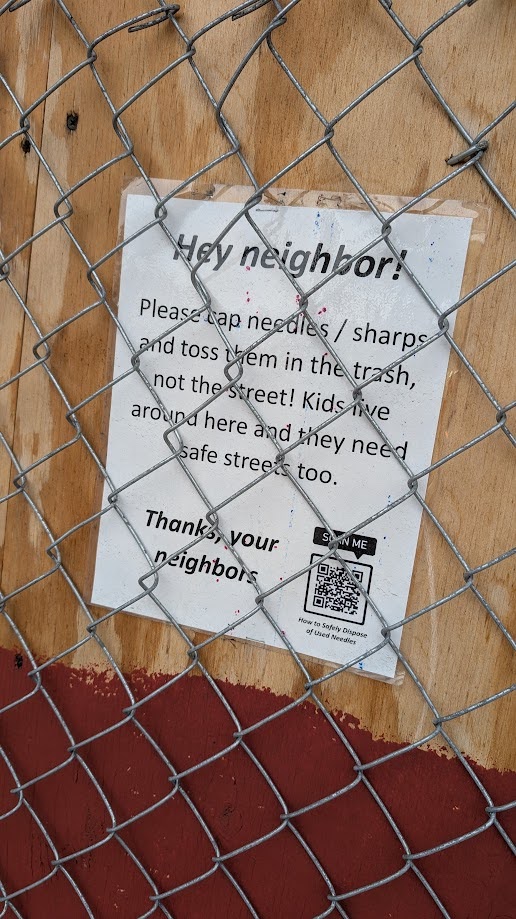
From April 2022 onward, 499 Snelling deteriorated fast. Intruders stripped the HVAC system. The roof sustained damage. Loiterers moved into the parking lot in numbers that neighbors described as sometimes reaching 40 people at a time, with open drug sales and regular police calls. That sign up on the plywood about safe sharp disposal? I made that with a friend’s laminator and Microsoft Word so even if people were using, they’d at least know how to clean up. The city’s Department of Safety and Inspections declared it an official nuisance site in the summer of 2025, triggering a formal process that could lead to demolition.
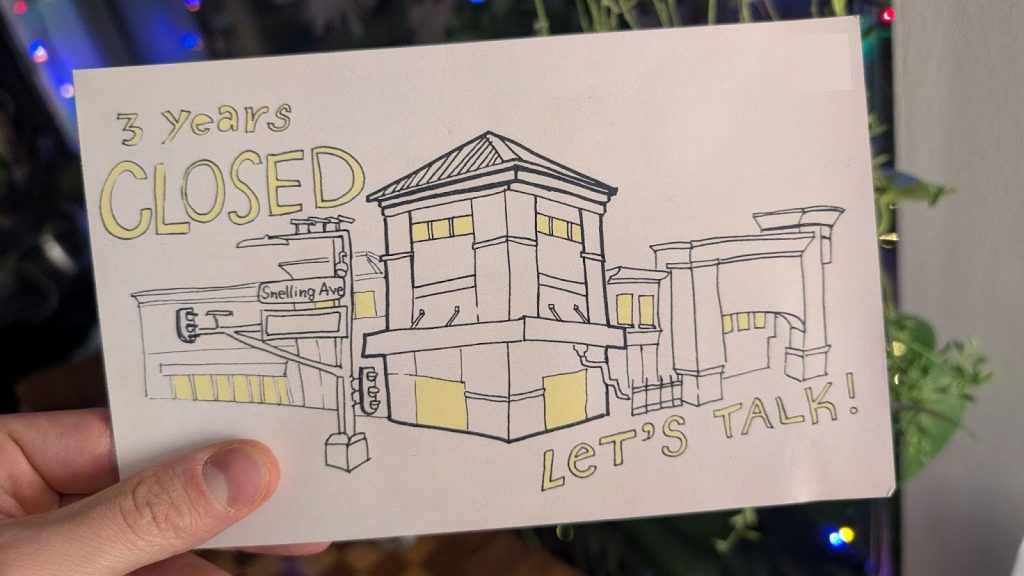
The nuisance designation arrived during a mayoral election year, which gave the CVS building more political visibility than a vacant pharmacy might normally command. I, myself a candidate for city council in 2025, had a lit piece about the CVS featuring art from one of our volunteers. Former Mayor Melvin Carter, at a September 2025 forum hosted by the League of Women Voters, said it was “time to either fix up or tear down” the building. State Rep. Kaohly Her, his primary challenger and eventual victor, seized on the city’s failure to even clearly identify who owned the property, calling it an indictment of City Hall’s responsiveness to Midway residents.
The Hamline-Midway Coalition had been organizing around the building for years, tracking conditions, hosting community forums, and pushing for either rehabilitation or demolition. By fall 2025, they were firmly in the demolition camp. “This building, in its current state, is unsafe, unsightly, and unfit for our neighborhood,” the coalition wrote. “It diminishes the aesthetics of the Snelling-University intersection, erodes community pride, and undermines the sense of safety and dignity neighbors deserve to feel in Hamline-Midway.”
At a September 2025 legislative hearing, about a dozen residents showed up in person and more than 40 more submitted letters. Neighbor Jacob Hooper said simply: “When people say that’s the worst intersection in St. Paul, they’re talking about the CVS.” Natalie Singer said the vacant building had pushed her out of the neighborhood entirely. Nicole Brown wrote that demolishing it would be “an act of collective justice and liberation.”
On November 6, 2025, the St. Paul City Council voted unanimously to order the building demolished within 15 days. Attorneys for CVS asked for 120 days to finalize discussions with prospective buyers. The council said no.
CVS’s attorney, Adam Niblick of the Taft law firm, acknowledged the obvious: “I think everyone can agree that the property is not currently being used in its highest and best use.”
The council agreed, unanimously, that the time for discussions had passed.
The city hired Veit Construction, a Rogers-based firm, to handle the demolition. The CVS lease was terminated on January 7, 2026. Permits were obtained. Utilities were scheduled for disconnection. The demolition cost, $89,000, will be assessed against the property owner’s tax bill.
Then the delays. A demolition date of March 9 was announced, drawing celebratory plans from the neighborhood. The Hamline-Midway Coalition organized a watch party. The Midway Saloon said it would open early. Then Veit cited internal scheduling issues, and the date was pushed to March 16. Coleman apologized to neighbors who had made plans. “Everybody’s been ready for so long,” she said.
On March 16-17, 2026, Veit’s crew finally moved in. The building’s demolition was underway. And of course, we all got our photos in.
The Ghost Lot Problem
Here is where the celebration gets complicated. The building is gone, but the property isn’t. The site at 499 Snelling is still held by a mysterious West-coast trust. The city cannot compel the owner to redevelop it. The most likely near-term outcome is a grass-seeded vacant lot at the most transit-connected intersection in St. Paul — which is an improvement over a burning, looted ghost pharmacy, but not exactly the community anchor that Midway residents have been asking for in this moment of developer-driven peril and people-powered opportunity.
Neighbors have said repeatedly what they want at the intersection: a grocery store, affordable housing, something that serves the neighborhood rather than extracting from it. Even in the short term, the neighborhood chats and social media pages are abuzz with dreams of community gardens and green spaces for growing our own food. The departure of the Midway’s 24-hour Cub Foods in 2025, which drew its own attention during the mayoral race, left the neighborhood with a real food access gap that a CVS parking lot certainly won’t fill. What fills it — and on whose terms — is the next fight.
The Midway is, genuinely, in a moment of momentum. Four new buildings are under construction at United Village, the development cluster around Allianz Field, directly across the street. The new Hamline-Midway Library on Minnehaha Avenue is a $10.6 million project set to open by year’s end. The Midway YMCA is building a new early learning center. Mayor Kaohly Her, who made the CVS a centerpiece of her campaign, was planning to be on site for part of the demolition.
The Hamline-Midway Coalition earned this moment after years of effort, petitions, and townhalls. So did the neighbors who kept showing up to hearings, writing letters, and refusing to accept that an out-of-state trust and a Rhode Island-based pharmacy chain should get to define what the most important intersection in their neighborhood looks like. The city’s willingness to order and fund demolition over CVS’s legal objections was itself a statement: community pressure works, eventually.
But “eventually” took four years. And the question of what comes next at Snelling and University — who builds it, who benefits, whether it serves the people who fought for this corner or the next round of distant investors who smell an opportunity — is a question the Midway hasn’t answered yet.
The ghost on the corner is gone. The argument over what takes its place is just getting started.