The Rethinking I-94 conversation has been stuck in a false binary. The Minnesota Department of Transportation (MnDOT) frames the choice as freeway vs. surface boulevard — more cars fast, or fewer cars slow. But if the “At-Grade” (boulevard) alternatives advance and the I-94 trench could be re-filled, there is the opportunity to do something that would transform the Twin Cities more profoundly than any road configuration: build the region’s first heavy-rail subway line underneath before the dirt is filled and the concrete is formed.
The trench is already dug
Surface-running transit like the Metro Green Line serve local destinations along the same Minneapolis-St. Paul corridor, but at a fundamentally different pace and granularity. Light Rail, despite its strengths, by its nature cannot match a subway for end-to-end, SUV-beating transit through dense urban centers.
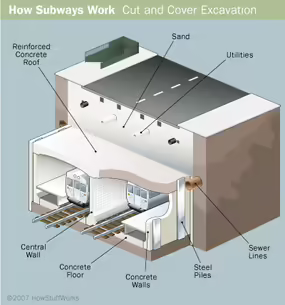
The primary barrier to affordable subway construction is excavation. Tunnel boring costs billions per mile. The alternative — cut-and-cover, where you dig an open trench, build the tunnel structure and fill it back in — is far cheaper, but it means tearing up city streets for years. The ongoing Kenilworth Tunnel for the Green Line is one example of how even the cheaper model is still cost-prohibitive.
As Brian Potter documented in Works in Progress, “Cut and cover is a much more disruptive construction method (since it tears up the street while construction is taking place), but it’s often much cheaper than using a TBM (tunnel-boring machine).” Because of protections like NEPA, cut-and-cover is now less viable in dense urban areas than it once was.
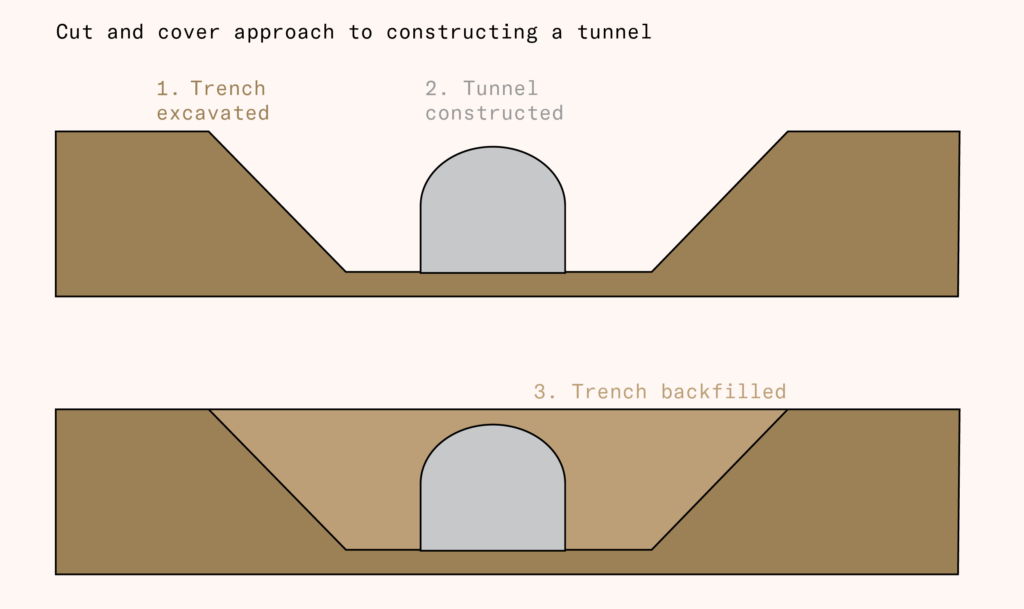
In the case of the I-94 trench, this tradeoff of two expensive options would be avoided entirely because the “cut” already exists as today’s I-94 roadbed, and any disruption is already inevitable.
The corridor between the downtowns of Minneapolis and St. Paul is, right now, an open trench. If the At-Grade alternatives for I-94 move forward, this trench could be filled. The civil engineering opportunity is staring us in the face: build the subway tunnel box first, then fill and build a neighborhood on top of it. As Mr. Potter continues: “The most straightforward method is to dig a trench with gently sloping sides that require no additional support.” Sound familiar? We could get subway infrastructure without the boring costs or the disruption costs, because the ideal cut already exists and the surface is already to be torn up.
This is a once-in-a-century opportunity, and it is obvious once you think about it. Once that trench is filled and a street and buildings are built on top, the cost of subway construction reverts to the billions-per-mile figures that make American transit projects so daunting, and permanently in the realm of fantasy.
The time to act is now.
Rail wasn’t sincerely considered
Rail in the trench is an idea that has been circulating in the community for years. Jesse Cook argued for regional rail in this corridor in 2023, and Seth Bose made a detailed case for subway and commuter rail in the trench in 2024. Both were right about the fundamental opportunity. I am not proposing an ambitious transit plan, but framing an achievable economic transformation through a single trunk connection, effectively merging the two downtowns.
When MnDOT summarily dismissed rail options from Rethinking I-94, they sorted all of rail transit into three categories: light rail, commuter rail and high-speed rail. Light rail was unsurprisingly excluded because it would parallel the Green Line. Commuter rail was excluded because I-94 isn’t a suburban commuter corridor. And high-speed rail was excluded … because it’s high-speed rail. A subway, the most proven form of urban heavy rail on Earth, wasn’t even a category. MnDOT, still living up to its former name of the Department of Highways, defined rail so abstractly that a subway couldn’t even enter the conversation. The framing choice itself quietly foreclosed the most transformative (and weather-agnostic) option before anyone could evaluate it.
The Green Line is for local access, and the Gold Line is a regional connector
The Twin Cities already have a rail connection between the two downtowns. The Green Line light rail takes about 45 minutes end to end, crawling along University Avenue through dozens of traffic signals with station spacing measured in city blocks. Adding connections to the light rail just makes it even less appealing for longer jaunts. Yes, it’s good at being a neighborhood circulator, but it is not a competitive alternative to driving between Minneapolis and St. Paul, which takes about 16 to 30 minutes on I-94 depending on the time of day. A 15-minute subway trip would beat driving (not even counting circling for parking) at peak and could even match it during off-peak periods.
Metro Transit knows this. The Gold Line BRT, which opened in 2025 connecting Woodbury to downtown St. Paul, is scheduled to be extended along I-94 to downtown Minneapolis in the coming years, supplanting the underrated, but basic, 94 bus. That bus extension will remain faster than the Green Line for intercity trips, but it’s still a surface-running vehicle subject to freeway congestion variability, weather and limited capacity. It’s an incremental improvement to a problem that calls for a structural solution.
Despite a very common misconception, the Green Line was never designed to be a fast connection between the downtowns. As David Markle documented on this site in 2014, the I-94 Green Line alignment was the original preferred route for its speed and ridership, but was abandoned in favor of University Avenue for economic development reasons. A decade later, University Avenue’s businesses and residents are served, but the cross-town speed gap remains.
Transit research consistently shows that mode shift accelerates as transit trip times approach equivalent driving times. The Green Line, at about three times the driving time end-to-end, doesn’t come close. The Gold Line extension will narrow the gap, but won’t close it. A true subway running directly between the two downtowns through the I-94 corridor could be not only competitive with driving in ideal conditions, but more reliable than driving because it wouldn’t be affected by crashes, weather, construction, or rush hour congestion.
Reliability and frequency (i.e. convenience) would spur behavior shifts. Busy people don’t just want transit to be fast “on average.” They want to trust that it will be fast every time.
Few stops, maximum impact
This line doesn’t need twenty stations. It needs the right ones. A limited-stop subway — perhaps just one intermediate stop between two downtown terminals — would keep trip times short while connecting the nodes that matter most.
Snelling is the obvious midpoint choice. It’s the crossroads of the Midway, adjacent to Allianz Field and close enough to the State Fairgrounds to serve as a relief valve during the Great Minnesota Get-Together. A Lexington-area stop could serve the dense residential neighborhoods along University, any future Reconnect Rondo cultural enterprise district and connect to key north-south bus routes. Each station would be a seed for the kind of transit-oriented development that surface-level transit has struggled to catalyze at scale in the Twin Cities.
Fewer stops means faster end-to-end times, which is the whole point. This isn’t a local connector; it’s a neural connector.
This isn’t just about moving cars. It’s about merging two downtowns.
MnDOT’s I-94 Scoping Decision Document evaluates alternatives primarily on vehicle throughput — how many cars can move through the corridor per hour. This framing misses the real economic question, which is not about vehicles but about access. The metrics that matter are the effective size of the labor market, customer base and amenity pool comfortably reachable within about 20 minutes.
Right now, Minneapolis and St. Paul function as two separate downtown economies. They overlap in some ways, but have distinct restaurant and entertainment scenes, at least for those who want to use transit instead of driving and parking.
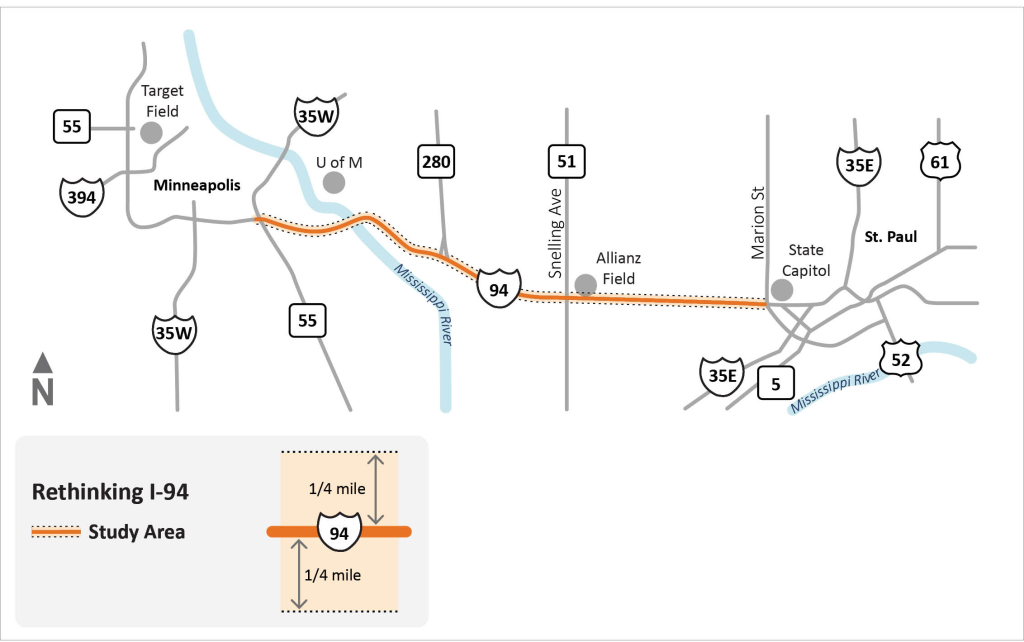
We still lack the kind of seamless connectivity where a consultant in a St. Paul office takes a meeting in Minneapolis and is back before lunch, or where a Lowertown restaurant draws from the Minneapolis happy hour crowd. These are people who have cars. They’d just rather not use them if the alternative is genuinely faster and more predictable than navigating traffic and parking.
A subway at 15 minutes end-to-end would create that connectivity. It would functionally merge the two downtowns into a single economic zone. A lawyer in St. Paul could take a deposition in Minneapolis and return within the hour. A startup in the North Loop could recruit from the opposite end of the metro core without asking employees to endure an hour-long transit commute. Two mid-sized downtowns become one large one — and a combined downtown of that size could better compete, draw and retain corporate headquarters, conventions and talent.
A tighter metro is a stronger metro
Today, visitors tend to pick a city and stay there — you’re either doing the Minneapolis thing or the St. Paul thing. Even AAA publishes separate travel guides for each, as if they were different destinations entirely. If they’re dealing with a rental car for each destination, they might be right.
A subway measured in mere minutes turns the Twin Cities into a single destination. A visitor staying near the Minneapolis Convention Center can catch a Wild game downtown St. Paul and be back at their hotel without fighting out of the parking garage or staying up till midnight. A family visiting the Science Museum in St. Paul can add the Mill City Museum to the same afternoon without thinking about parking. The “Twin” in Twin Cities finally becomes a feature rather than a logistical inconvenience.
Major events would benefit enormously. Anyone who’s tried to leave an Allianz Field game on the Green Line knows what surge demand looks like on infrastructure pushed to its limits — trains stuck at red lights on University Avenue limiting throughput. Now scale that problem to a Vikings game or a major concert. A high-capacity subway line between the two downtowns distributes the load, drawing from parking, hotels and restaurants on both ends of the corridor. When the Super Bowl, World Series, Final Four or the X Games returns, the metro operates like a single venue rather than two cities awkwardly cooperating. That event-hosting capacity is a selling point that no road investment can match. (Reluctant bonus points if you connect the downtown terminus stations directly to the skyways.)
More broadly, this is about what kind of metro area the Twin Cities wants to be. The cities that are pulling ahead globally, in talent attraction, in corporate investment, in quality of life, are the ones with fast, reliable, grade-separated transit connecting their cores. The Twin Cities have world-class cultural institutions, a strong and diversified economy, major sports in both cities and two of the best park systems in the country. What they lack is the connective infrastructure that makes all of those assets feel like parts of a single place. A subway fills that gap in a way that no road, bus or light-rail train can.
Leverage the Underutilized Union Depot
St. Paul’s Union Depot is already the convergence point for the Green Line, the Gold Line, Amtrak, local bus routes and intercity bus service. The hub-and-spoke transit network radiating from Union Depot (and to a lesser extent Target Field Station) would multiply in value the moment a high-speed subway link connects it to Minneapolis, because every spoke would suddenly provide access to both downtowns.
Consider what this means for the Gold Line rider in Woodbury, or the upcoming Green Line Extension rider in Eden Prairie. Today, those lines deliver you to one downtown. With a subway connection measured in mere minutes, they effectively deliver you to both. The entire regional transit network becomes more useful even without adding a single new suburban line.
This is the kind of “network effect” that transit planners dream about. Individual lines become more valuable not because they’ve been extended or improved, but because the connective tissue between them has been transformed.
The first line proves the concept
A subway network should start with its strongest corridor. That first line has to justify everything that comes after it — and the I-94 corridor is, by a wide margin, the strongest possible first line the Twin Cities could build. It connects the two largest employment centers in the state along the most heavily traveled corridor. If heavy rail can’t prove itself here (it can), it can’t prove itself anywhere in the region.
But if it does prove itself (it will) — and the ridership demand between two connected downtowns suggests it would — the I-94 subway (the “Rondo Line,” perhaps?) becomes the anchor for future expansion. The first line creates the operational knowledge, the maintenance facilities, the political constituency and the demonstrated ridership to make the next line possible.
Even in modest ridership projections, you’ve still built heavy-rail transit on the single highest-demand corridor in the Twin Cities. There is no better location for this investment in our metro. If not here, then nowhere. And if it’s going to be here eventually, building it while the trench is open is the only version that makes financial sense.
Look to Munich
When Twin Cities urbanists look for international models, Nordic cities are a popular reference point. But the more instructive comparison is Munich (one metric that shows MSP is comparable to Munich is that our primary airports have nearly identical flight traffic volume). Both cities lost many of their historic structures. They both have world-famous urban fairs. Germany is also the country of the Autobahn, and the home of BMW, Mercedes and Porsche. A car-loving culture. Sound familiar?
And yet Munich built one of Europe’s best integrated transit systems — U-Bahn, S-Bahn, trams, extensive bike infrastructure — and has been progressively pedestrianizing its center and calming traffic for decades. Munich didn’t achieve this by banning driving; it gave people alternatives good enough that driving became a choice rather than a necessity.
If BMW’s hometown can build a subway and make it the preferred way to cross the city, the Twin Cities can too.
MnDOT’s road logic doesn’t work in reverse
MnDOT defends rebuilding I-94 by optimizing for vehicle throughput — how many cars can move through the corridor per hour. But nobody at MnDOT would propose bulldozing Franklin or Selby avenues to build a new freeway, even though doing so would, on paper, make it faster to drive across the city. The logic only flows one direction: it justifies keeping freeways, but can’t justify building new ones. That inconsistency reveals the flaw in the project’s Purpose and Need statement, which treats “mobility” as synonymous with car capacity.
A subway flips the question. Instead of asking how many cars the corridor can move, it asks how many people the corridor can connect — and delivers an answer no road configuration can match. A single subway line running at single-digit-minute headways can move more people per hour than a six-lane freeway, with zero emissions, zero crash risk and zero noise pollution for the neighborhoods above.
This works with any alternative, but one version is clearly better
My proposal is a cut-and-cover subway beneath a filled trench with a city street and amenities above. This would be grade-separated, weather-protected, have no conflicts with surface traffic and the construction savings that come from building in an open excavation. The result is a true subway merging the downtowns.
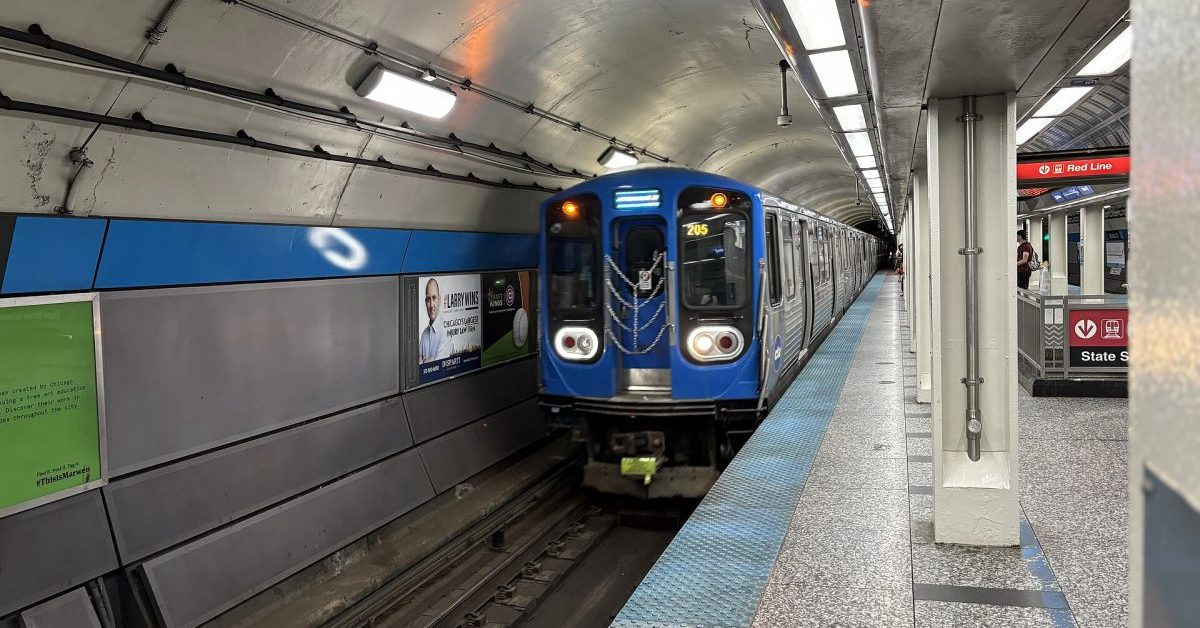
But even if the freeway is rebuilt, rail belongs in this corridor. Chicago’s Blue Line has run at grade in the median of the Eisenhower Expressway since the 1950s, a model adopted by cities across the country. The line transitions underground as it approaches downtown Chicago. The same could work here: rail in the median through the corridor, transitioning to subway as it enters each downtown and connecting directly into the urban cores.
The right-of-way and trench are already there. The question is whether we allocate any of it for heavy rail when the corridor is reconstructed. I submit that filling the trench after building a subway underneath is the best answer. Rebuilding the corridor with no rail at all is the only answer we should refuse to accept from MnDOT.
The window is now
Rethinking I-94 is a generational decision point for our entire metro. But the conversation has been too narrowly viewed as mere variations on road design: how many lanes, what speed limit, which interchange configuration. These are important details, but they are details of a 20th-century American transportation paradigm.
Ask: when this trench is open and construction crews are on site, what do we build that our grandchildren will thank us for? A wider road? How about world-class, connective infrastructure that turns two mid-sized cities into one major one? Then cap it with a vibrant boulevard on top.
For better or worse, the trench is already dug. The opportunity before us is obvious. A rethought I-94 without incorporating rail might permanently foreclose the most transformative transit investment the Twin Cities could make. It’s time to actually rethink I-94.
Build the Rondo Line Subway.