Sarah Johnson moved to Saint Paul from Omaha in 2023 with a lot of baggage. Not the suitcase kind — the kind that comes from spending years pushing a city toward better bike infrastructure, watching it actually happen, and then watching the city tear it apart anyway.
In Omaha, Johnson had been a bike shop owner, a co-founder of advocacy nonprofit Mode Shift Omaha, and the person most responsible for getting the city’s first on-street bike corral installed in the Benson neighborhood in 2013. She’d done everything right: built a coalition, secured a signed agreement with the city, celebrated at a ribbon cutting. Then, six years later, the city’s Public Works department showed up one morning and started removing it. No notice. No data to justify it. No meaningful accountability afterward.
So when Johnson landed in Saint Paul and immediately started noticing the absence of on-street bike parking, she had reason to be skeptical. She got involved anyway.
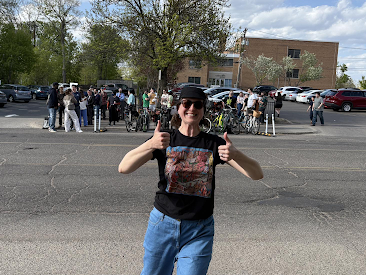
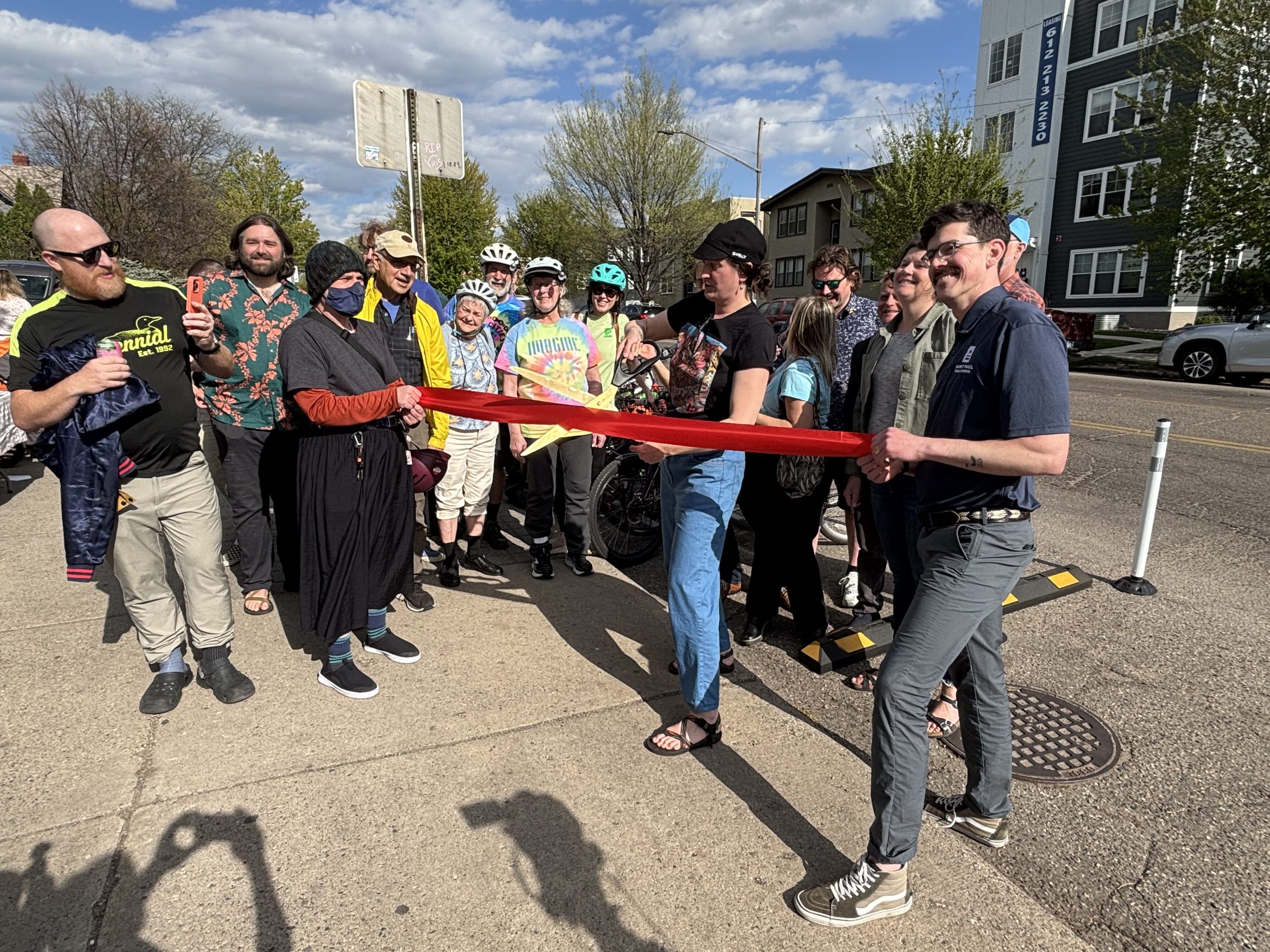
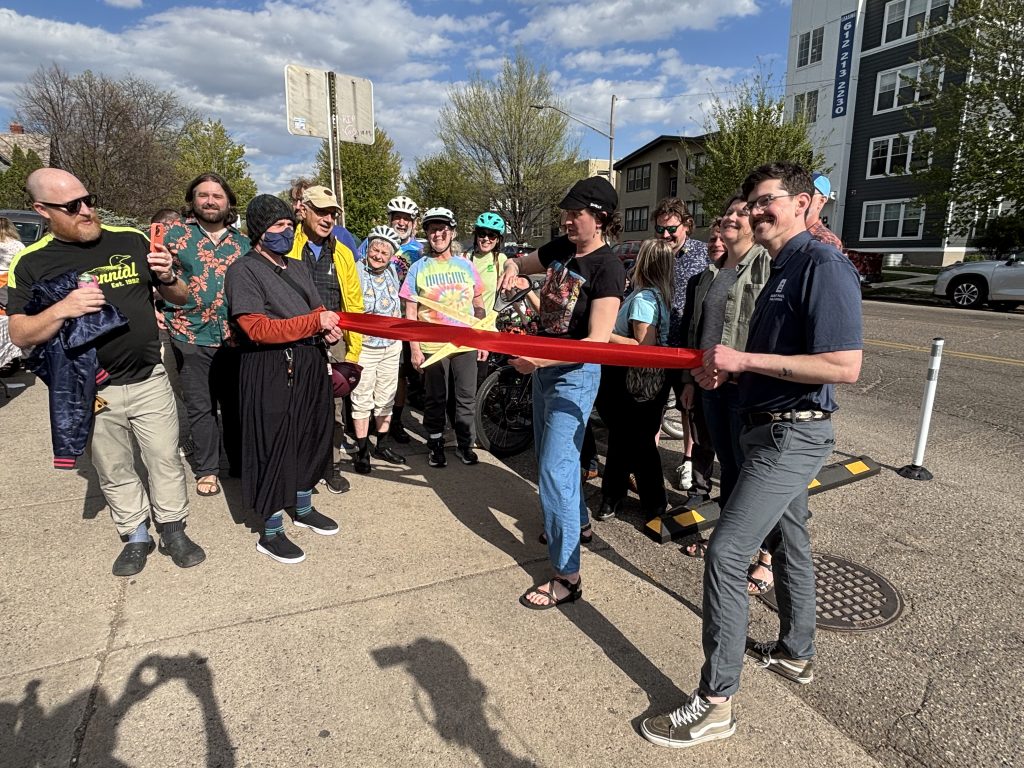
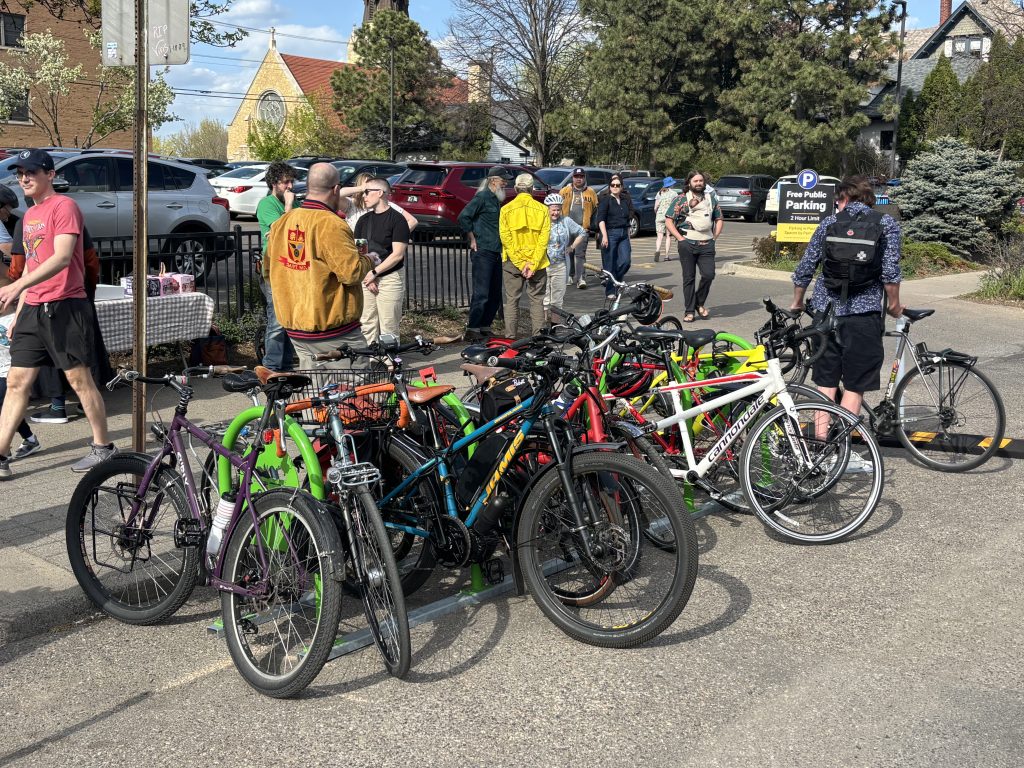
Last Friday, she stood with a crowd of excited members of the public on the sidewalk outside Dunn Brothers Coffee at 1569 Grand Ave, and upon the third try, managed to successfully cut the ribbon — complete with a pair of (somewhat dull) giant scissors — on something that hadn’t existed in Saint Paul less than a year ago…when she first sent an email asking whether it could.
“When someone shows up not in a car and they see that there is dedicated bike parking they get to have the reaction of ‘Oh, this is for me? I belong here.’ It’s not an afterthought, it is intentional,” said Johnson shortly after cutting the ribbon.
An Email, A Bounced Address, and a Policy Nobody Was Using
The story starts, as a lot of good advocacy stories do, with Johnson not knowing exactly who to call. She was on the Macalester-Groveland Community Council board and its Transportation Committee, and had been hearing recurring frustration about the lack of bike parking on Grand Avenue. “I was mostly shocked that on-street bike parking wasn’t at all discussed during the Grand Ave. streetscape redesign,” remarked Johnson. In May 2025, she emailed a city contact about Saint Paul’s bike corral policy — and got a bounce. The contact had left the city.
She found her way to Jimmy Shoemaker, a transportation planner with the city’s Department of Public Works. What she learned from him was both encouraging and deflating: Saint Paul had technically allowed on-street bike corrals since 2019. The policy just hadn’t gone anywhere. In five years on the job, Shoemaker was only aware of one or two active corrals in the entire city. His read on why? Businesses either didn’t know the program existed, or they did know — and decided the terms weren’t worth it.
Under the 2019 policy, the business in front of which a corral sat was responsible for everything: purchasing the racks, paying for installation, pulling them out before October 31, storing them through winter, and reinstalling them every spring. The permitting fee started at $100 a season. For a small business already stretched thin, that’s a significant ask for infrastructure that benefits the whole block.
Johnson had seen this pattern before. In Omaha, placing all the burden on a single business had been a recurring source of friction. She knew what a more workable policy looked like, and she started pushing for one. At the same time, she started looking for a way to get something built under the existing rules — because sometimes you move the policy and sometimes you just find the funding that makes the policy irrelevant.
She found both.
The Grant That Changed the Equation
The Macalester-Groveland Community Council (MGCC) was in line to receive funding through Saint Paul’s Commercial Corridor Organization Assistance Program (C-COAP, now known simply as the Commercial Corridor Program) — a city grant aimed at economic development and beautification along commercial corridors. When Johnson realized the funding could potentially cover bike corrals, the dynamic shifted.
One of the main barriers in the existing policy was cost. C-COAP grant money could cover purchase, installation, and in the case of this pilot, the ongoing snow removal that had made year-round installation seem impossible. With community council funding in the picture rather than individual business owners, the whole premise of the policy’s burden-sharing could be renegotiated.
It still required persistence. Johnson sent emails that didn’t get replies and followed up anyway. She looped in fellow MGCC board member Hugo Bruggeman, who helped research how other cities — Chicago, Denver, Portland — had structured their corral programs. She reached out to other district councils receiving similar corridor funding to build a broader case. She got quotes from vendors, ran the numbers, and proposed specific locations.
She also hit walls. The city was understaffed. A grant application for a consultant-led bike parking policy review came back denied. Shoemaker was candid about what the city could and couldn’t do on its own: any deviation from the existing policy, including leaving corrals out through winter, would need to be demonstrated through a pilot, cleared with the Right-of-Way and Permitting division, and coordinated with snow plow drivers. None of that was fast.
Johnson pushed anyway. She offered to be a partner rather than a petitioner. She proposed a one-year pilot on Grand Avenue at three specific locations. She responded to the city’s concerns with research, cited precedent from peer cities, and kept the correspondence warm even when the replies were slow.
“I thought it was cool that Macalester-Groveland challenged us to leave these out year round,” noted Shoemaker, which helped to overcome the small-business challenge of off-season storage.
Finding the Right Vendor, Finding the Right Spot
Johnson got quotes from Dero, the rack manufacturer she’d worked with in Omaha, and from Cyclehoop, a Minneapolis-based company. The Cyclehoop quote came in notably lower — $7,155 for all three corrals across the sites. They’d also deliver and install, which simplified the logistics considerably. Ultimately, MGCC went with a third vendor, Parkitect, which offered 15 percent off and free delivery with installation. Parkitect being based out of Isanti, MN meant a lower carbon footprint for delivery.
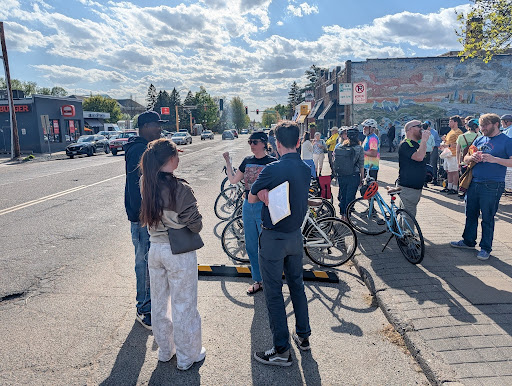
Finding the right locations proved equally important. Rather than tying the corrals to a specific business’s frontage — as the existing policy required — Johnson had wanted to use underutilized street space near parking lots, closer to the “daylighting” approach that’s shown up in other cities’ programs. That wasn’t possible under the 2019 policy, but the pilot would end up at four locations — two at Dunn Brothers Coffee and Kowalski’s Market, another at Shish, and one on the back patio entrance of Catzen — where business buy-in came together.
Should Saint Paul expect to see more on-street racks near business districts? “The short answer is yes, if there is funding it is scalable,” said Jimmy Shoemaker. He went on to say that the best way to showcase success is if the adjacent businesses are happy and see the racks being utilized, adding that he doesn’t see the issue of the rack occupying an on-street parking spot as being a problem. “There is plenty of on-street parking, I’m not really concerned with that.”
The corrals went in last month. Each one occupies the footprint of a single car parking space and holds up to ten bikes. They will stay in place through winter 2026-2027, with a third-party contractor handling snow clearing, while the city collects data on usage. If the pilot works, it becomes the template for what Saint Paul’s updated corral program could look like — one where the funding can flow through corridor programs or district councils, the maintenance burden gets shared, and the racks don’t have to come down every fall.
What This Took
Start-to-ribbon-cutting took just under a year. Johnson sent her first email in May 2025. The corrals opened in April 2026.
That’s fast. Johnson will be the first to tell you it’s fast, especially measured against the ten-year slog of Omaha’s protected bike lane pilot — or, for that matter, the six years of work she put into the Benson bike corral before a Public Works crew showed up and took it away.
What made it move? A few things came together: a city contact in Shoemaker who was genuinely supportive and kept the conversation going even when the policy made progress difficult; a community council with grant funding that removed the cost barrier; and an advocate who showed up persistent, specific, and collaborative enough that “no” kept becoming “not yet.”
“You should aim high for projects like this, especially when they are allowing us to be creative,” was the advice Johnson has for other advocates. She went on to say that what felt like ‘shooting for the moon’ on this project meant ending up with three new racks on Grand Ave in addition to year-round maintenance.
Johnson brought her Omaha PTSD to Saint Paul, as she put it herself, and also brought the playbook she’d built from it: build your coalition early, get the funding sorted, make it easy for the city to say yes, and don’t stop following up. The Grand Avenue corrals are the result.
Now she wants to see them replicated. 18 corridors will be receiving funding, with six Saint Paul neighborhoods already earmarked for Commercial Corridor funding with bike parking in mind this year. The pilot data from Grand Avenue could be the evidence that makes the case for all of them.
“This is incredible — what we have right here,” said Saint Paul resident James Slegers pointing to the new rack, adding that he’d “love to see these in front of Cafe Latte… we should have these in front of the Farmer’s Market where parking is atrocious. I think that’d be pretty great!”
Saint Paul residents and visitors are encouraged to fill out a brief survey about on- street bike parking. It can be found on the City of Saint Paul’s Microsoft Cloud Survey, or by emailing [email protected].