With federal hostility toward bike and pedestrian funding, the Twin Cities should shift authority from the highway department to a unified regional agency focused on people.
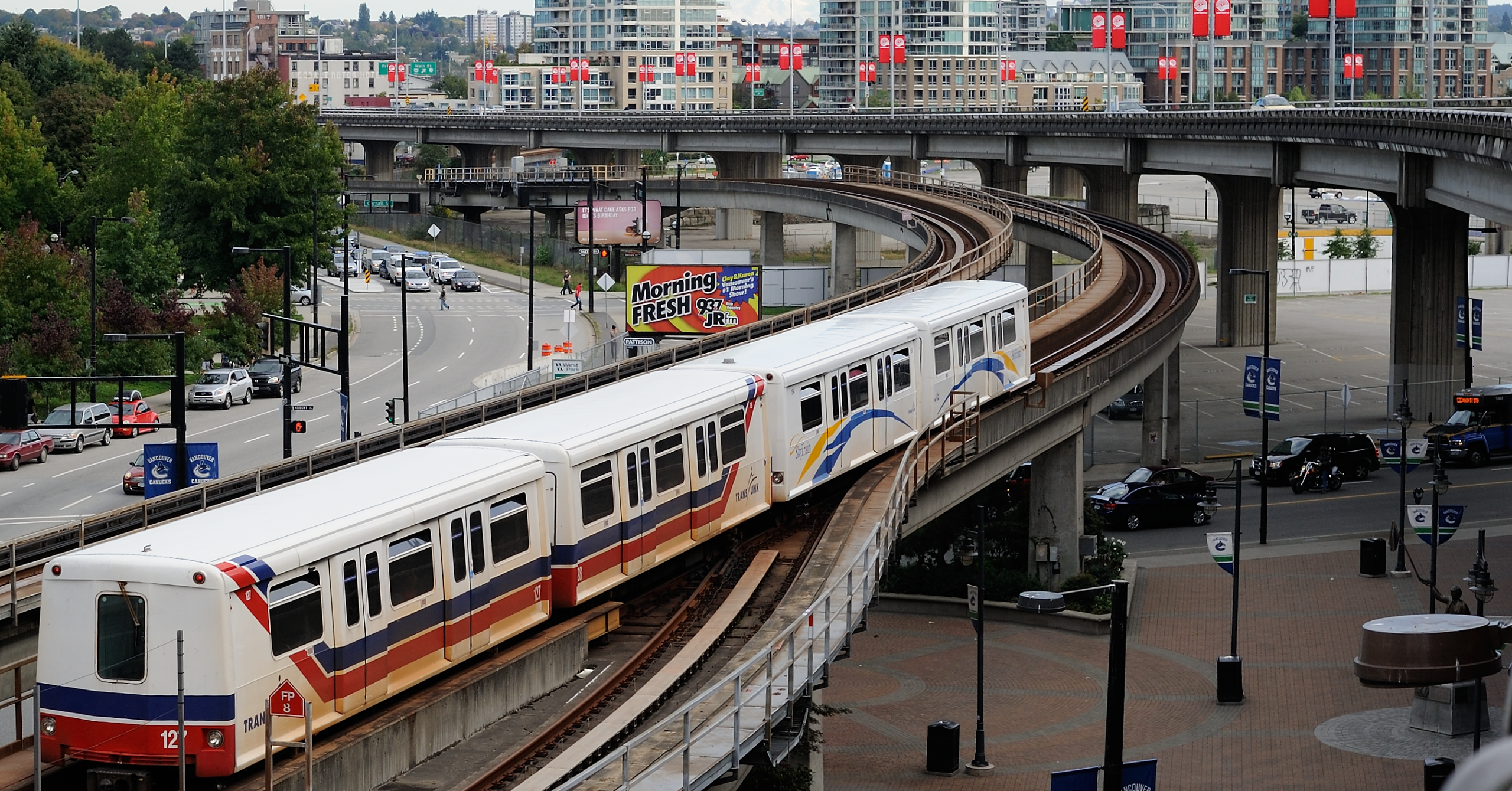
The second Trump administration has vowed to reallocate federal funding for bicycle lanes and sidewalks to highways. For St. Paul, which relies on this funding to complete its ambitious bicycle plans, the threat could jeopardize the project’s completion. It may be time for St. Paul and cities like it to look at other projects, like Vancouver’s TransLink, as we consider our own public transit future.
Before last year’s election, Project 2025 (a policy plan created by the conservative think tank The Heritage Foundation, which has some relation to actions by the contemporary Trump administration), called for federal funding for “hiking trails, bicycle lanes and local sidewalks” to instead be reallocated to highways, and for active transportation projects to be the “sole responsibility of local or state governments, [and] not dependent on [federal] funding.”
The U.S. Department of Transportation under the second Trump administration has moved to review—and in some cases revoke—grants tied to climate, environmental justice and active transportation. Combined with the Project 2025 blueprint, which argues that federal dollars for “hiking trails, bicycle lanes and local sidewalks” should be left to states and cities, St. Paul’s bike plan faces a funding cliff. If federal support recedes, Minnesota should respond not with piecemeal cuts, but with a structural fix: unify our region’s transportation authority so streets, transit and bikeways are planned and funded as one system
Federal Impacts on Local Community Transportation
Federal orders like these spell trouble for cities such as St. Paul, which market themselves as bike-friendly but lack the dedicated, protected infrastructure that would make traveling by bike safer and more accessible. In Saint Paul’s Bicycle Plan, adopted more than a year ago (April 2024), references to federal funding for the expansion and improvement of the city’s bicycle network appear numerous times. The network of bicycle infrastructure anticipated in this plan is aimed to add 108 miles of additional bikeways in St. Paul, most of it protected from car traffic — a 47 percent increase over the size of the network in 2024.
However, the absence of federal favor for active transportation for an unknowable period of time, in a place where municipal finances are already tight, adds a challenge in moving the plan from paper to pavement.
Roads are expensive
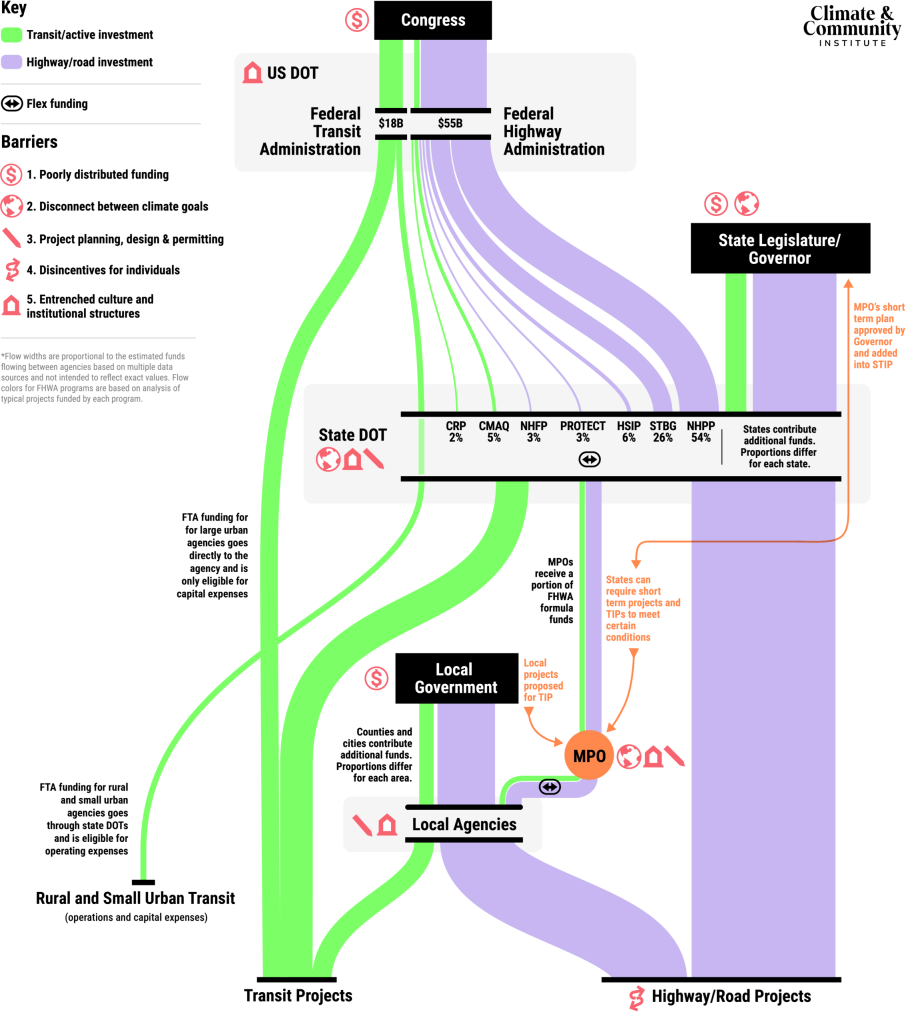
I have alluded to this before, Society has progressed past the need for additional roads. We must consider the dual costs of building new roads and maintaining them, the underfunding of transit, pedestrian and bicycle infrastructure, as well as the social imperatives of the climate crisis and traffic casualties. A recent report from the Climate and Community Project has called for a national moratorium on road and highway expansions. This flow of money, with different streams for highways and transit, illustrates how the current fragmented system creates financial and institutional barriers to the integrated, people-focused network the Twin Cities needs.
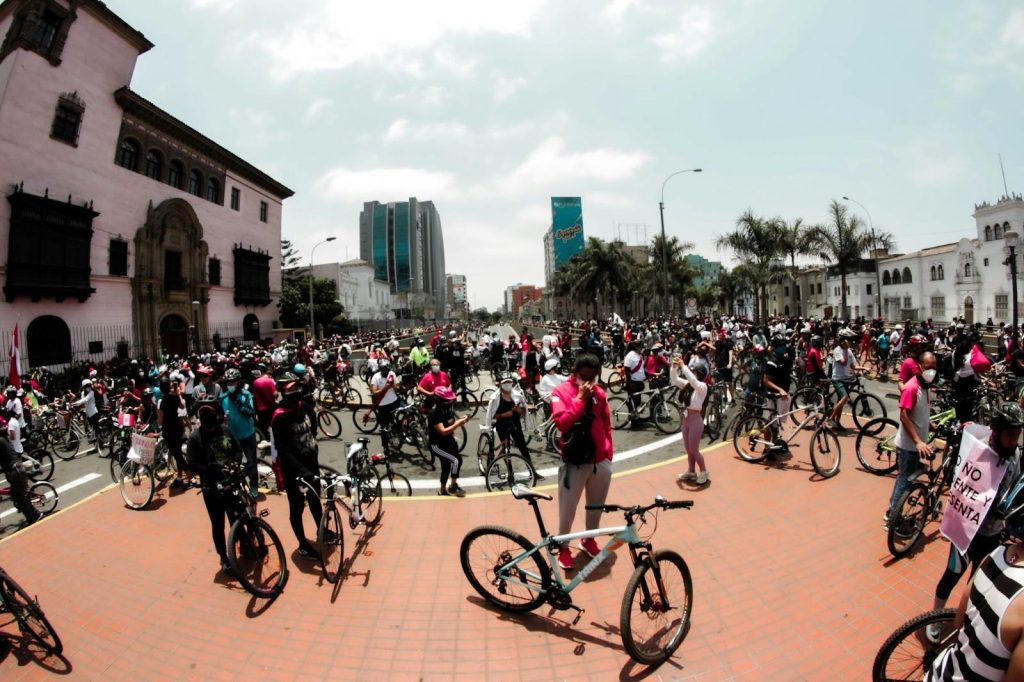
The report places much of its focus on the reallocation of funds from highways to transit, but there is significant space for sneakers and spokes in an alternative transportation system. Compared to other forms of transportation infrastructure, facilities for walking and bicycling are relatively inexpensive, and the returns on investment can be immense. Furthermore, developments beyond infrastructure, such as the advent of cargo bicycles (and sharing systems), and bike trains for schoolchildren, demonstrate that bicycles can be for people and circumstances beyond fearless commuters or lycra-clad hobbyists.

A different model of transportation governance in the Twin Cities?
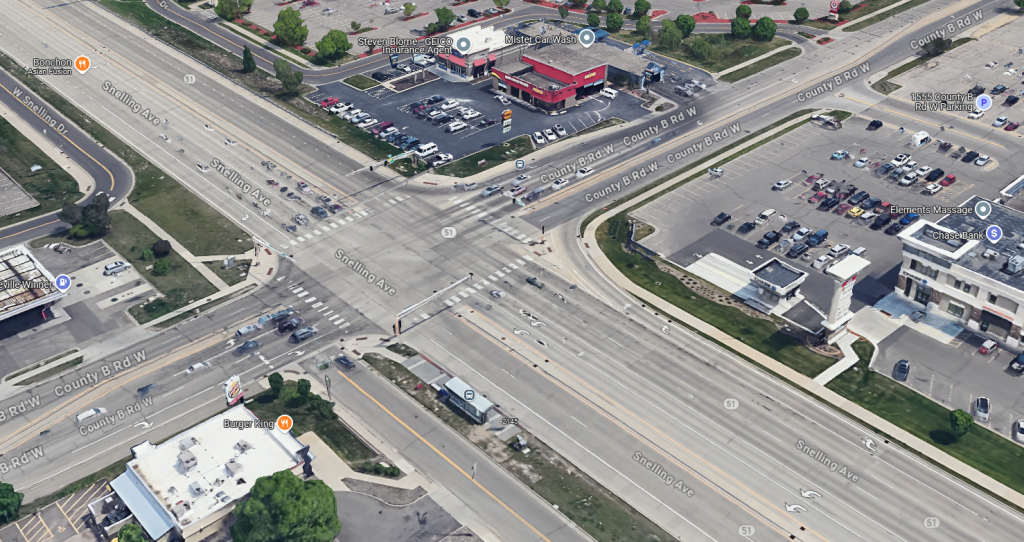
Minnesota’s current transportation landscape is hampered by fragmented decision-making, right down to the street. MnDOT controls trunk highway, even when they run through cities like St. Paul (think Snelling Ave/TH-51), which constrains municipalities’ ability to redesign streets with safety, access or multi-modal goals in mind. At the same time, regional planning by the Metropolitan Council and siloed city or county efforts lead to piecemeal investment and inconsistent policy. This patchwork approach creates delays, inefficiencies and conflicting priorities, ultimately steering money away from active-transportation projects and toward car infrastructure, despite public demand and climate urgency.
Furthermore, these entities often have different priorities. The cities of St. Paul and Minneapolis, and Metro Transit, often have urbanist-friendly goals in mind, such as increasing the proportion of people moving around without a car. On the other hand, MnDOT, although making great strides to include active transportation, transit and public health within its purview, has yet to fully shed its prior identity as the “Department of Highways.”
MnDOT has yet to fully shed its prior identity as the “Department of Highways.”
This organizational hodgepodge has resulted in uncoordinated outcomes at the ground level, usually to the detriment of making transit facilities more accessible to those outside of a car.
I believe that unifying transportation responsibilities in the Twin Cities—perhaps in the full seven-county metro—would serve the area well in better coordinating different aspects of the transportation network. Such a consolidation could also unify the direction of state and local transportation resources towards a direction more supportive of walking and bicycling.
More to the point, in considering what it might take to steer the state’s collective transportation resources away from highways, I wonder how much utility there would be in shifting some transportation responsibilities in Minnesota away from MnDOT, and towards a more urbanist-friendly entity.
Towards a Cohesive, Sustainable, Regional Transportation System: TransLink in Metro Vancouver
Immediately prior to living in Minnesota, I resided in Vancouver, Canada, and experienced a transportation system like the hypothetical I posed above. In the Vancouver metropolitan region, one organization manages not only public transit, but also major roads and bridges, regional bicycling infrastructure and regional transportation and planning research: TransLink. The organization was established in 1999, with the divestment of transportation and transit responsibilities away from the provincial government of British Columbia, and towards a unified authority for its most populous region.
While not perfect, the net outcome I have seen in such organizational unification is the orientation of the entire regional transportation network towards TransLink’s most significant responsibility: public transit.
On the ground, this looks like a transportation network where bicycle and transit facilities are integrated into the fabric of the streets, roads and rails, rather than seemingly tacked on, like an inconvenient afterthought. From such a perspective, bicycle, transit and pedestrian facilities are less of a do-good amenity and more of a way to reduce expenses from wear and tear on roads, generated by an ever-increasing volume and mileage of vehicle traffic. Planning for cars, bicycles and buses is integrated into a comprehensive regional transportation scheme.
Perhaps most importantly, in a context where federal support for transportation funding of any kind — potentially even including highways — is not guaranteed, I wonder about the extent to which a TransLink-type transportation authority for the Twin Cities might be able to more efficiently plan and manage mobility in the Metro, compared to contemporary trifurcation of Metro Transit, MnDOT and local governments. If Minnesota, like other states, runs the risk of being left alone to sustain its transportation systems, every dollar counts, and each cent spent with agencies at loggerheads — like a local government constructing a bicycle boulevard, only for it to be bifurcated by a congested state highway (for example, the intersection between Charles and Snelling Avenues in St. Paul) — limits the ability for governments in Minnesota to create a safe, sustainable and useful transportation system for all, under limited circumstances.
What Is to Be Done?
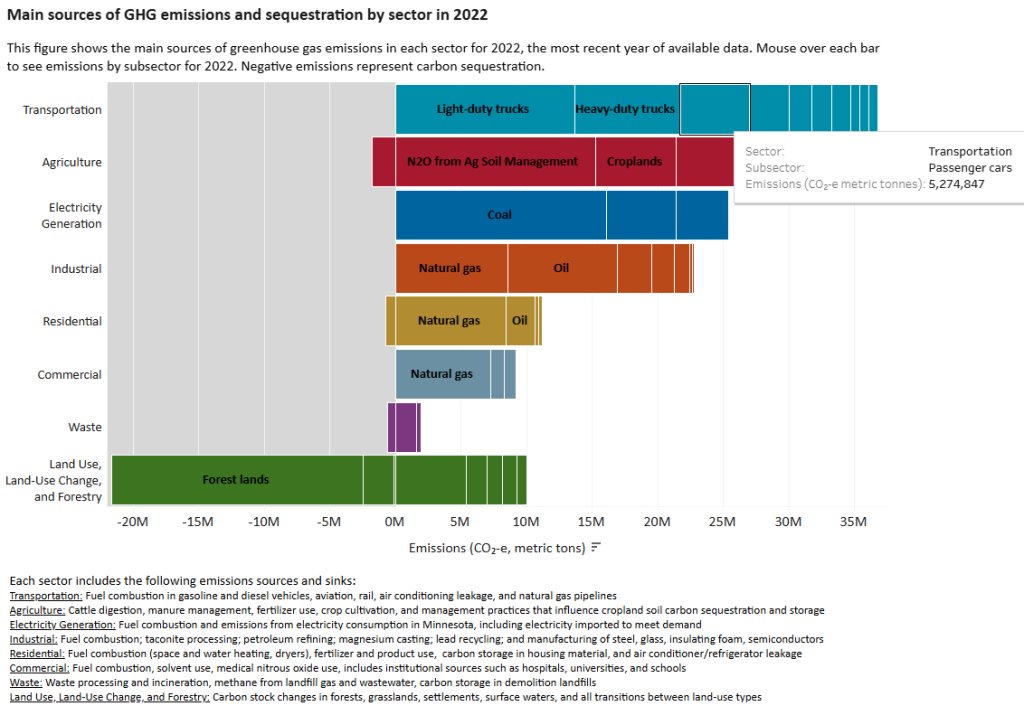
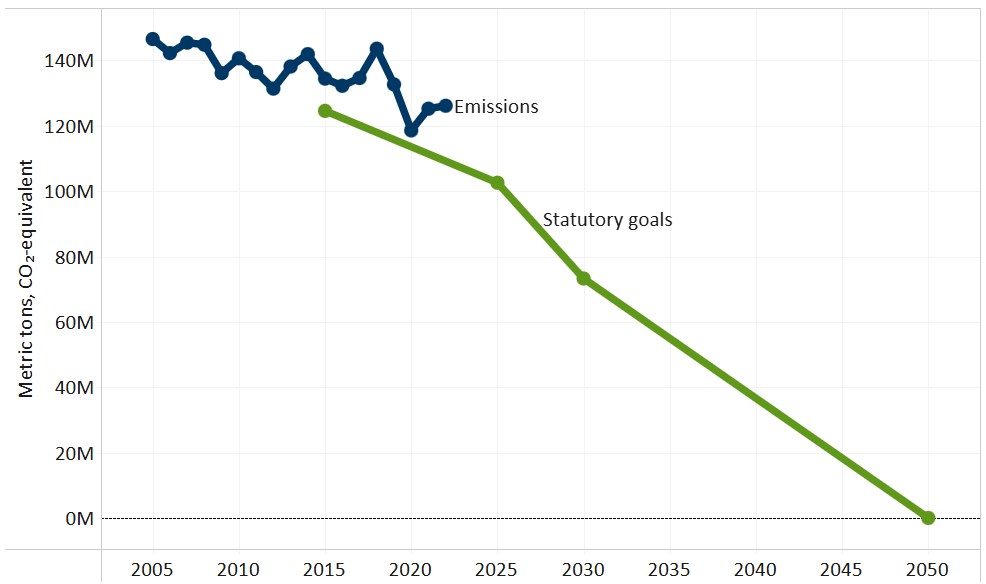
From fires to floods, the impacts of climate change are here to stay — and if anything, intensify over the coming years. Transportation is the largest source of greenhouse gas emissions in the United States and Minnesota. Any meaningful reductions in greenhouse gas emissions will derive, in large part, from shifting away from driving and towards walking, bicycling and transit.
There is a public health imperative for active transportation infrastructure. Traffic fatalities in Minnesota increased by 26 percent from 2019 to 2022 and by a further 12 percent, according to an article from the St. Cloud Times, from 2023 to 2024. The cost in human life, while quantifiable, is ultimately incalculable — “at least 479 people died on Minnesota roads” in 2024. These figures are largely the result of unsafe driving behaviors and risks inherent to the act of driving itself — namely, the ability to bring a multi-ton steel vehicle to high speed in seconds with a simple press of the foot.
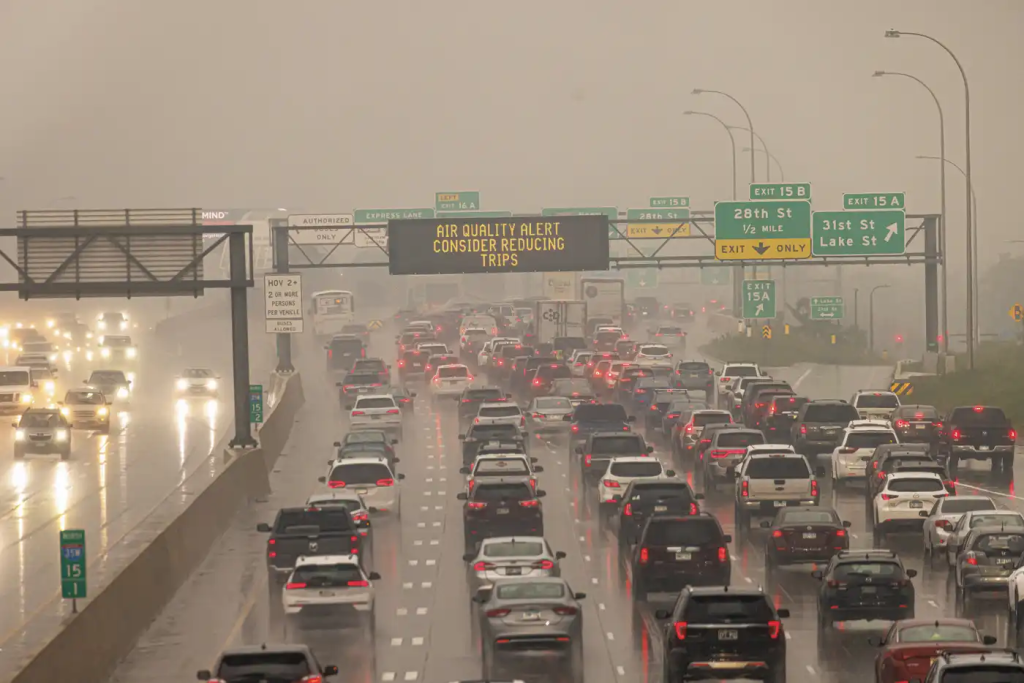
The orientation of Minnesota’s transportation system around driving is also detrimental to air quality. The most significant air pollutants in Minnesota today come from vehicles, which, in turn, can contribute to lung and heart diseases and early death. Although controlling some of the most extreme inputs in Minnesota’s air quality is outside of our direct control (Canadian wildfire smoke), Minnesota’s transportation emissions are, at least nominally, within the internal control of the state.
Final Thoughts
Perhaps in a perverse sense, the abdication of responsibility in the Trump administration for transportation (not to mention a host of other fields) might present an opportunity for progressive local and state governments in the United States — such as Minnesota and the Twin Cities — to act more assertively in addressing the dual issues of death on the roads and of climate change, on every potential avenue of advance. This past year, bills in the state House (HF 186) and Senate (SF 817) were introduced to allow state highway funds to be used for active transit purposes as well, rather than roadways for cars alone. Actions within state DOTs can also ensure limited resources within the state can be allocated to less costly infrastructure than supports for cars and trucks.
Here, I only offer one suggestion, merely in the organization of existing resources and responsibilities at the local and regional level of governance. It is my inclination that a unified regional transportation authority in the Twin Cities metro, considering the totality of the resources at its disposal and the circumstances at hand, would allocate more of its attention and treasure towards integrating walking and bicycling into a meaningful, primary way of moving around the region, rather than the add-on or afterthought it too often is at the moment.
There is little to indicate when, or how, the federal government’s auto-oriented posture may shift — next month, next year, in 2029, maybe never. Even if there is a change in circumstances where a federal administration opens its arms again to active transportation, who’s to say a reversal would not happen in a few years’ time?
In a time when the Governor calls upon us to prepare for “the very worst in everything this administration does,” what does this look like in practice? If federal government is to reduce or eliminate funding for infrastructure and institutions in Minnesota — or even subjugate the land in part — how do officials in positions of authority anticipate to continue moving forward with aspirations once set forth, such as a cleaner environment or safer and more accessible streets?
Beyond politics, I wonder what space there is for tactical urbanism, such as the emplacement of “guerrilla bus benches” by local activists, to be employed to compensate for the precarious state of federal support for active transportation projects. Oftentimes tactical urbanist projects are initiated in response to perceived shortcomings of government, but I wonder about what space there is for both community groups and governments to cooperate on a hyper-local context — for example, a city councillor and the municipal government working together with members of a district council committee to repaint a crosswalk or build a barrier to protect a small stretch of bike lane in a St. Paul neighborhood.
At least for now, we still live in a democracy, and I encourage people to use the faculties of democratic self-government in service of these aspirations. Whether it be through voting, contacting elected and appointed officials at all levels of government, public demonstrations or other forms of advocacy and organizing. Ask questions to those with power for what their plans are for if (or when) the other foot falls.