Author note: Since writing this article, Renee Good was killed by an ICE agent on Portland Avenue in South Minneapolis. I walked through the temporarily pedestrianized block to pay my respects. I saw hundreds of people there who traversed slippery sidewalks to get to the memorial. In some ways, it feels like 2020 again. As I was leaving, I noticed a two-person team putting down sand and chipping away at thick ice so mourners could safely get to the memorial site. I want to publicly thank those two for being thoughtful about getting around safely and helping as they could: Access matters for us all.
I ended my 6 years on the Streets.mn Board, and three years as a Co-chair, at the end of 2025. The nature of a volunteer board is turnover, but it still felt decidedly strange I was the board ‘elder’ at 6 years. As I finish off some lingering tasks, I wanted to reflect a bit on what changes the board had over that time, and what I can share about serving on a volunteer board.
Joining a Board During a Pandemic
I had attended the 2019 Winter Party and Fundraiser and decided to apply to the Streets.mn board unsure exactly how I’d be contributing. I was selected! If you already did the math on my six years, you’ll have noticed I started my first term in the auspicious time of January 2020. The board met in person, and I got to meet my fellow board members at the now-closed CoCreatz coworking space off University Avenue in St. Paul with a lunch nearby to socialize more informally afterward. Off to a great start on my first board! By the March meeting, we were meeting on Zoom.
I was unexpectedly the ‘Zoom expert’ for Streets.mn, my neighborhood organization, and online meetups with friends as we figured out how to manage things in the Covid-19 pandemic. I had worked remotely prior, so this didn’t feel like a tremendous difference, at least at first, but it certainly had ramifications for an organization like Streets.mn, which held all of its events in person and relied on knowing the other board members outside of the board meetings themselves. For a while it felt like we had pivoted successfully to make things work, trying events online with speakers and happy hours. But as it became summer and the uprising after the murder of George Floyd, it was a lot harder to maintain momentum with a volunteer group that was trying its best in a really challenging time for everyone, whether professionally, emotionally, or financially.
The new Streets.mn was now online for all its meetings and held mainly outdoor events, which meant considering the weather, creating a Covid policy, and the ever glamorous, ‘does this venue have a bathroom?’ question.
2021 felt like the changing of the guard in many ways. Our last remaining original founder, Bill Lindeke, and several other long-time board members stepped down and we decided to try something new: a part-time managing editor. The intent was for this person to recruit new writers and support those writers through their first article. Writing an article is intimidating. You question whether your idea is ‘good enough’ or you can’t see how people would be interested in your little story about your slice of life getting around town when there are TREATISES with graphs and data and citations posted on our site. (Note: More technical articles are great too though!) Hiring someone to support new writers made a ton of sense and is something we’ve continued through today. But we also created a big unintended stressor for the future.
Changed but Moving Ahead
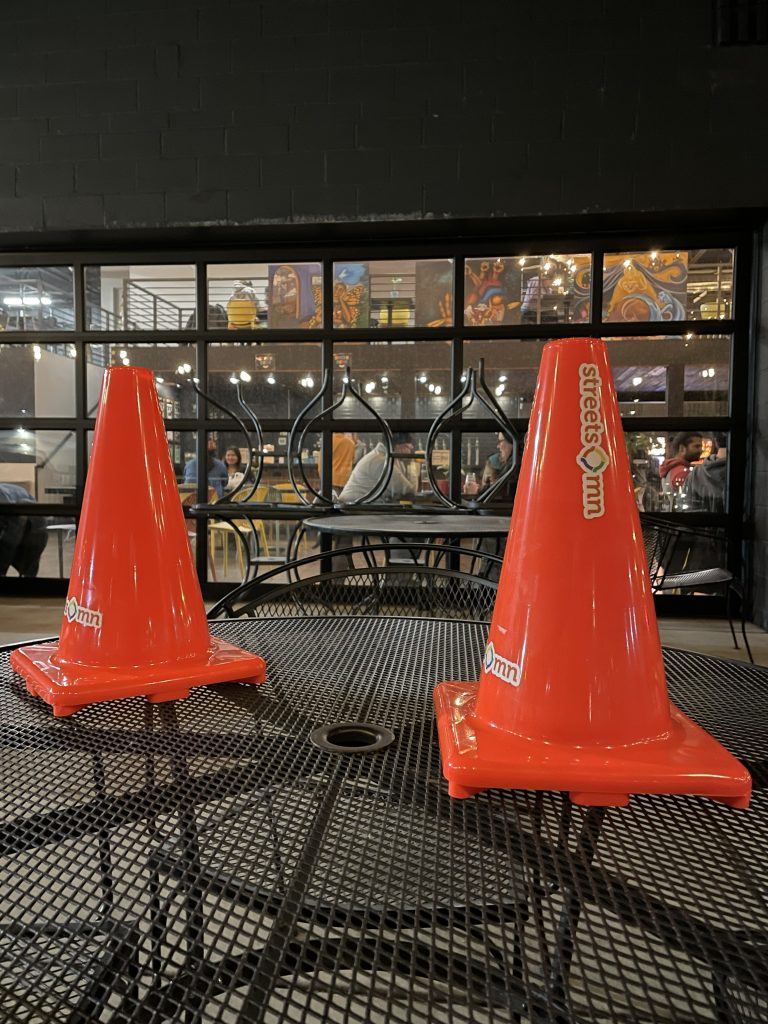
Orange cones let our guests know they were in the right place. This photo was from the November 2022 recruitment event held on a patio. Photo by Glen Johnson
In 2022 we seemed to have gotten to a new equilibrium. We were doing the occasional event indoors, although the board still met online, and the Streets.mn Podcast, which had been the one-person Bill Lindeke production and ended in 2019, was back in a new iteration with a committee of people producing. We also found our long-term managing editor in Amy Gage. Amy had been a volunteer copy editor for us and was the right fit to bring a level of professionalism to the editorial side of our organization that we had never had before. I also completed a long-term goal of moving all our documents under one organization-run Google Drive and set up emails under the streets.mn domain for all board members. No more using our personal emails as we represented Streets.mn!
The Really Tough Year

Things were feeling good and I talked a good friend of mine, Christy Marsden, into being co-chair with me for 2023. In fact, I ended up with the Dream Team Executive Committee, which turned out to be absolutely essential to getting through the year.
That stressor I mentioned earlier? A managing editor costs money. Even at 40 hours a month it adds up for a small organization that relied on modest donations and hadn’t had a fundraiser since 2019. We didn’t realize it, but we were running a major deficit. If we didn’t act quickly, we’d have to cut back to only essential functions, like keeping the website up and reducing the managing editor hours dramatically or cutting the role entirely. All credit for identifying the issue early goes to the incredibly capable Treasurer, Mike Allen. As he revamped how we did budgeting he noticed the budget gap: the donation revenue was way behind the spending. He developed contingency plans that didn’t rely on magical fundraising filling the entire gap. The plan was for a mix of cuts and some fundraising. We had a specific goal to keep key functions running: Raise $5000 in three months.
Thankfully, we had a lot of support from the board once we shared the details and we did meet the fundraising goal! It still left us with a tough budget for 2024, but at least we got through the emergency.
Not Over Yet
Somehow this wasn’t the only stressful thing we dealt with that year. If you’ve been a long-time reader, you may remember the comment section at the end of articles. As someone who enjoys discussing an article, it seemed great! What could be better than posting your takes on a trail project or fantasy transit map? It seemed like the idealized internet: we’re sharing our thoughts and learning with like-minded people we could politely disagree with. Turns out this pleasant space to chat was all because one person had taken up content moderation: Content Manager, Jenny Werness.
That invisible labor was happening all the time and added up to many hours (at all hours). People may love commenting on articles, but it doesn’t stay friendly without moderation. We tried some things, like asking board members to be more active in the comments to help set a good tone and letting authors decide if they wanted to turn on comments for their article. Neither seemed to make much of a difference; racist and abusive language continued. After several years of doing this thankless, incredibly important work, Jenny wanted to stop. We worked on options, including someone else taking on the role or even contracting for moderation services, but ultimately made the decision to shut down article comments. This came with pushback and concerns about losing interaction with our readers. I fully agree with that, and, along with our leaving Twitter that year, it did curtail how we interacted with readers. I stand by the difficult decision as an unmoderated comment section would reflect incredibly badly on the organization, but do think we should have done a proactive explanation of why we made the decision we did.
We also finished our Racial Equity Analysis in 2023, which was done by our now-managing editor Dr. Cirien Saadeh, but implementing it in significant ways has been challenging in a volunteer organization. We were able to be more thoughtful about events to make them more welcoming to all and have maintained an Anti-Racism Committee to move the work forward.
Moving Forward and a Pleasant Surprise
At the least, the year of putting out fires was over and 2024 seemed poised for a productive year. It also had one of the strangest good things to happen in my entire Streets.mn tenure.
In 2020 it was hard to keep up with everything and visiting the P.O. box fell off the to-do list for some time. When it was eventually checked there was a large donation to the organization, but unfortunately the check had expired. Leadership members tried to figure out how to get the check reissued, but ultimately it ended up as a Streets.mn legend: The $20,000 that got away.
I made it my personal mission to check that P.O. box every month for three years to make sure we never missed an important document (or check) on my watch. Late in 2024 we received an unclaimed property notice. Yes, the bank that issued the check still had the money and let us know they would send it to unclaimed property with the state of Minnesota. Christy and I whipped up an official letter on behalf of the organization, and next thing I know I’m doing a mobile deposit of the largest amount of money I’ve ever held in my hands.
If you’ve looked at our 990s (tax documents for non-profit organizations), we’re listed in the ‘under $55,000 per year’ revenue category. It may be surprising to many, but we’re far under that. $20,000 is closer to our entire operating budget for a year. This donation was organization-changing money. If you are the person who made this incredibly generous donation years ago, I want you to know how much this meant to us and how it allowed us to start thinking long-term. We kept a similar budget in 2025 and 2026, so we weren’t in crisis mode doing emergency fundraising. Instead, we were thinking about applying for a grant to pay writers for deeply researched articles (which we achieved in 2025 after three attempts and learning a lot) and expanding the hours of our managing editor, slightly, to do even more of this important work. Our grant from the Minnesota Historical Society focused on researching the impact of highways in areas not reported anywhere before (in contrast to more well-known ones like I-94 ripping apart the Rondo neighborhood). All four articles published at the end of 2025 (links to articles included at the end). These are the culmination of years of work and the effort of many people; it’s amazing to see the end result just as I leave the board.
Closing Thoughts
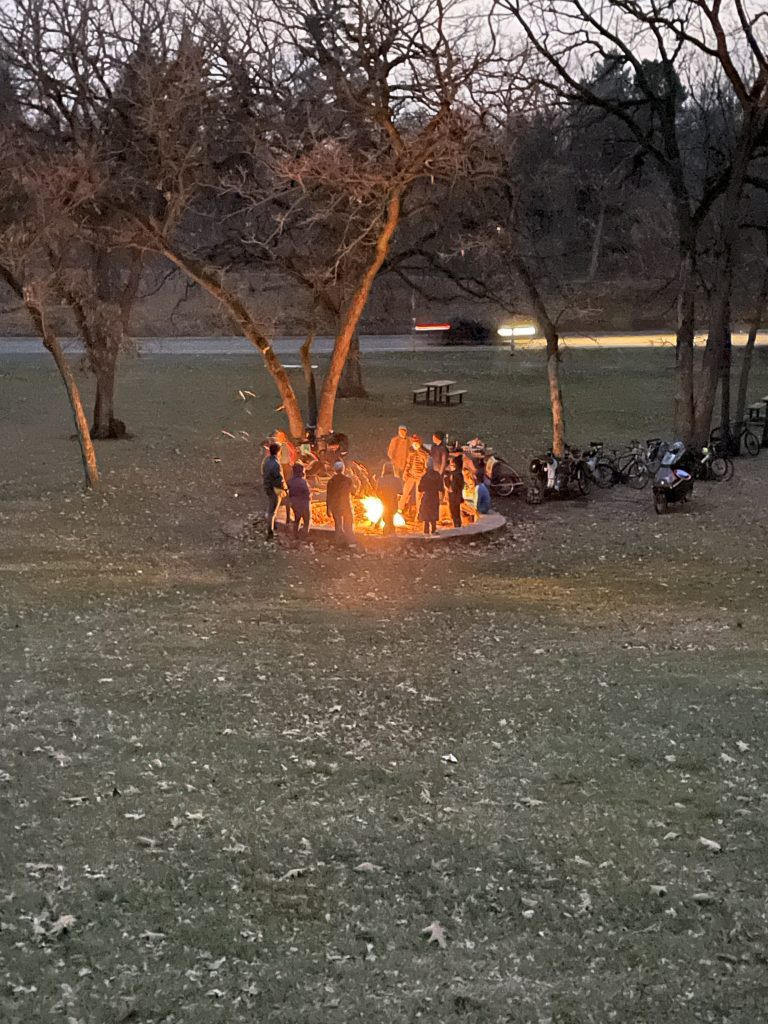
One of our first winter bonfire events in 2021. Held at Como Park at one of the few public fire pits in the Twin Cities.
The Streets.mn community wants to get together to talk about trains, bikes, and, housing even when it’s a muddy winter evening during a pandemic.
Photo by Glen Johnson
As I end my time at Streets.mn, I think about how volunteer work should really emphasize the work part. It’s just uncompensated and often thankless work. Volunteer boards and organizations are always going to face challenges maintaining momentum and enough bandwidth to do the work well. I hope I moved Streets.mn forward in important ways, but also acknowledge I didn’t do everything I set out to do.
I don’t know what Streets.mn will look like in the future, but I aim to write more and donate and encourage others to do so as they’re able.
My boyfriend recently asked me why I served on the board so long, since so many others wouldn’t. I didn’t have a quick answer. As I wrote this article, I think I have a better one: It’s lonely sometimes to be the only person you know who likes riding transit or biking, has deep concerns about how we’re going to address the coming climate crisis with land use and transportation changes, or just finds joy in walking around their neighborhood. If I helped connect like-minded people through Streets.mn, I think it’s a less lonely place for us all and something to be proud of.
Minnesota Historical Society Grant-Funded Research Articles
Deer Highway: How the U.S. Route 14 Reconstruction was Retrofitted to Prevent Wildlife Collisions
Rerouted Lives: How Route 52 Transformed West St. Paul
The “Pines to Palms” in Northfield: A Biography of Highway 3
The Accidental Backbone: A 100-Year History of Incrementalism on Highway 36